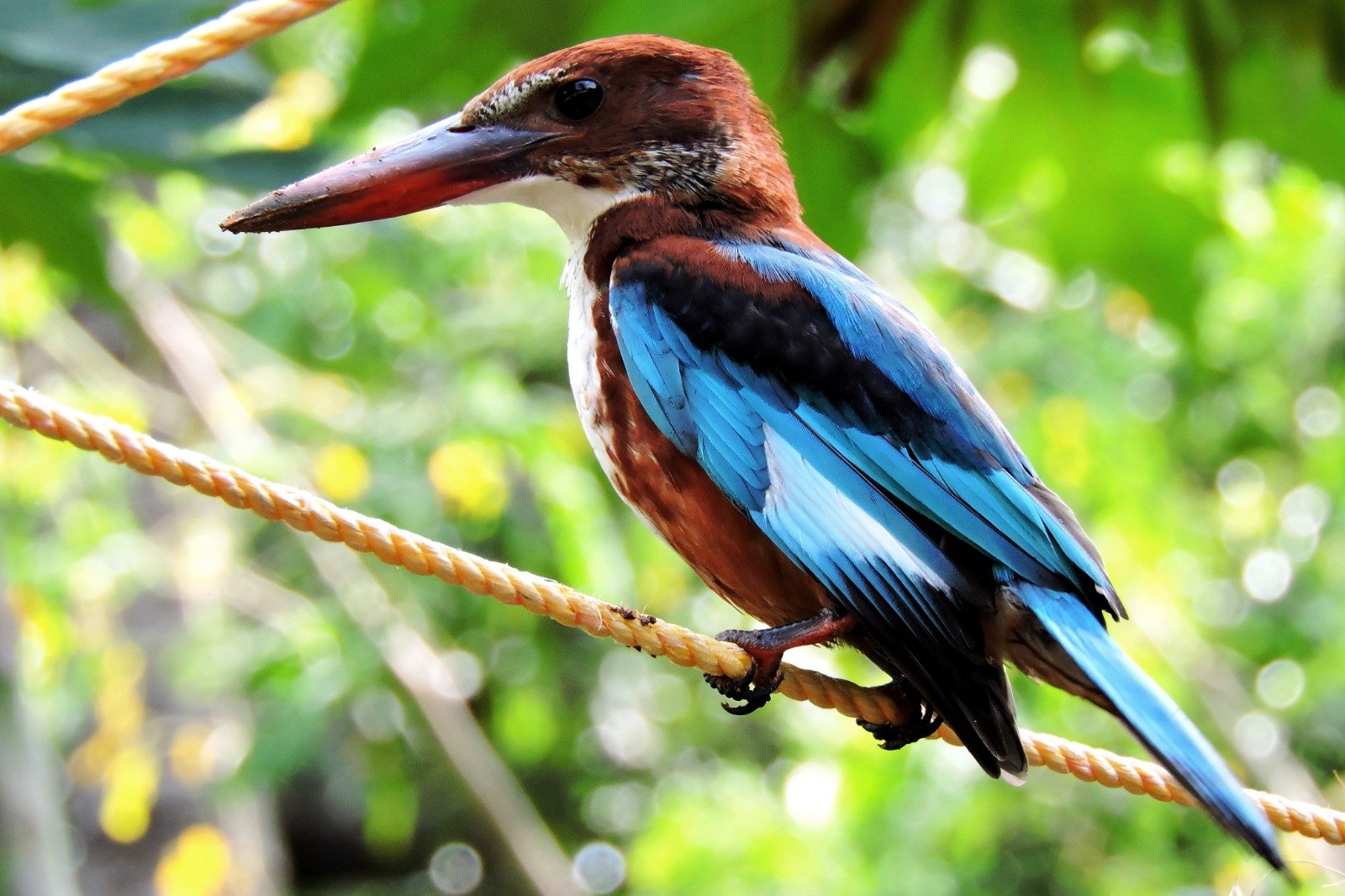
The White-throated Kingfisher (Halcyon smyrnensis), also known as the White-breasted Kingfisher, is a striking tree kingfisher widely distributed across Asia. The species was first recorded in 1758 by Swedish naturalist Carl Linnaeus. The genus Halcyon was introduced in 1821 by English naturalist and artist William Swainson. The species name smyrnensis refers to Smyrna, the ancient name of İzmir in Turkey.
Unlike many kingfishers that depend heavily on water, the White-throated Kingfisher has a varied diet. It feeds on insects, crustaceans, earthworms, rodents, lizards, snakes, fish, frogs and even small birds. The species rarely drinks water but regularly bathes.
During courtship, the birds flick open their wings and tail while raising their bills. The female may respond with a rapid, prolonged “kit-kit-kit” call. Both birds participate in digging the nest tunnel, usually using their bills. Nest tunnels have even been recorded in haystacks.
The subspecies found in Kerala, Halcyon smyrnensis fusca, was first recorded in 1783 by Pieter Boddaert. The name fusca refers to its dark chocolate-coloured underside.
These photographs were taken near Alathur in Palakkad district, Kerala, in 2014, documenting the beauty of this familiar yet fascinating bird.
Vincent Vanur