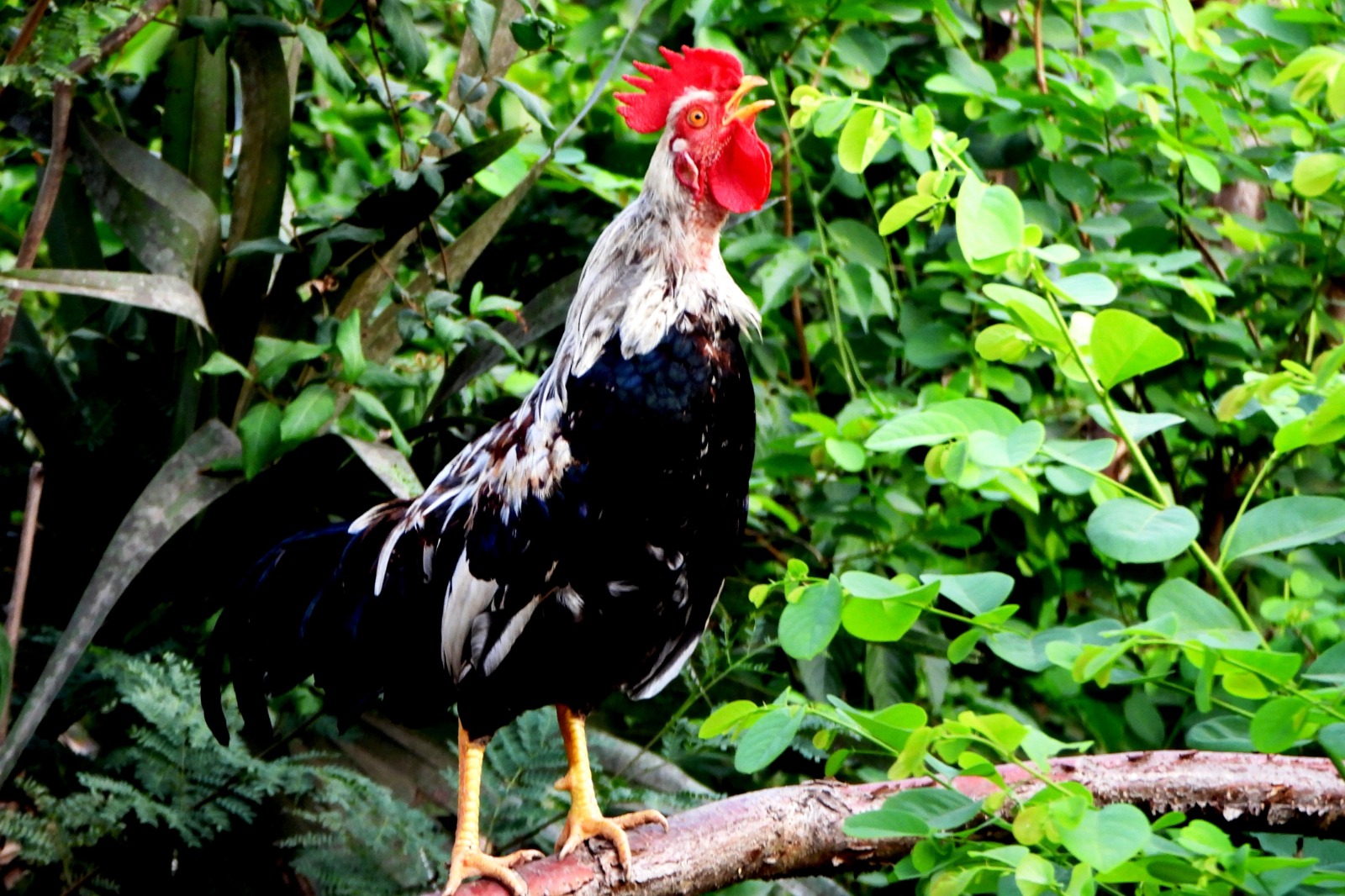
The familiar dawn crow of the rooster is driven primarily by its internal biological clock, or circadian rhythm. Even in complete darkness, roosters can accurately anticipate sunrise and begin crowing at the expected time. Crowing serves several important purposes: it marks territorial boundaries, warns rival males to keep their distance, and reinforces the social hierarchy within a flock. Typically, the dominant rooster crows first, while subordinate males wait their turn. Roosters also crow throughout the day to reaffirm territory, alert the flock to potential threats, or respond to sudden disturbances.
The crow of a rooster can be surprisingly loud. In humans, exposure to sudden, intense sounds can cause temporary or permanent hearing damage. Loud noises create powerful vibrations that move the fluid inside the inner ear, potentially damaging the delicate sensory hair cells and their microscopic stereocilia. This condition, known as noise-induced hearing loss (NIHL), often begins with ringing, buzzing, or humming sounds in the ears. While mild damage may recover within a couple of days, repeated or extremely loud exposure can permanently destroy these cells.
So why do roosters not damage their own hearing every time they crow?
The answer lies in a remarkable natural adaptation. When a rooster opens its beak to crow, specialized soft tissues near the ear canal partially close the auditory passage. This mechanism functions much like a built-in earplug, significantly reducing the amount of sound energy that reaches the inner ear. As a result, the rooster can produce an exceptionally loud call while simultaneously protecting its hearing from the very sound it creates.
This ingenious adaptation allows roosters to communicate effectively over long distances without suffering the harmful effects of their own powerful vocalizations—a fine example of nature’s ability to solve biological challenges through evolution.
Vincent Vanur