Among the more than 1,300 known varieties of coconut palms worldwide, most are grouped into the Tall and Dwarf categories, with numerous intermediate forms arising through natural cross-breeding. One of the rarest and most unusual forms is Cocos nucifera var. spicata, a tall coconut palm found mainly in the districts of Palakkad and Coimbatore.
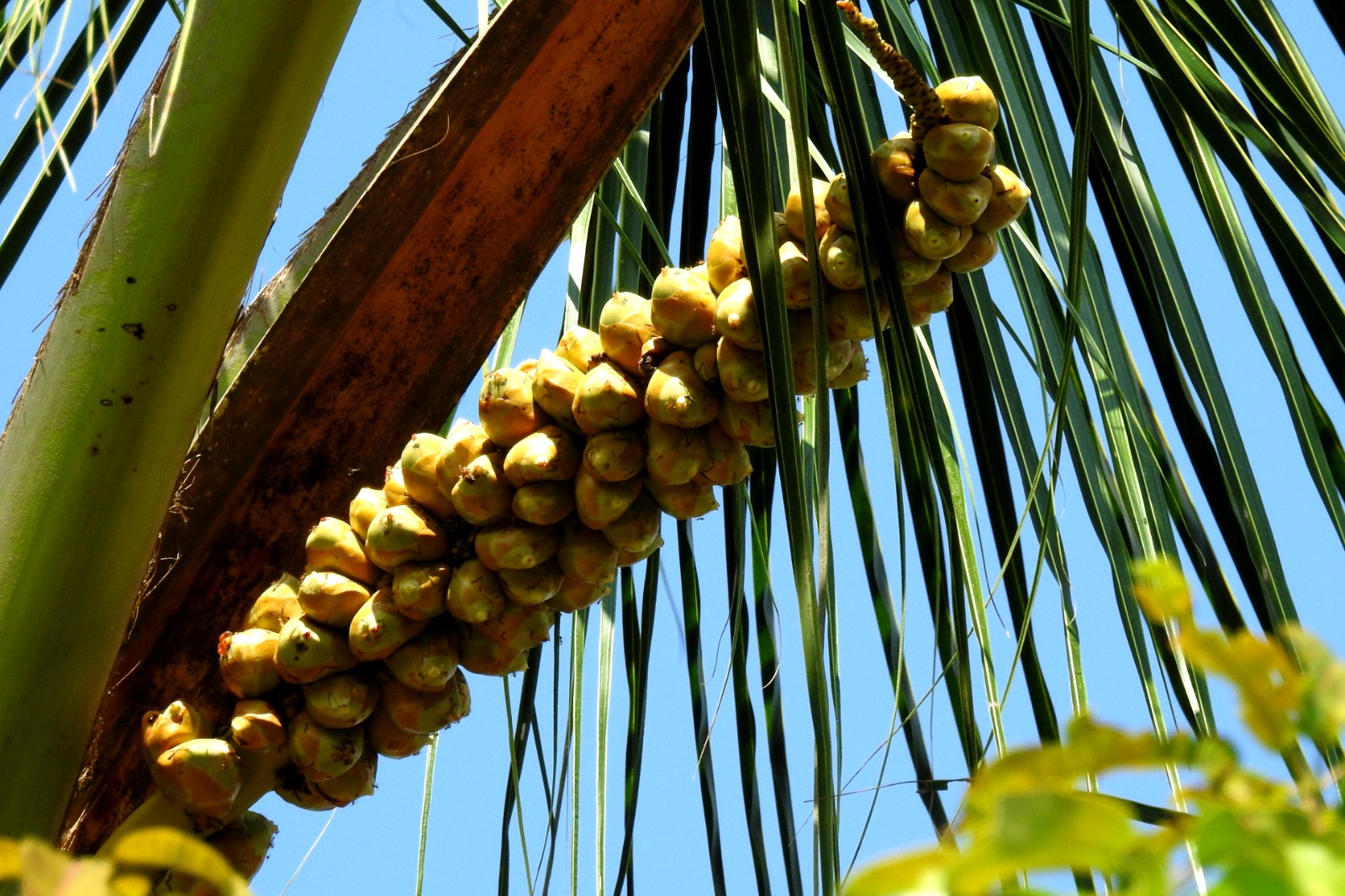
What makes this palm extraordinary is its fruit bunch. Instead of the typical branching coconut inflorescence, the nuts are borne on a long, spike-like structure resembling a bunch of black pepper. In Palakkad, it is popularly known as “Aayiram Kaaychi” (“one thousand nuts”), a reference to the astonishing number of young fruits that may develop on a single bunch. Although only a fraction of these mature into full-grown coconuts, the spectacle is remarkable.
A notable example was exhibited at an agricultural fair held at Government Girls Higher Secondary School Alathur, where a bunch carrying more than 200 nuts was displayed. The exhibit came from the farm of P. C. Sivanarayanan, who aptly named the variety “Vilayannur Grapes” because of its grape-like clusters of developing coconuts.
The author of this account received a seed from Mr. Sivanarayanan, and the resulting palm grew in the backyard until about a decade ago. The accompanying photograph was taken eleven years ago and serves as a record of this rare botanical curiosity.
The scientific significance of this coconut variety was documented by Kurumthottical Cherian Jacob, who published a detailed description in 1940 under the title “A New Variety of Coconut Palm, Cocos Nucifera L. Var. Spicata K. C. Jacob.” His observations appeared in the Bombay Natural History Society Journal, the Madras Agricultural Journal, and Garden’s Bulletin, bringing wider attention to one of South India’s most distinctive coconut palms.
Vincent Vanur