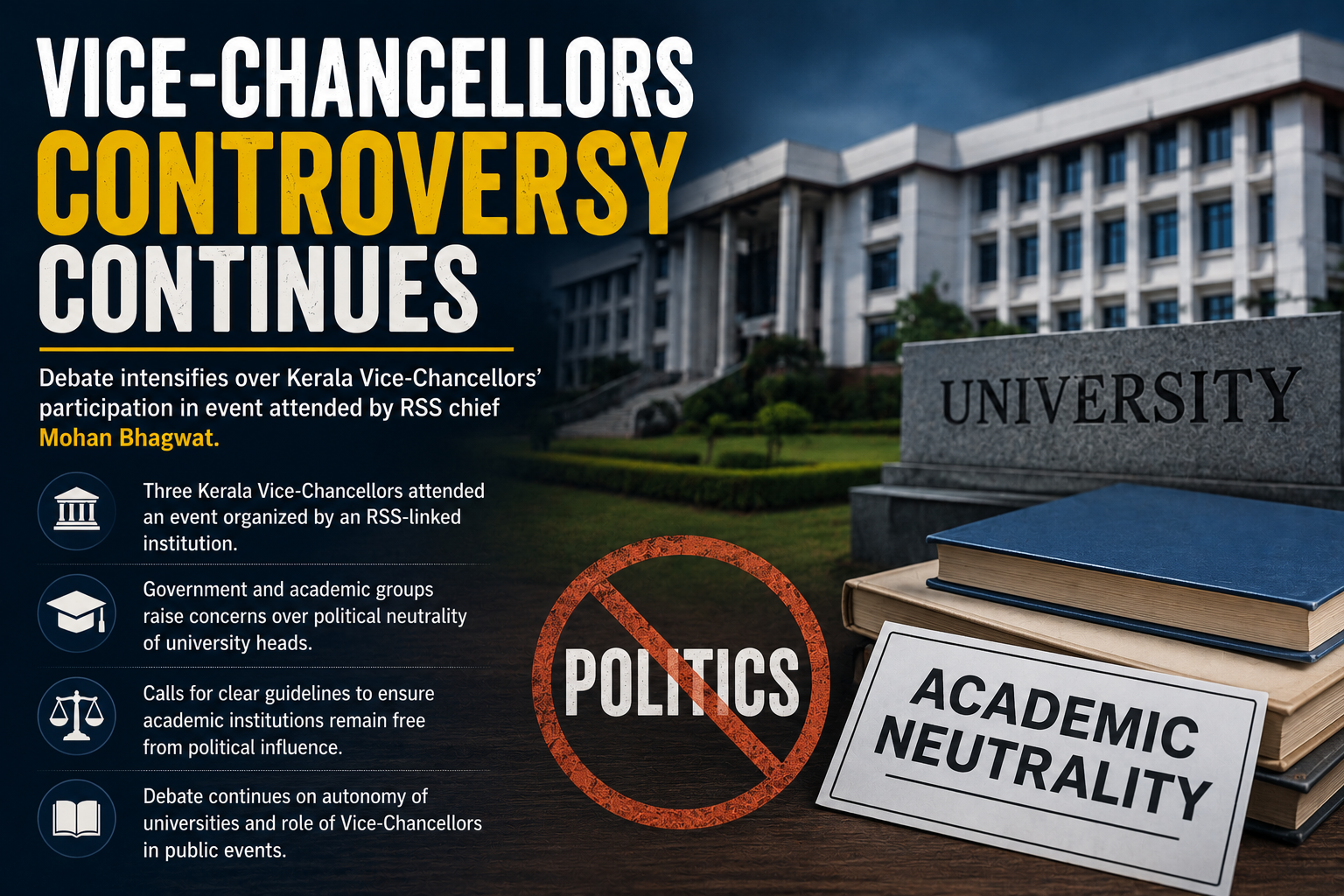
The controversy surrounding the participation of several Kerala university Vice-Chancellors in an event attended by RSS chief Mohan Bhagwat continues to generate intense debate across the state. The issue has sparked discussions on academic neutrality, the role of university leadership, and the relationship between educational institutions and political or ideological organizations.
The dispute began after three Vice-Chancellors from Kerala universities attended a programme organized by an institution associated with the Rashtriya Swayamsevak Sangh (RSS). Their presence at the event drew criticism from political leaders, academic groups, and sections of the public, who argued that university heads should maintain political neutrality and avoid participation in events linked to ideological organizations.
The Kerala government has expressed concern over the matter, with Higher Education Minister R. Bindu stating that Vice-Chancellors should refrain from participating in programmes organized by political or ideological groups. The minister emphasized that universities are autonomous academic institutions and that their leaders are expected to uphold values of impartiality and inclusiveness.
Meanwhile, opposition leaders and various academic organizations have voiced differing opinions. Some have argued that participation in public events does not necessarily indicate political affiliation and that academic leaders should have the freedom to attend educational or cultural programmes. Others maintain that university officials must avoid situations that could create perceptions of political bias.
The issue has also led to calls for clarification regarding guidelines governing the public participation of university administrators. Several teachers’ organizations and student groups have sought clear policies to ensure that educational institutions remain free from political influence.
Political reactions have intensified after statements from senior leaders across party lines. The controversy has expanded beyond the original event and evolved into a broader debate about the autonomy of universities, academic freedom, and the responsibilities of senior educational administrators.
Experts note that the matter reflects larger national discussions regarding the role of educational institutions in public life and the balance between individual freedom and institutional neutrality. Legal experts have also pointed out that any action regarding university officials would need to comply with existing regulations and statutory provisions governing higher education institutions.
As public debate continues, the Vice-Chancellors involved have not indicated any wrongdoing and maintain that their participation was within their professional and personal rights. The controversy is expected to remain a prominent topic in Kerala’s academic and political circles in the coming weeks, with further discussions likely among government officials, universities, and stakeholders in the higher education sector.