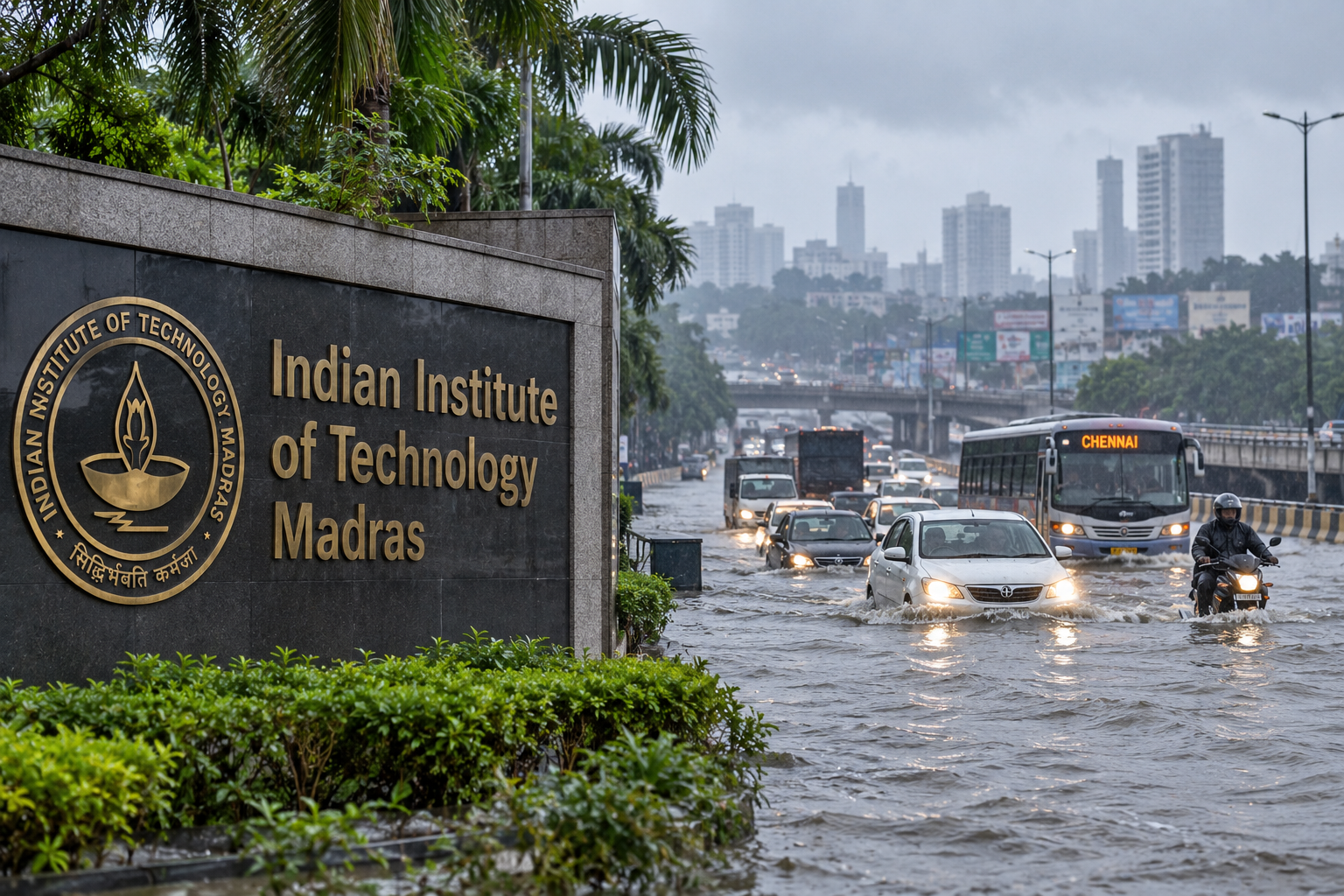
An international study led by Indian Institute of Technology Madras has found that accounting for atmospheric aerosols—tiny airborne particles that influence clouds and rainfall—could substantially improve forecasts of extreme rainfall and urban flooding in Chennai.
Researchers studied the devastating December 1, 2015 Chennai rainfall and flood event, focusing on the Adyar basin. When aerosol-cloud interactions were explicitly included in their modelling, the simulation of rainfall improved by about 22%, while the accuracy of simulated flood inundation improved by roughly 50–51%.
The research involved scientists from IIT Madras, Germany’s GFZ Helmholtz Centre for Geosciences, the Japan Aerospace Exploration Agency (JAXA) and Kathmandu University. They combined high-resolution atmospheric modelling with hydrological and hydraulic models to examine rainfall, runoff, reservoir inflows and the eventual extent of flooding.
Researchers said conventional flood forecasting can struggle to accurately reproduce where and when intense rain falls within a city. Better representation of aerosol-cloud interactions could therefore help models capture extreme rainfall patterns more accurately and provide better information for flood management and reservoir operations.
However, the researchers stressed that the method is not yet an operational flood-forecasting system. The findings are based on one major event, and further testing across other storms and cities is needed before the approach can be routinely deployed.