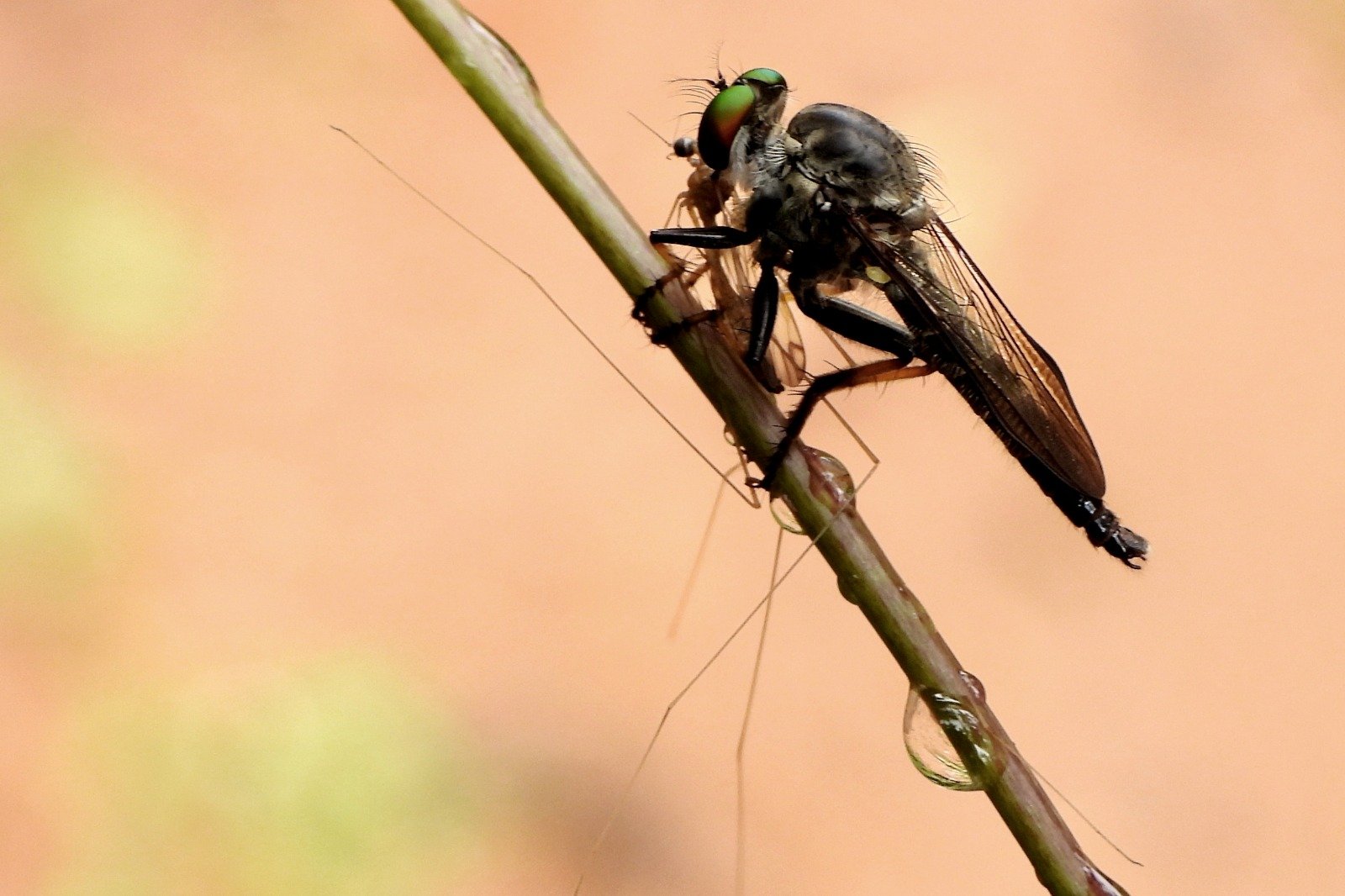
The common awl robberfly (Neoitamus cyanurus) is a predatory insect belonging to the family Asilidae, commonly known as robber flies. The family was established in 1802 by French zoologist Pierre André Latreille (1762–1833) and contains more than 7,000 described species. The name “robber flies” was first suggested in 1869 by American entomologist Alpheus Spring Packard Jr., based on the German term “Raubfliegen,” meaning predatory flies.
The species Neoitamus cyanurus was first recorded in 1849 by German entomologist Friedrich Hermann Loew (1807–1879). It gets its common name “awl robberfly” from the female’s long, pointed ovipositor, which resembles an awl, a traditional tool used for piercing leather or wood. Its scientific name, derived from Greek words, broadly refers to a “new bold dark-blue tail.”
The common awl robberfly is an efficient aerial hunter. It typically perches on an elevated position, patiently watching for suitable prey. Once a target is detected, it launches into flight and captures the prey in mid-air. Its powerful legs and sharp mouthparts help it secure and consume its victims.
The photographs featured here were taken in 2020, documenting this fascinating predator and highlighting the remarkable diversity of robber flies found in nature.
Vincent Vanur