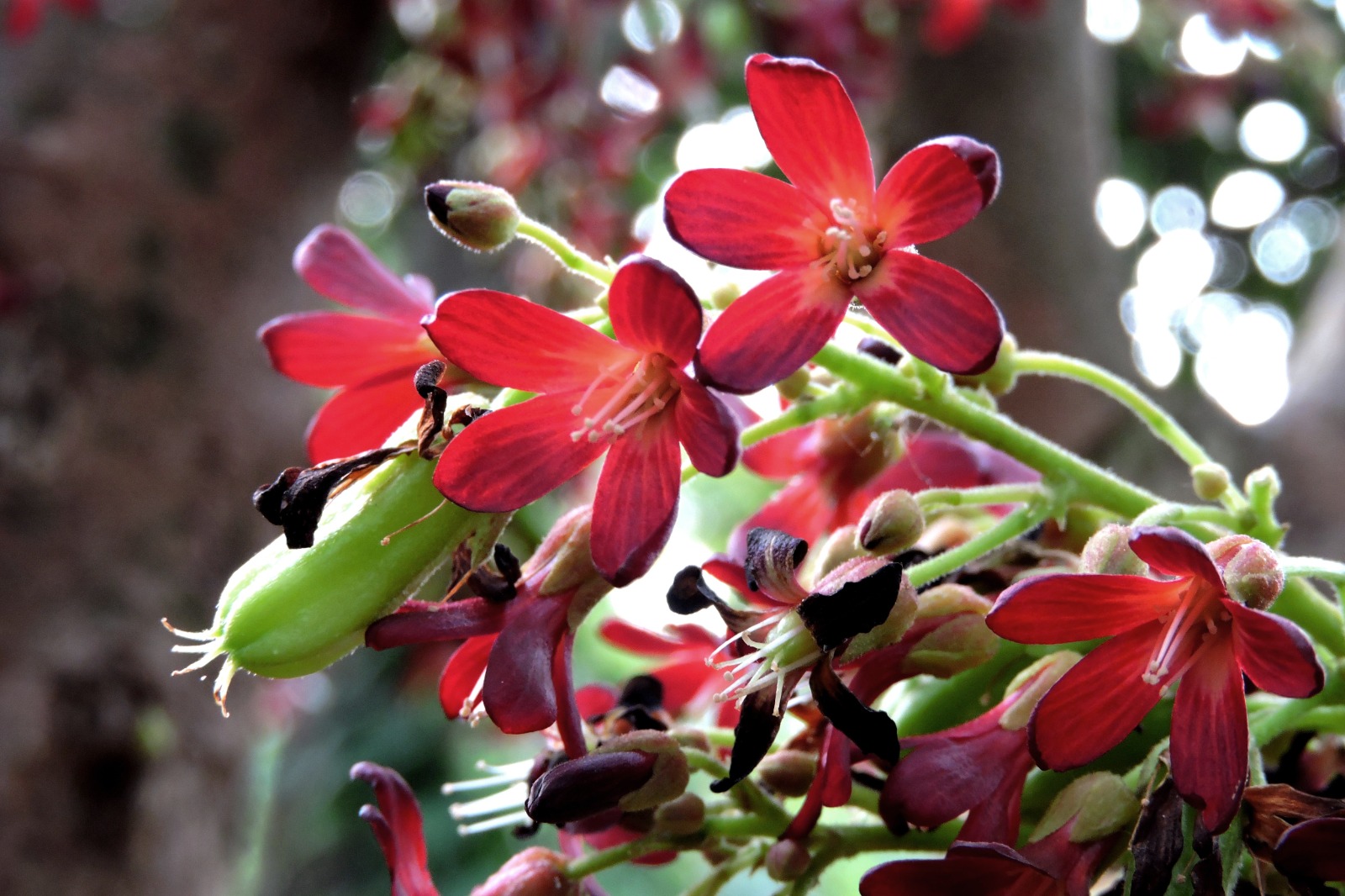
Averrhoa bilimbi, commonly known as bilimbi, orkkaappuli, cucumber tree, or tree sorrel, is a tropical fruit-bearing tree belonging to the genus Averrhoa. Native to the Maluku Islands and Sulawesi of Indonesia, it has become naturalized across much of Southeast Asia. The species was first described by Carl Linnaeus.
One of the tree’s most fascinating features is the behavior of its odd-pinnate leaves. As evening approaches, the leaflets gradually fold downward in a rhythmic sequence, often described as “two steps forward, one step back.” At dawn, they slowly reopen in the reverse order, a movement linked to the plant’s natural circadian rhythm.
Bilimbi fruits are highly acidic, with the juice having a pH of about 4.47. In Malaysia, Indonesia, the Philippines, and parts of South America, the fruit is widely used in curries, chutneys, and pickles. In Kerala and Coastal Karnataka, it is a favorite ingredient in fish curries, particularly those prepared with sardines. In parts of Karnataka, Maharashtra, and Goa, the fruit is often eaten raw with salt and spices.
Beyond the kitchen, bilimbi has several traditional uses. Its acidic juice is employed for cleaning iron blades and removing stains from clothing, while the flowers are used as a natural dye in the Maldives.
Despite its culinary value, bilimbi should be consumed with caution. The fruit contains high concentrations of oxalates and the neurotoxin caramboxin. Medical reports have documented cases of acute kidney injury caused by tubular necrosis in individuals who consumed concentrated bilimbi juice repeatedly over several days as a home remedy for high cholesterol. Moderate consumption is generally considered safe, but excessive intake, especially in concentrated form, can pose serious health risks.
Vincent Vanur