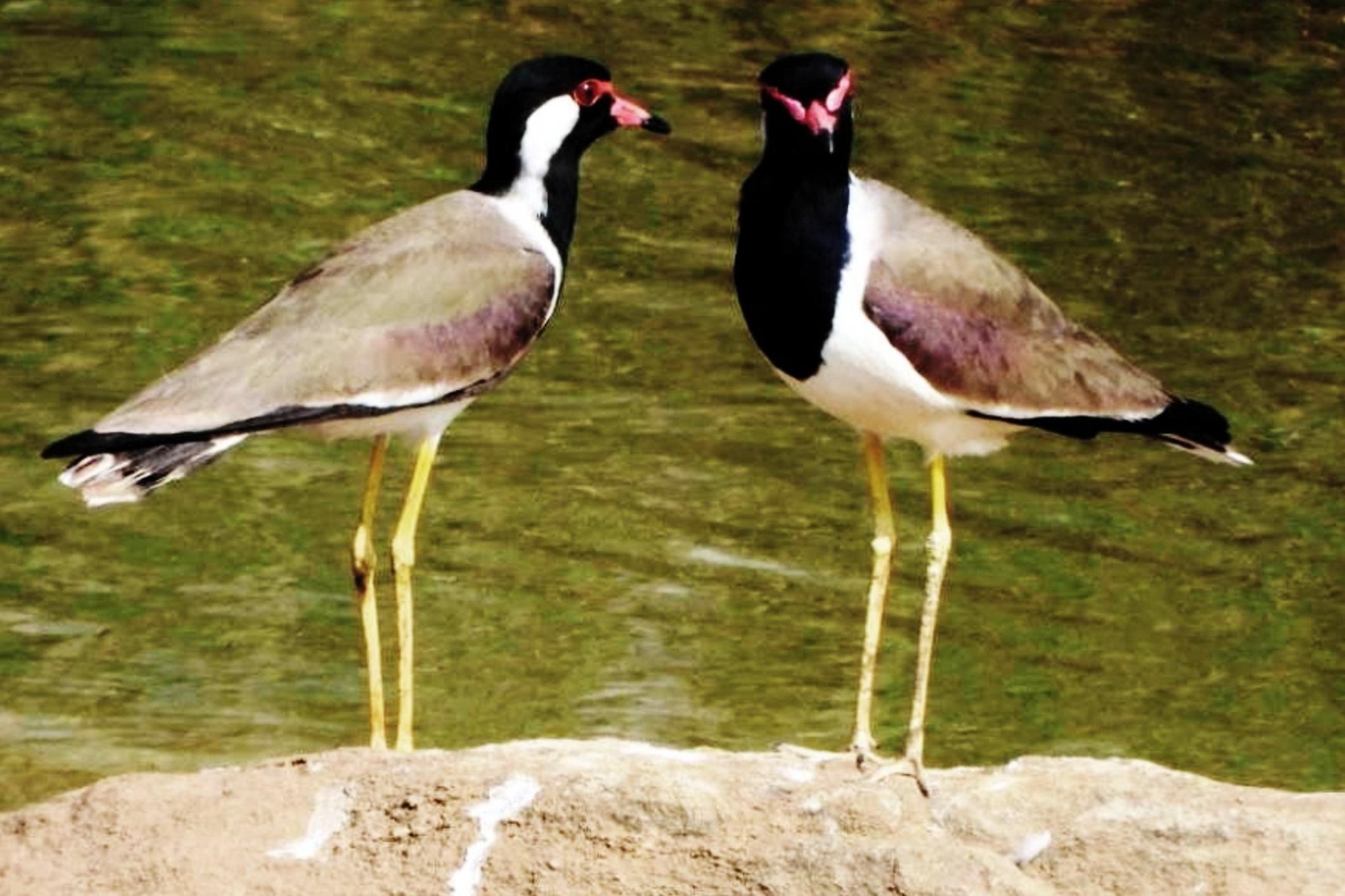
The Red-wattled lapwing was first scientifically recorded in 1781 by Georges-Louis Leclerc, the renowned French naturalist, mathematician, and astronomer. The Indian subspecies, Vanellus indicus indicus, was later described in 1783 by Pieter Boddaert. This striking bird, recognized by its red facial wattles, long yellow legs, and loud calls, is commonly found near wetlands, grasslands, agricultural fields, and open landscapes across the Indian subcontinent.
Unlike many birds, the Red-wattled lapwing cannot perch on trees and therefore spends most of its life on the ground or in flight. It is famous for its sharp alarm calls, which warn nearby animals and birds of approaching danger, especially humans. Because of this behavior, it is called “aalkaatti” (‘ആൾകാട്ടി’ — one that shows humans) in parts of Kerala and Tamil Nadu.
During nesting season, the bird displays remarkable defensive behavior. It often pretends to be injured, limping away from the nest to distract predators. If the threat persists, the lapwing may aggressively dive at intruders, targeting sensitive areas such as the eyes and ears.
The bird also holds a place in Indian folklore. In Hindi, the saying “Titahri se asman thama jayega” (“Can the lapwing support the heavens?”) refers to people attempting tasks beyond their abilities. Among the Bhils of Malwa, the location of lapwing nests and eggs was traditionally believed to predict rainfall patterns and the timing of monsoon rains.
– Vincent Vanur