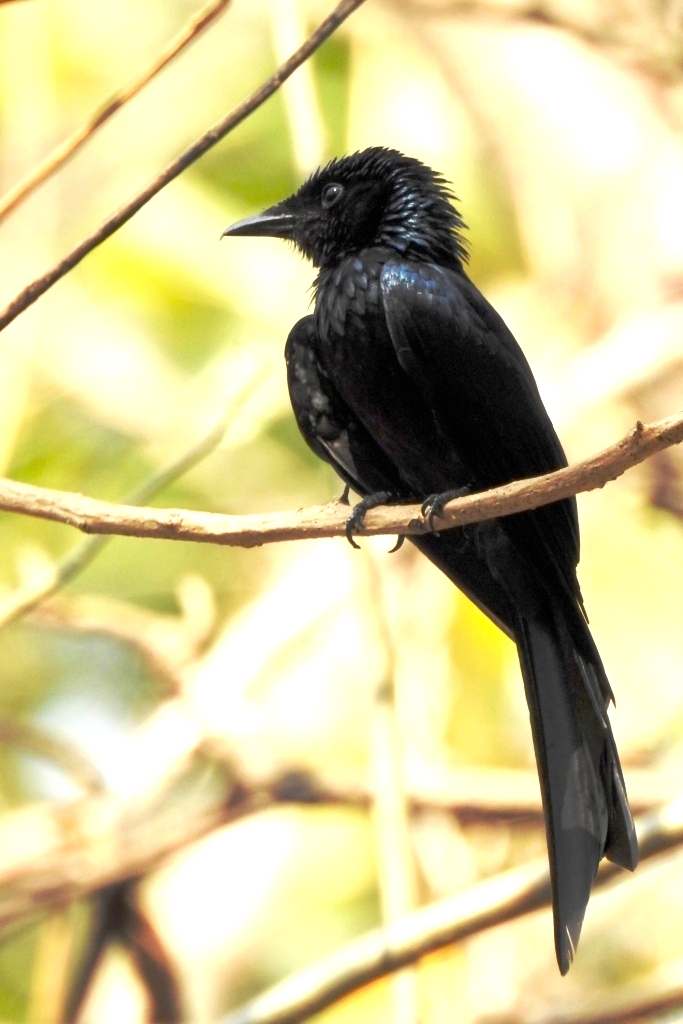
The Black Drongo is a small passerine bird belonging to the drongo family, Dicruridae, and is widely found across tropical South Asia. The species was first scientifically described in 1817 by the French ornithologist Louis Pierre Vieillot. It is especially common in open farmlands, grasslands, villages, and lightly wooded regions, where it often perches prominently on exposed branches, electric wires, or telephone lines while scanning for prey.
Primarily insectivorous, the Black Drongo feeds on flying insects, catching them with swift aerial movements. During the breeding season, males and females are known to sing together in the mornings. Their courtship behaviour includes dramatic aerial chases, locking wings and beaks mid-flight, descending rapidly toward the ground, and performing display movements on land. Pair bonds generally remain strong throughout the breeding season.
The species is famous for its extraordinary courage and territorial aggression. Despite its small size, the Black Drongo fearlessly attacks much larger birds such as crows, kites, and other birds of prey whenever they approach its nesting territory. Because of this bold behaviour, it is commonly called the “King Crow.” Its defensive nature also benefits nearby bird species including bulbuls, orioles, babblers, pigeons, and doves, many of which prefer nesting near drongos for protection from predators.
The bird also holds cultural significance in parts of India. In central India, a traditional superstition claimed that cattle would lose their horns if a young drongo perched on them. In parts of Punjab, the species is respected in local belief for bringing water to Husayn ibn Ali, a revered figure among Shī‘a Muslims.
– Vincent Vanur