

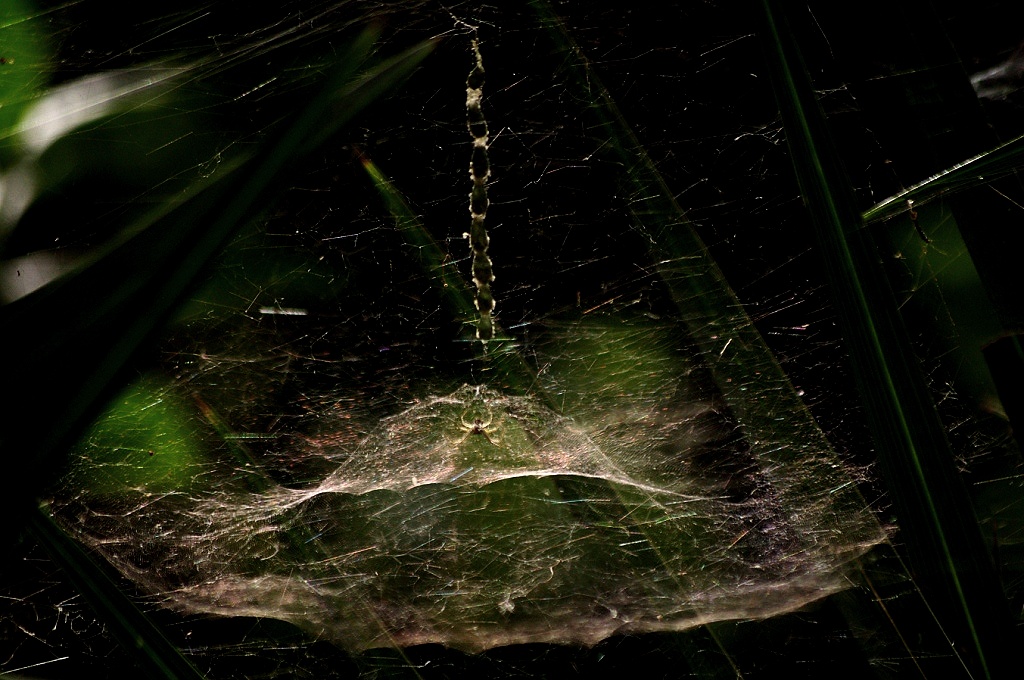
The tropical tent-web spider (Cyrtophora citricola) is an orb-weaver spider belonging to the family Araneidae. It was first recorded in 1775 by Peter Forsskål (1732–1763), a Swedish explorer and naturalist who died of malaria at the age of 31 while collecting specimens in Yemen.
This remarkable spider is renowned for constructing highly complex, three-dimensional, tent-shaped webs made from non-sticky silk. Unlike most orb-weavers, its web consists of a dense upper barrier of silk and a thinner lower barrier surrounding the central orb web. Flying insects striking the upper silk layer are deflected downward into the capture web below, where they are trapped. The spider then wraps its prey in silk, cuts it free from the web, and carries it to the hub for feeding.
Females possess the ability to change coloration rapidly, helping them blend into their surroundings and avoid predators. Despite their impressive appearance, tropical tent-web spiders are harmless to humans and pose no medical threat if encountered.
These spiders are primarily nocturnal and remain largely inactive during the daytime, except when protecting their offspring. A striking feature of the species is its extreme sexual size difference: males are tiny compared to females. After mating, females may consume the males, a behavior known as sexual cannibalism.
Females lay chains of up to ten egg sacs, each containing approximately 100–200 eggs. The mother typically rests directly beneath the egg sacs, vigilantly guarding them until the spiderlings emerge, demonstrating a notable level of parental care among spiders.


- upgraderz.aws@gmail.com
- upgraderz.aws@gmail.com
- upgraderz.aws@gmail.com
- upgraderz.aws@gmail.com