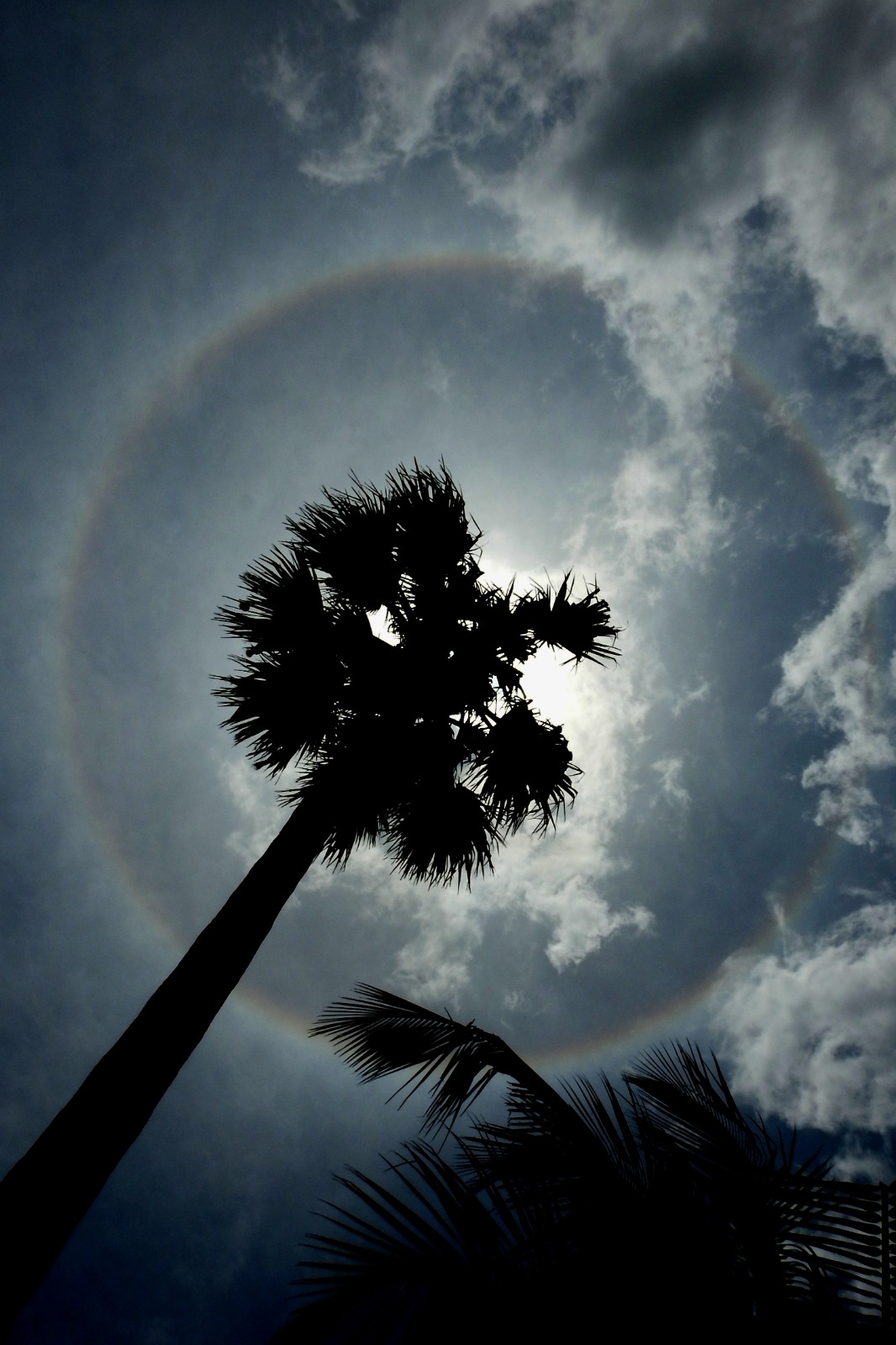
Halo (from the Greek ἅλως, halos) is a term used to describe optical phenomena caused by light interacting with ice crystals suspended in the atmosphere. This halo, which I photographed around the Sun about ten years ago at about noon, is the best-known form of halo. It is called the ’22° halo’.
The ice crystals that cause halos are usually found in cirrus or cirrostratus clouds in the troposphere, usually at an altitude of 5–10 km. These crystals reflect each other like mirrors or prisms, sending light rays in different directions. Due to the optical properties of the ice crystals, no light is reflected into the interior of the ring, thus making it appear darker inside than the surrounding sky, giving it the appearance of a “hole in the sky”.
Although Aristotle mentioned them in antiquity, the first European descriptions of halos were made by Christoph Scheiner in Rome (1630), Johannes Hevelius in Danzig (1661), and Tobias Lowitz in Saint Petersburg (1790). Chinese observers have recorded them for centuries. In the book “Official History of the Chin Dynasty” written by Chin Shu in 637, ten types of halos are described in detail.
– Vincent Vanur