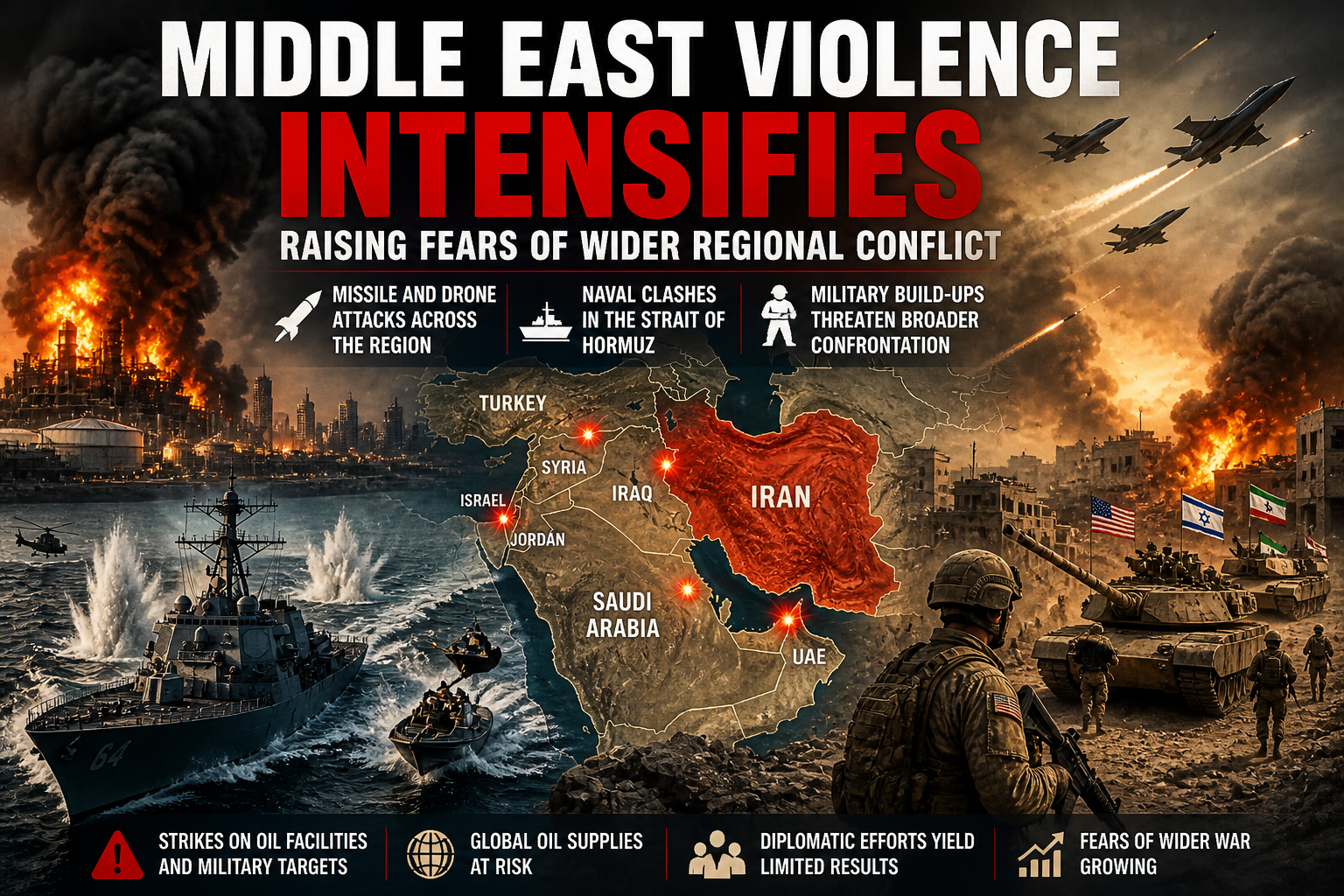
Violence across the Middle East has intensified sharply, sparking growing fears of a broader regional conflict as military clashes expand across land, sea, and air.
Fresh hostilities in the Strait of Hormuz have emerged as a major flashpoint, with missile and drone attacks targeting ships, oil facilities, and military assets. Recent strikes attributed to Iran hit vessels and infrastructure in the Gulf, including a significant attack on a UAE energy facility, marking one of the most serious escalations since a fragile ceasefire was declared weeks ago.
At the same time, U.S. naval forces have engaged Iranian units in the region, intercepting missiles and drones while destroying multiple fast-attack boats near key shipping routes. These confrontations come amid ongoing efforts by Washington to secure safe passage through the Strait of Hormuz, a vital artery for global oil supplies.
The situation has further deteriorated as both sides exchange warnings. Iran has declared foreign military presence in the strait a “legitimate target,” while the United States has reinforced its commitment to maintaining freedom of navigation. Attacks on commercial vessels and energy hubs have raised alarm among global powers and disrupted maritime traffic.
Beyond the Gulf, the conflict is spreading across multiple fronts. The ongoing war involving Iran, the United States, and Israel has already triggered missile exchanges across several countries, including strikes on military bases and infrastructure in neighboring states. Regional militias aligned with Iran have also intensified attacks in Iraq and Syria, widening the scope of the confrontation.
Meanwhile, large-scale military deployments continue to build up across the region, with advanced aircraft, naval strike groups, and missile defense systems positioned in strategic locations. Analysts warn that the presence of multiple armed actors in close proximity significantly increases the risk of miscalculation and rapid escalation.
Diplomatic efforts to de-escalate tensions have so far yielded limited results. With ceasefire agreements under strain and retaliatory strikes continuing, concerns are mounting that the conflict could evolve into a wider regional war—potentially drawing in more countries and severely impacting global energy markets and security. News as Reported.