

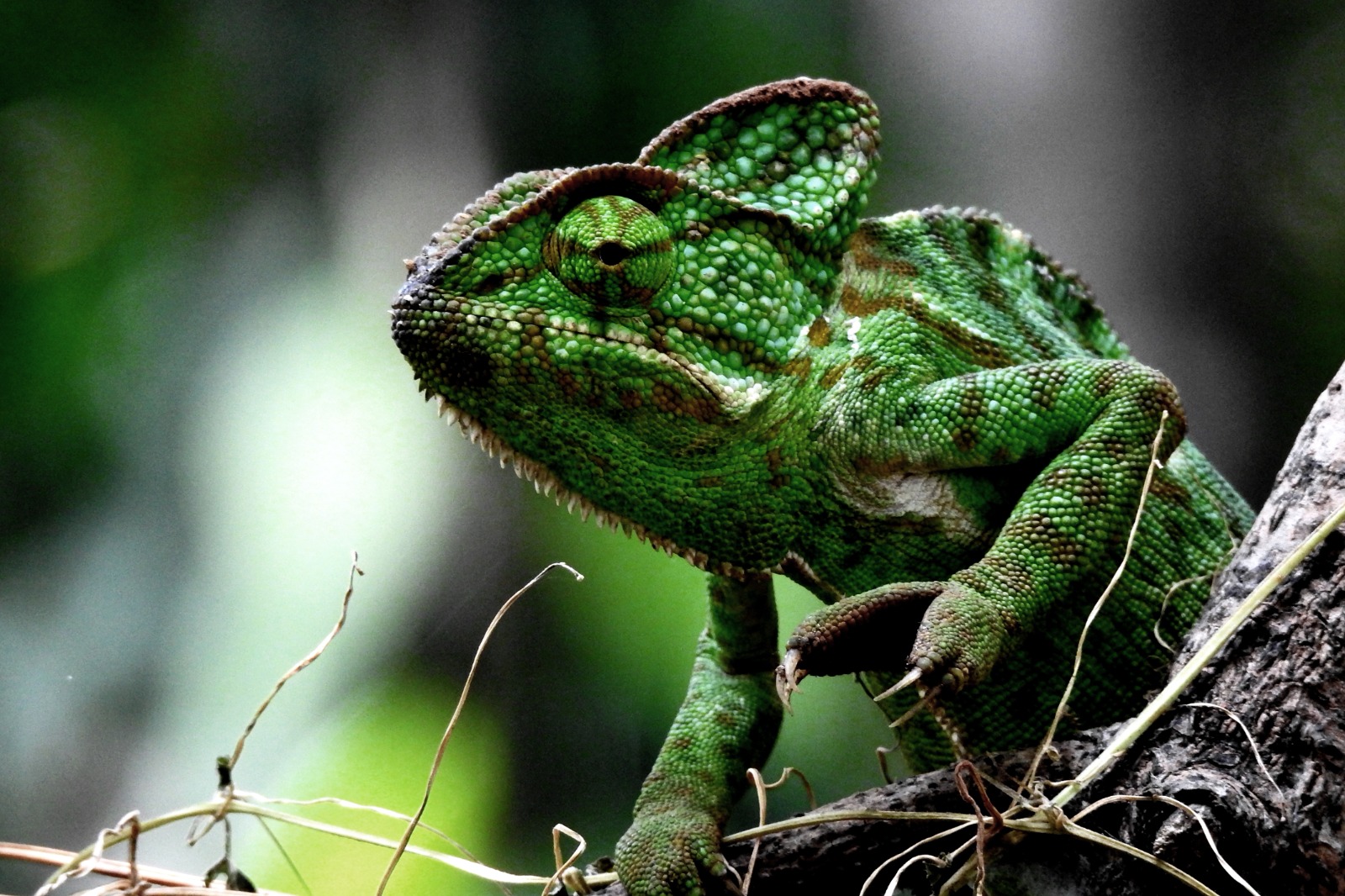
The Indian chameleon is a remarkable reptile species found across parts of South Asia, including India, Sri Lanka, and Pakistan. It was scientifically recorded in 1768 by Josephus Nicolaus Laurenti, an Austrian zoologist of Italian origin.
This fascinating creature moves slowly through vegetation with a characteristic swaying or bobbing motion that mimics leaves moving in the wind, helping it avoid predators. Its bifurcated, tongs-like feet provide a powerful grip on branches, while its prehensile tail — slightly longer than its body — acts like an additional limb for balance and support.
One of the chameleon’s most extraordinary adaptations is its independently moving eyes, allowing it to observe different directions simultaneously without moving its head. Equally impressive is its ability to rapidly alter skin colour and patterns. Contrary to popular belief, these colour changes are not primarily for camouflage alone. Darkening or lightening often reflects mood, stress, territorial disputes, mating readiness, or temperature regulation. As observed during your photograph eleven years ago, the animal darkened when approached closely, likely indicating fear or stress.
Its hunting mechanism is equally astonishing. The chameleon’s tongue can extend to nearly twice its body length and launch toward prey in a fraction of a second. The sticky, suction-like tip, coated with highly viscous saliva, enables it to capture insects from more than a foot away with remarkable precision.
– Vincent Vanur