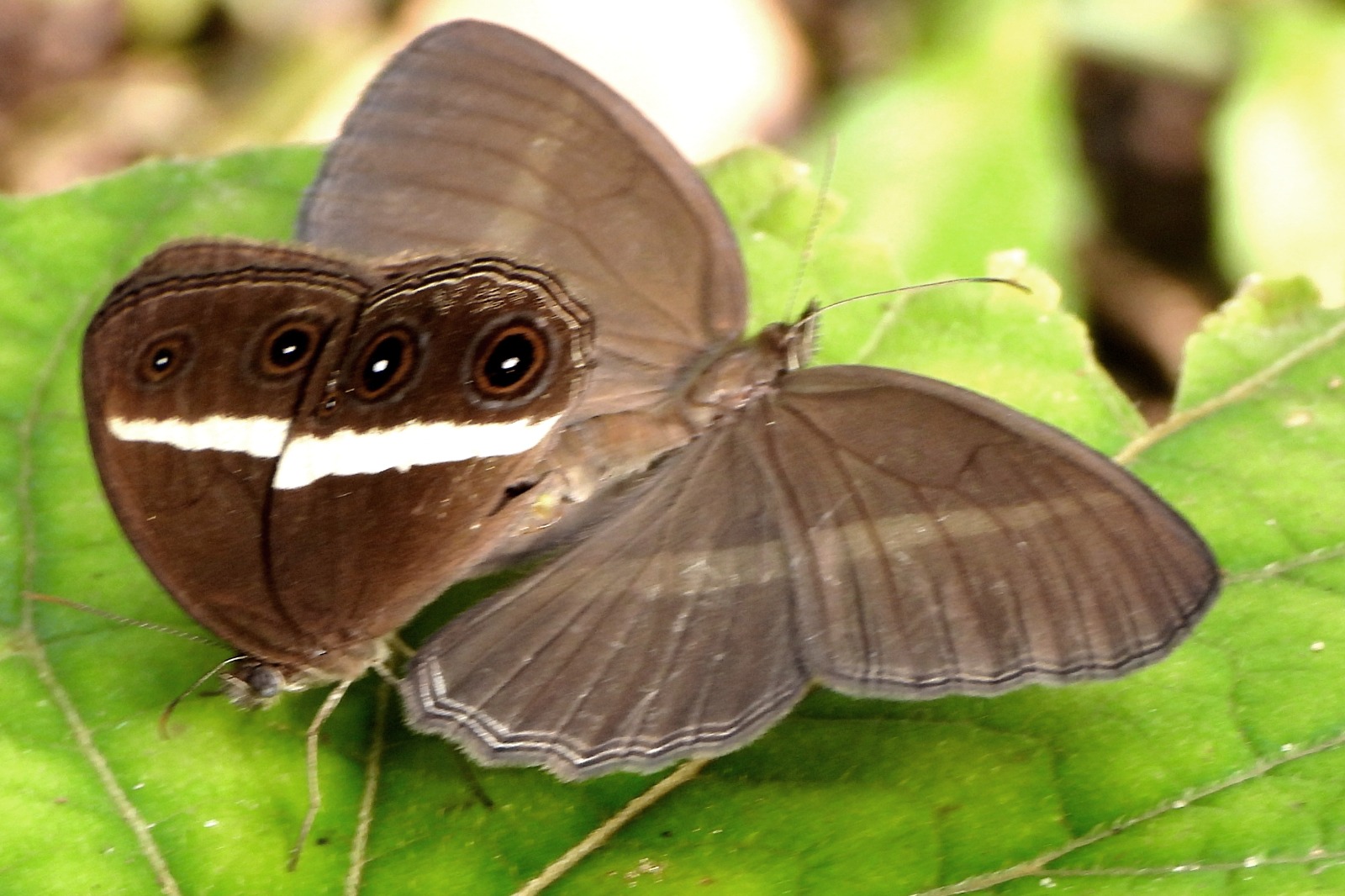
The ‘Medus Brown’ butterfly, scientifically known as Orsotriaena medus, is a small dark butterfly belonging to the family Nymphalidae. It was first scientifically described in 1775 by Johan Christian Fabricius, a renowned Danish zoologist who specialized in insects. The subspecies found in India, Orsotriaena medus mandata, was later recorded in 1857 by Frederic Moore.
This butterfly is easily identified by the prominent white discal band stretching across both wings. The underside of its wings displays five distinct eyespots — two on the forewings, with the front eyespot slightly smaller than the other. Interestingly, the upper side of the wings lacks any eyespots. The caterpillars mainly feed on grasses, including rice plants and sugarcane, making them common in agricultural landscapes. Unlike many butterflies active during the day, the Medus Brown is largely crepuscular, meaning it is most active during dawn and dusk.
Historically, this butterfly was referred to by a racially offensive common name linked to its dark brown colouration. As the term became widely recognized as derogatory and unacceptable, entomological and faunal organizations officially replaced it with respectful alternatives. Today, it is commonly known as the “smooth-eyed bushbrown” in Australia, “Medus Brown” in India, and “dark grass-brown” in several Southeast Asian countries.
– Vincent Vanur