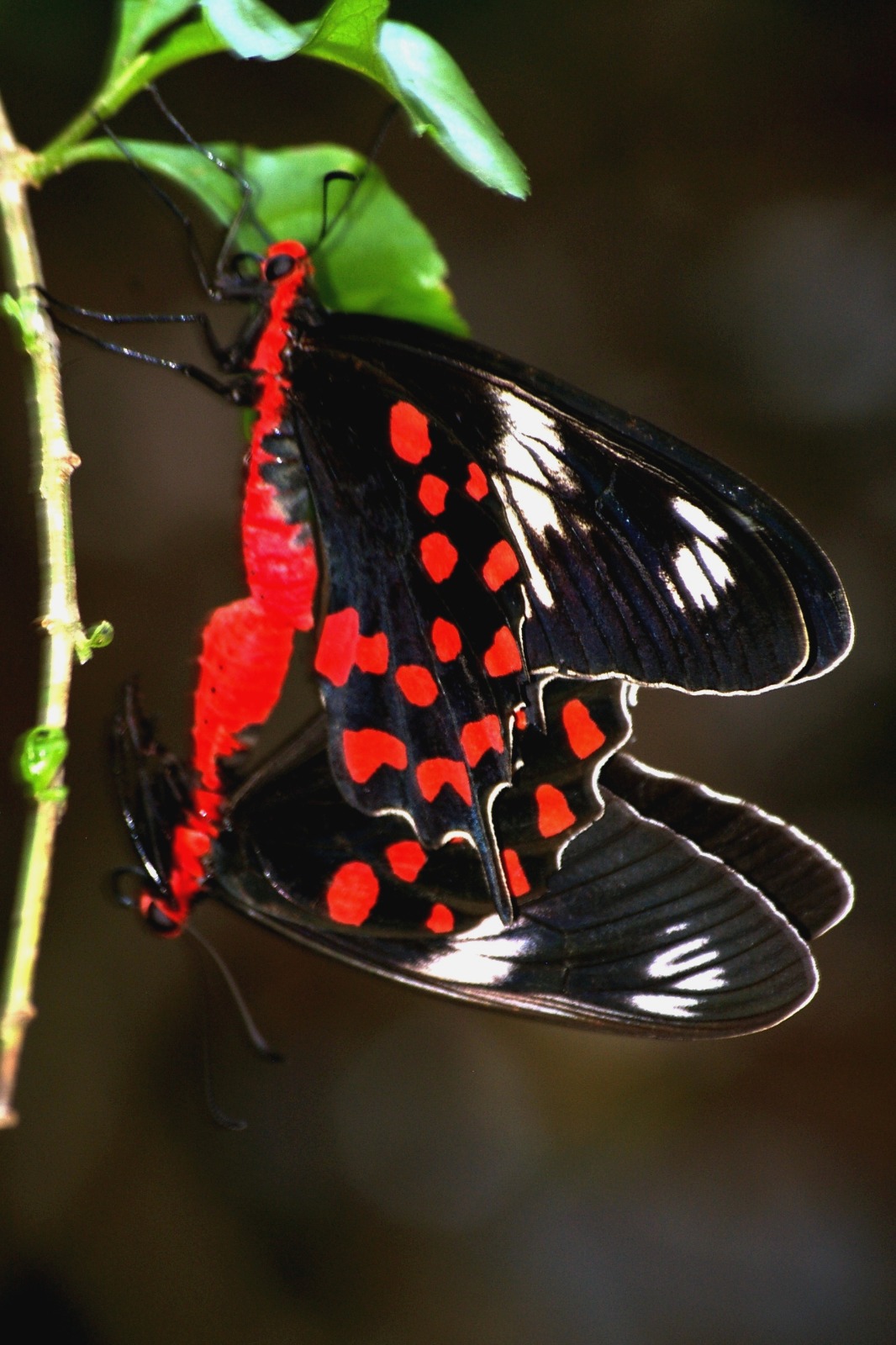
The Crimson Rose (Pachliopta hector), one of South Asia’s most spectacular swallowtail butterflies, continues to fascinate scientists and nature enthusiasts with its striking appearance and extraordinary survival adaptations. Native to India and Sri Lanka, this large butterfly was first described in 1758 by Swedish naturalist Carl Linnaeus, who named it after the legendary Greek hero Hector.
Protected under Schedule II of India’s Wildlife (Protection) Amendment Act, the Crimson Rose is safe from most predators due to its natural toxicity. As a caterpillar, it feeds on poisonous Aristolochia, or birthwort, plants, storing aristolochic acids within its body. These toxins remain throughout adulthood, making the butterfly distasteful to birds and reptiles. Its vivid crimson-red body and wing markings serve as a warning signal, discouraging potential predators from attacking.
The Crimson Rose inhabits forests, gardens, and open landscapes up to elevations of about 8,000 feet. It is a powerful migratory flier, often basking with its wings spread wide before travelling long distances in search of suitable habitats and nectar sources. Interestingly, its caterpillars have also been observed displaying cannibalistic behavior, consuming weaker siblings to reduce competition for food.
The Crimson Rose stands as a remarkable example of nature’s ingenuity, showcasing how beauty, adaptation, and survival work together in the wild.