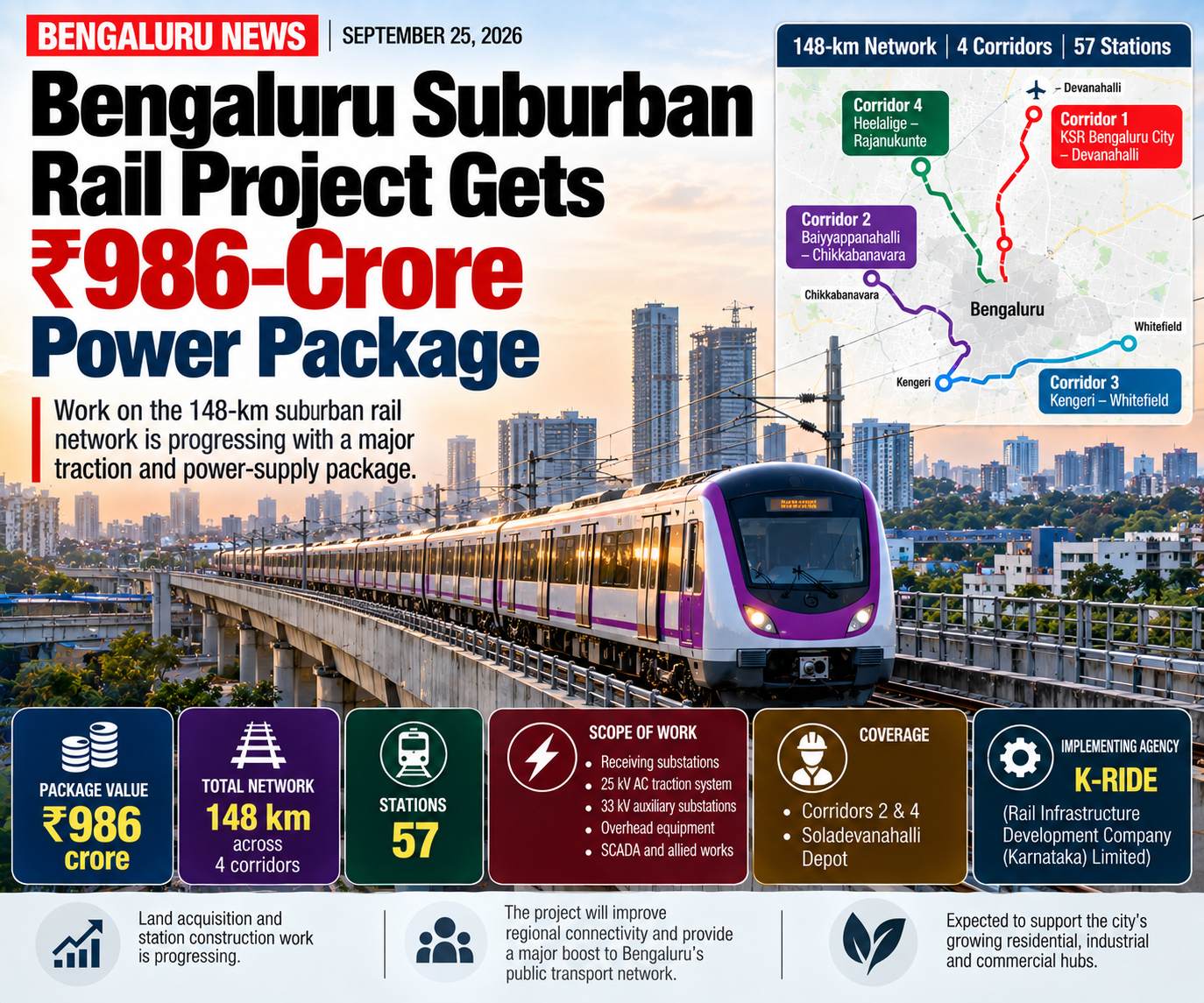
BENGALURU, September 25: The Bengaluru Suburban Rail Project (BSRP) has moved forward with a major ₹986-crore traction and power-supply package, marking another step in the development of the city’s planned suburban rail network.
The 148.17-km project is being developed across four corridors with 57 stations, connecting Bengaluru with key suburban and peripheral areas including Devanahalli, Chikkabanavara, Whitefield and Rajanukunte.
The latest package covers Corridors 2 and 4 as well as the Soladevanahalli Depot. K-RIDE has invited bids for the supply, installation, testing and commissioning of the required traction and electrical systems, with the tender estimated at ₹986.50 crore.
The electrical package includes receiving substations, grid-substation connections, 25 kV AC traction systems, 33 kV auxiliary substations and 25 kV overhead equipment. It will also cover auxiliary power systems, SCADA and other associated electrical works required for railway operations.
The four corridors are planned as Sampige Line 1 from KSR Bengaluru City to Devanahalli, Mallige Line 2 from Baiyyappanahalli Terminal to Chikkabanavara, Parijata Line 3 from Kengeri to Whitefield, and Kanaka Line 4 from Heelalige to Rajanukunte. Together, they form the 148.17-km network.
Work is progressing at different stages across the corridors. Land acquisition for Corridor 2 has been completed, with station-building and other construction works underway. On Corridor 4, land acquisition is progressing, with 43 acres of the required 57 acres acquired so far, while station-building contracts have also been awarded.
The overall Bengaluru Suburban Transport Project was sanctioned at a cost of ₹15,767 crore, with funding structured through contributions from the Centre and Karnataka government along with debt financing. The project is being executed by K-RIDE, the Rail Infrastructure Development Company (Karnataka) Limited.
The suburban rail system is intended to strengthen rail connectivity between Bengaluru and its rapidly expanding outskirts, providing an additional mass-transit option for commuters travelling between residential, commercial and industrial areas. The new power and traction package is expected to support the infrastructure required for eventual train operations across the relevant corridors.