


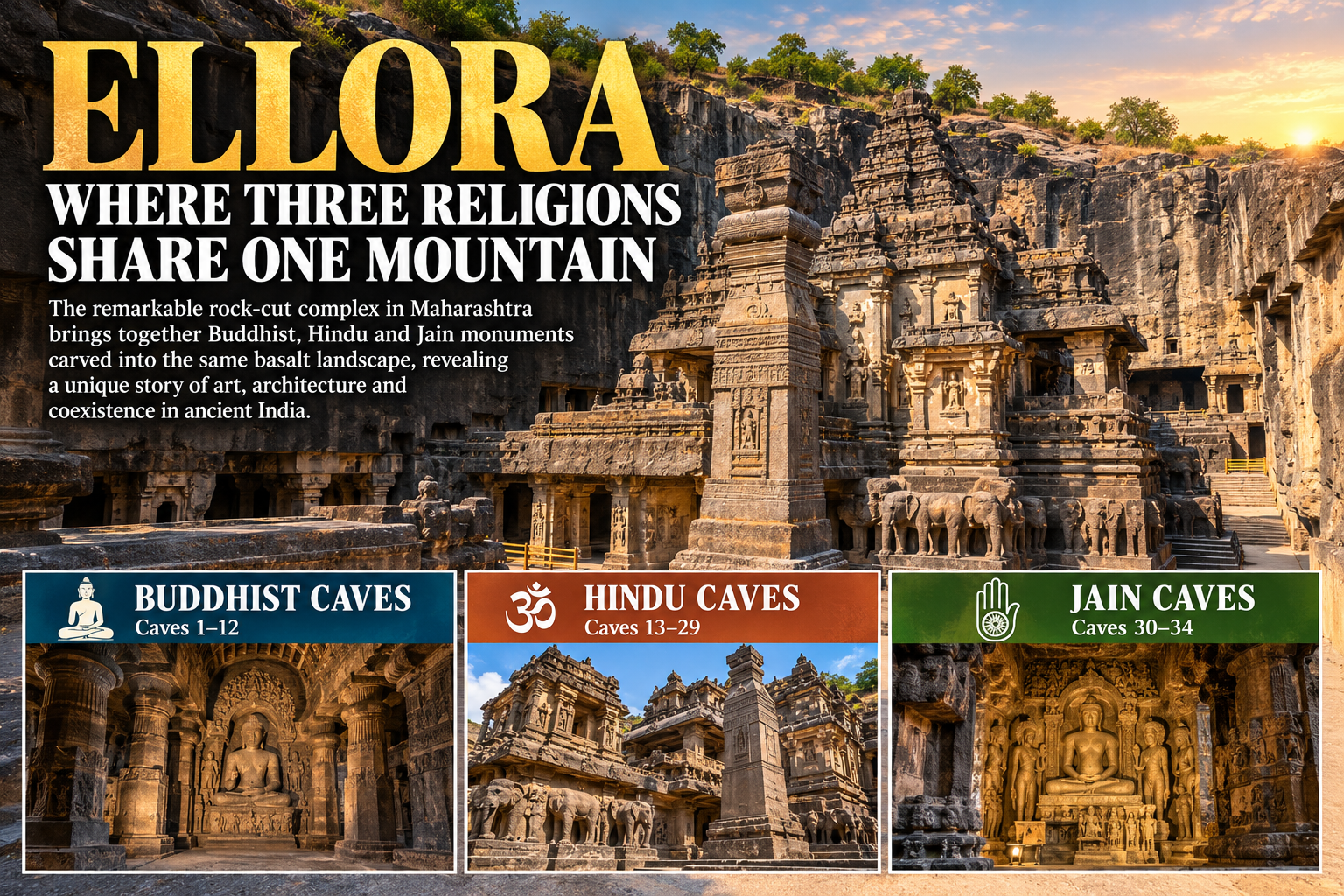
Maharashtra, India: Along the basalt cliffs of Maharashtra lies a remarkable archaeological complex where Buddhist monasteries, Hindu temples and Jain sanctuaries stand together across the same rocky landscape. Known as the Ellora Caves, the site is one of India’s most extraordinary achievements in rock-cut architecture and has been a UNESCO World Heritage Site since 1983.
Spread across more than 2 kilometres, Ellora contains 34 major monasteries and temples carved into the face of a high basalt cliff. Rather than being constructed from blocks of stone, many of these monuments were created by removing rock from the mountainside, transforming the living rock itself into halls, pillars, shrines and sculptures.
Three Faiths, One Landscape
The monuments at Ellora developed in different phases. The earliest group consists of Buddhist caves, numbered 1 to 12, associated with Mahayana Buddhism. These include monasteries, prayer spaces and sculptures of Buddhist figures. Cave 10, known as the Visvakarma or Carpenter’s Cave, is particularly notable for its chaitya-style sanctuary, while Cave 12, the three-storeyed Teen Tal, is one of the largest Buddhist monastic caves at the site.
The Hindu or Brahmanical caves, numbered 13 to 29, form the central section of the complex. They contain elaborate representations of Hindu deities and mythological stories. Among them, Cave 16 is the celebrated Kailasa Temple, one of the most ambitious examples of monolithic rock-cut architecture anywhere in the world.
The final group, Jain caves 30 to 34, reflects the Jain tradition and includes finely carved figures and decorative details. These monuments demonstrate that rock-cut architecture at Ellora continued to develop over several centuries rather than belonging to a single period or artistic tradition.
The Extraordinary Kailasa Temple
Perhaps the most astonishing monument at Ellora is Cave 16, the Kailasa Temple. Instead of assembling a temple from separately quarried stones, craftsmen transformed a huge section of basalt into a freestanding temple complex through excavation and carving.
UNESCO describes the Kailasa Temple as a technological achievement without equal when considering the enormous effort involved in excavating the rock. Its architecture reproduces features associated with constructed temples while remaining carved from the mountain itself.
Its sculptures tell stories from Hindu mythology. One of the most striking depicts Ravana attempting to lift Mount Kailasa, the sacred mountain associated with Shiva. The monument also preserves remnants of paintings on parts of the temple’s ceilings.
How Was Ellora Created?
Ellora was not produced in a single generation. UNESCO identifies three broad phases of rock-cut activity, extending from roughly the 6th to the 12th centuries. The Buddhist group belongs to the earlier phase, the Brahmanical monuments followed, and the Jain caves represent the later phase.
The craftsmen had to understand the structure of the basalt cliff before cutting into it. Their work involved excavating enormous quantities of rock while leaving behind precisely positioned pillars, chambers, stairways, sculptures and architectural forms.
The result was more than a collection of caves. The artists reproduced architectural ideas normally associated with free-standing buildings directly within the mountain. This makes Ellora an important chapter in the development of Indian rock-cut architecture.
A Record of Ancient Indian Society
Ellora’s importance goes beyond its religious monuments. The sculptures and architecture provide evidence about the artistic traditions, religious practices, material culture and social life of the period.
The uninterrupted sequence of monuments also allows historians to study how artistic styles changed over several centuries. Different communities left their distinctive architectural and sculptural traditions within the same broader landscape.
This is one reason UNESCO considers Ellora significant not only as an artistic achievement but also as a window into the civilization of ancient India.
A Story of Coexistence
One of Ellora’s most remarkable characteristics is the presence of sanctuaries belonging to Buddhism, Hinduism and Jainism within the same complex.
UNESCO specifically identifies Ellora as evidence of the coexistence of these three major religious traditions and highlights the site’s cultural significance as an example of religious interaction and tolerance in ancient India.
The caves therefore tell two stories at once: one about extraordinary engineering and artistic skill, and another about the diversity of religious traditions that shaped India’s cultural landscape.
Preserving the Mountain
Ellora remains a living heritage site that requires continuous conservation. The Archaeological Survey of India manages the monument, while the surrounding buffer areas involve the ASI, the Forest Department and the Government of Maharashtra.
UNESCO has identified issues such as visitor management, water seepage and cracking within the caves as conservation concerns. Protecting Ellora requires balancing tourism with the preservation of its rock surfaces, sculptures, paintings and natural setting.
More Than 1,000 Years of Stone
Ellora is ultimately a story of patience, craftsmanship and cultural diversity. Over centuries, artists and religious communities transformed a basalt mountainside into monasteries, temples, shrines and monumental sculptures.
Today, the caves stand as an extraordinary reminder that India’s architectural history cannot be understood through a single religion, dynasty or artistic style. At Ellora, Buddhist, Hindu and Jain traditions share the same landscape, turning one mountain into a remarkable record of India’s ancient cultural diversity.
🏛️ Ellora at a Glance
- Location: Maharashtra, India
- Monuments: 34 major caves/monasteries and temples
- Extent: More than 2 km along a basalt cliff
- Major traditions: Buddhism, Hinduism and Jainism
- Key monument: Kailasa Temple, Cave 16
- Rock type: Basalt
- UNESCO World Heritage inscription: 1983
- Rock-cut activity: Broadly from the 6th to 12th centuries
- Conservation authority: Archaeological Survey of India