


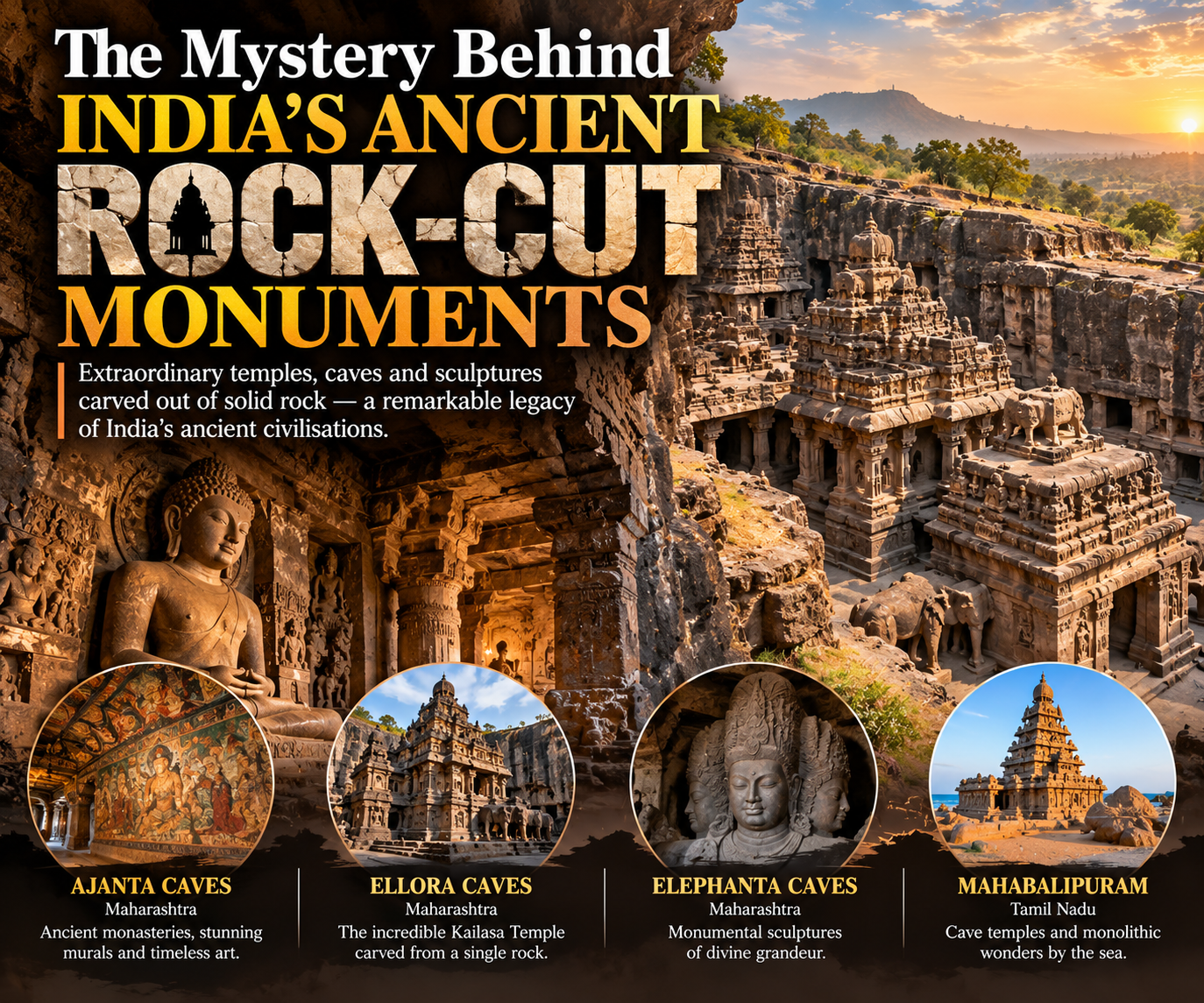
NEW DELHI: Across India, entire temples, monasteries, sanctuaries and monumental sculptures were carved directly into hillsides and massive rock formations centuries before modern construction technology. From the caves of Ajanta and Ellora to the temples of Mahabalipuram and the ancient Barabar caves, these monuments continue to reveal the remarkable engineering and artistic traditions of early Indian civilizations.
Unlike conventional buildings assembled from separate blocks, rock-cut monuments were created by removing stone from a natural rock face or outcrop. The builders had to plan the final structure before much of the excavation began, because mistakes could not simply be corrected by replacing a stone block.
🏔️ A Tradition That Began More Than 2,000 Years Ago
Some of India’s earliest known rock-cut monuments are the Barabar Caves in Bihar, dating to around the 3rd century BCE. Rock-cut architecture subsequently developed across western and southern India, particularly through Buddhist, Hindu and Jain traditions.
The Ajanta Caves in Maharashtra demonstrate how sophisticated the tradition became. The earliest caves at Ajanta date from the 2nd and 1st centuries BCE, while major additions were made during the 5th and 6th centuries CE. The complex contains monasteries, prayer halls, sculptures and celebrated murals carved and created within a dramatic cliffside setting.
🛠️ How Did Ancient Craftsmen Do It?
One of the enduring questions surrounding these monuments is how craftsmen managed such demanding excavation work with ancient tools.
Archaeological evidence indicates that craftsmen progressively removed rock to create halls, pillars, chambers, sanctums and sculptures. At Ajanta, unfinished caves provide valuable evidence of the methods and stages of rock excavation, offering researchers a rare opportunity to study how the work was carried out.
The craftsmen also retained architectural ideas associated with earlier wooden construction. UNESCO notes that elements of timber architecture were reproduced in stone, showing how established construction traditions influenced the development of rock-cut architecture.
🛕 Ellora and the Challenge of Carving a Temple From Rock
Perhaps the most dramatic example is the Kailasa Temple at Ellora, Maharashtra.
Ellora contains 34 major caves representing Buddhist, Hindu and Jain traditions, developed between approximately the 6th and 12th centuries. Cave 16, the Kailasa Temple, is a vast monolithic structure excavated from the rock and decorated with elaborate sculptures. UNESCO describes the excavation itself as an extraordinary technological achievement.
The remarkable feature is that the temple was not assembled piece by piece. Instead, the monument was created by cutting into the rock mass and leaving the intended architectural form standing.
🕌 Different Faiths, One Rock-Cut Landscape
India’s rock-cut heritage also reflects the country’s diverse religious history.
At Ellora, Buddhist, Hindu and Jain monuments stand within the same wider complex. The caves therefore provide not only architectural evidence but also insights into the coexistence of different religious traditions in ancient India.
The Elephanta Caves near Mumbai provide another example. Dating mainly to the 5th and 6th centuries CE, the complex contains monumental Shaivite sculptures, including the famous approximately seven-metre-high Sadashiva image in Cave 1.
🌊 When Nature Became Part of the Architecture
At Mahabalipuram on the Tamil Nadu coast, Pallava craftsmen used natural rock formations to create cave sanctuaries, monolithic temples and enormous relief sculptures during the 7th and 8th centuries. The monuments demonstrate how natural landscapes could become an integral part of architectural design.
The Early Chalukyan centres of Aihole and Badami provide another important chapter. UNESCO describes the region as an important stage in the experimentation and development of Hindu cave and temple architecture, eventually contributing to later free-standing temple forms.
🔍 What Remains a Mystery?
Despite centuries of study, many questions remain about the organisation of ancient construction projects: how work was scheduled, how craftsmen coordinated complex excavations, how materials and tools were managed, and how architectural designs were transferred accurately onto irregular rock surfaces.
The unfinished portions of sites such as Ajanta are particularly valuable because they preserve evidence of the construction process itself. They allow archaeologists to study not just the finished masterpiece, but traces of the work that produced it.
🏛️ A Legacy Carved Into Stone
India’s rock-cut monuments are more than ancient tourist attractions. They preserve evidence of religious traditions, artistic practices, engineering knowledge, social organisation and architectural experimentation spanning more than two millennia.
Today, sites such as Ajanta, Ellora, Elephanta and Mahabalipuram are recognised as UNESCO World Heritage properties. Their continued preservation is important because the monuments themselves are irreplaceable records of the people and cultures that created them.
The real mystery may therefore not be how these monuments were created with ancient technology, but how generations of craftsmen developed the knowledge, planning and artistic vision required to turn solid mountains and cliffs into architecture.