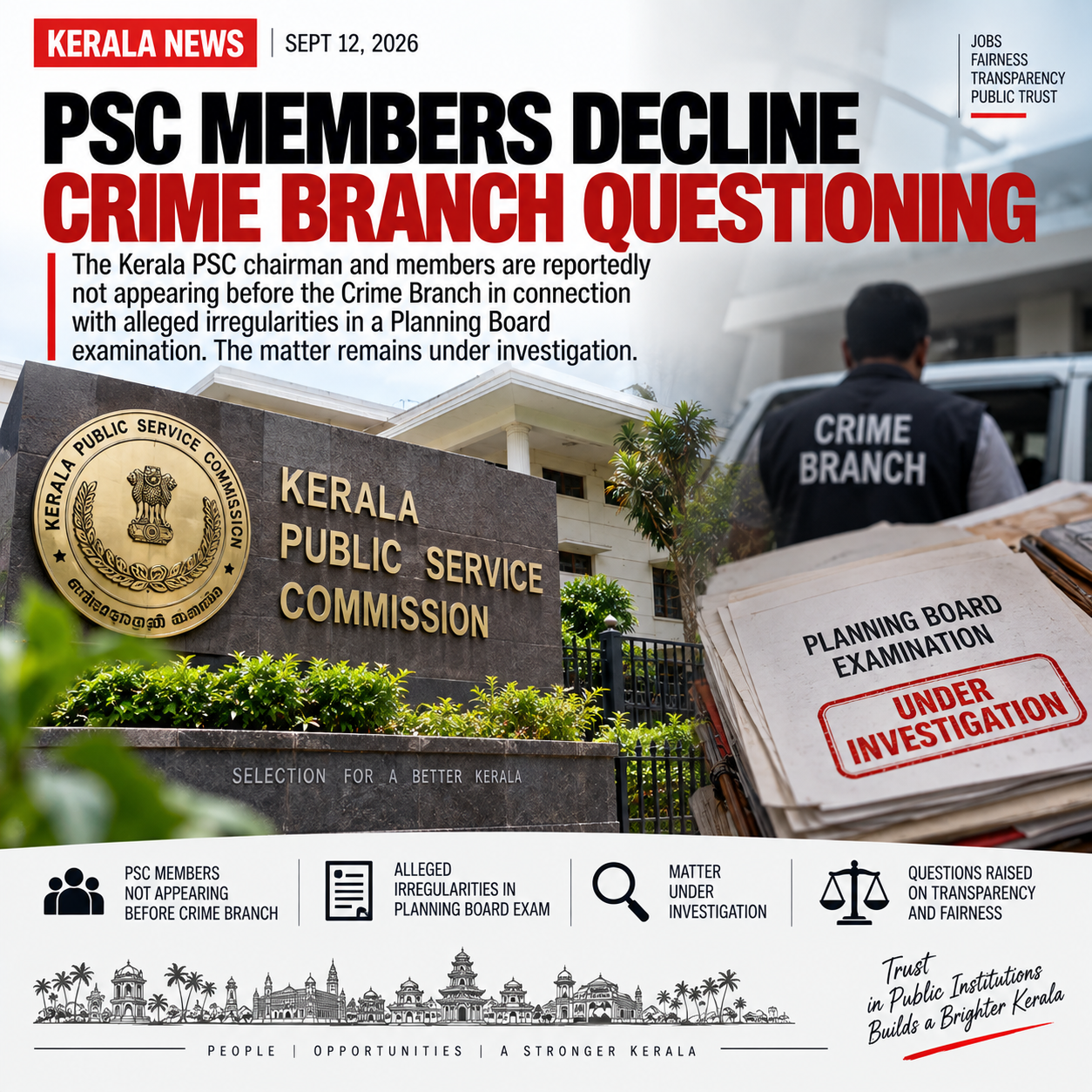
THIRUVANANTHAPURAM: The Kerala Public Service Commission (PSC) has decided that its chairman and members will not appear at the Crime Branch headquarters for questioning in connection with alleged irregularities in the examination conducted for the post of Chief of the Kerala State Planning Board.
The PSC has instead informed the investigating team that its members are willing to provide their statements at the PSC headquarters. PSC Secretary Saju George has communicated the position to IG Ajeetha Begum, who is leading the Special Investigation Team (SIT).
The Commission has cited the constitutional status of the PSC and protocol as the reason for opposing the appearance of its members at the Crime Branch office. The PSC has also sought legal advice on the notices issued to its members. The SIT, however, has indicated that statements can be recorded at the PSC headquarters, subject to the legal position.
The Crime Branch investigation follows serious lapses identified in the evaluation of the Planning Board examination. Investigators found that 10 questions carrying a total of 58 marks were left unevaluated in answer scripts. The SIT has recommended departmental action against two PSC officials in connection with the lapses.
The investigation is also examining whether the failures were merely administrative errors or whether there was a deliberate conspiracy to favour particular candidates. The Crime Branch has recommended a review of two appointments made following the examination, as investigators found that the evaluation process had been incomplete.
PSC member S.A. Saifeen had earlier received a notice directing him to appear for questioning on September 15. Notices have also been issued to other members, including Dr S. Sreekumar, Dr C.K. Shajib and Dr Stany Thomas. PSC Chairman M.R. Baiju is expected to be questioned after the members’ statements are recorded.
Legal questions are now at the centre of the dispute. While the PSC maintains that its members should be questioned at its premises, legal sources cited in reports have pointed out that being a constitutional institution does not automatically provide immunity from criminal investigation and that investigators generally have authority to determine the venue for questioning.
The case is now developing into a significant investigation involving the state’s recruitment authority, with the Crime Branch continuing to examine the examination process, the role of officials and the possibility of wider irregularities.