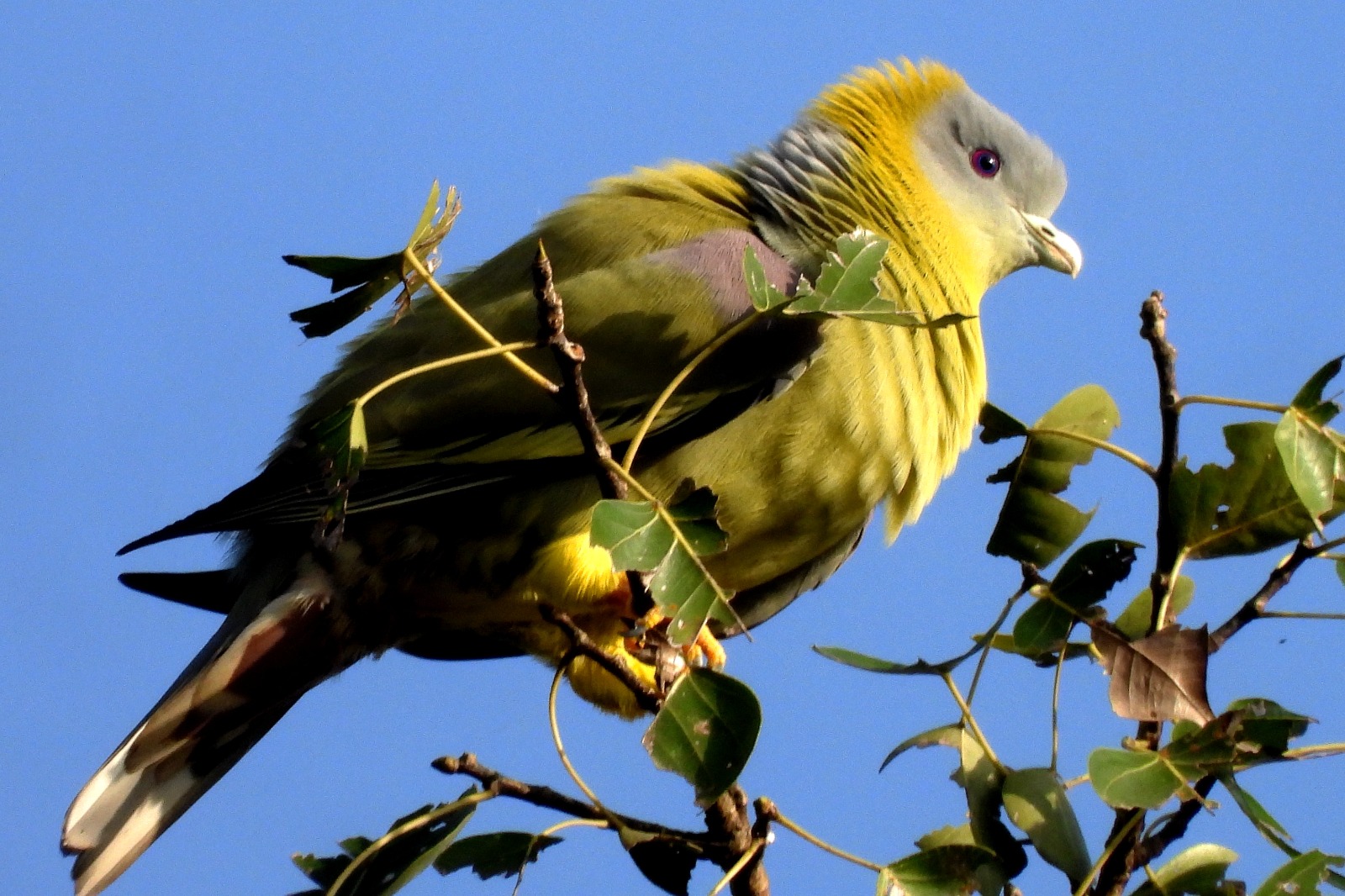
The Yellow-footed Green Pigeon (Treron phoenicopterus), also known as the Yellow-legged Green Pigeon, is one of the most common and attractive green pigeons found across the Indian subcontinent and parts of Southeast Asia. It was first described in 1790 by John Latham. Its scientific name reflects both its appearance and behavior. The genus Treron comes from the Greek word for pigeon or dove and also implies a shy or timid nature, while phoenicopterus means “red-feathered,” referring to the distinctive lilac-maroon patch on its shoulder. The species is proudly recognized as the State Bird of Maharashtra.
Yellow-footed Green Pigeons are monogamous, usually remaining with the same partner throughout their lives unless one dies. During courtship, the male courts the female by puffing out his chest, strutting gracefully, and producing soft cooing calls. If the female accepts him, the pair gently touch their beaks in a behavior known as “billing.” Both parents share nesting duties, with the male incubating the eggs during the day and the female taking over at night. After hatching, the chicks are nourished with crop milk, a protein-rich secretion produced in the parents’ crop that provides essential nutrients during their early growth.
These pigeons usually forage in flocks and feed mainly on fruits, particularly those of fig (Ficus) trees, making them highly effective seed dispersers that contribute to natural forest regeneration. Their ability to utilize a wide range of habitats and food sources has enabled them to thrive across diverse landscapes. Recent observations indicate that the species’ population in India is currently stable and even increasing in many regions, highlighting its successful adaptation to changing environmental conditions. The Yellow-footed Green Pigeon remains an important component of India’s forest ecosystems and a symbol of the country’s rich avian diversity.
Vincent Vanur