Butterfly size is determined by its wingspan, measured using the method introduced by William Harry Evans in his 1932 book The Identification of Indian Butterflies, published by the Bombay Natural History Society. Evans measured the distance from the center of the thorax to the tip of one forewing and doubled it, assuming both wings are symmetrical.
Using this standard, the Western Pygmy Blue (Brephidium exilis) remains the world’s smallest butterfly, with a wingspan of just 12–20 mm.
For many years, the Grass Jewel (Freyeria trochylus) was regarded as India’s smallest butterfly, with a wingspan of 12–22 mm. However, a landmark study titled “The Smallest Butterfly Ever Recorded in India”, published on 15 November 2025 by Anil Sarsavan and Peter Smetacek, established that the Tiny Grass Blue (Zizula hylax) holds this distinction. The study found that, among the 1,403 butterfly species reliably recorded in India, the Tiny Grass Blue is the smallest ever documented.
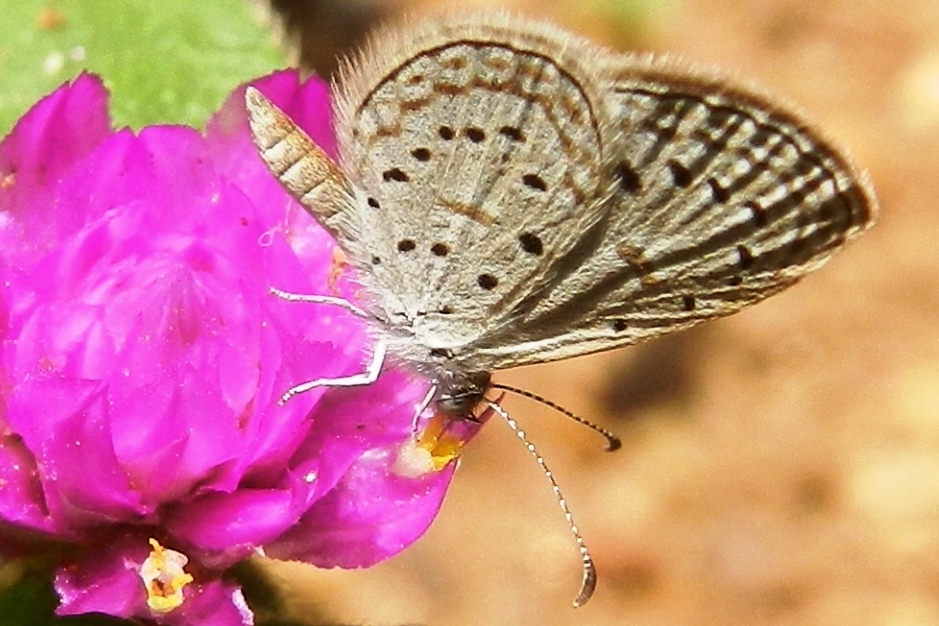
First described in 1775 by Johann Christian Fabricius, the Tiny Grass Blue is widely distributed across tropical and subtropical regions of Africa, Asia, and Oceania. The specimen examined in the study had an exceptionally small wingspan of 13.2 mm, smaller than the measured specimens of the Grass Jewel.
This remarkable butterfly demonstrates that even the tiniest creatures play an important role in nature. Its discovery highlights the value of continued scientific research and careful documentation of biodiversity. The photograph accompanying this account was taken 13 years ago in Dindigul, Tamil Nadu, capturing one of India’s most fascinating and diminutive butterflies.
Vincent Vanur