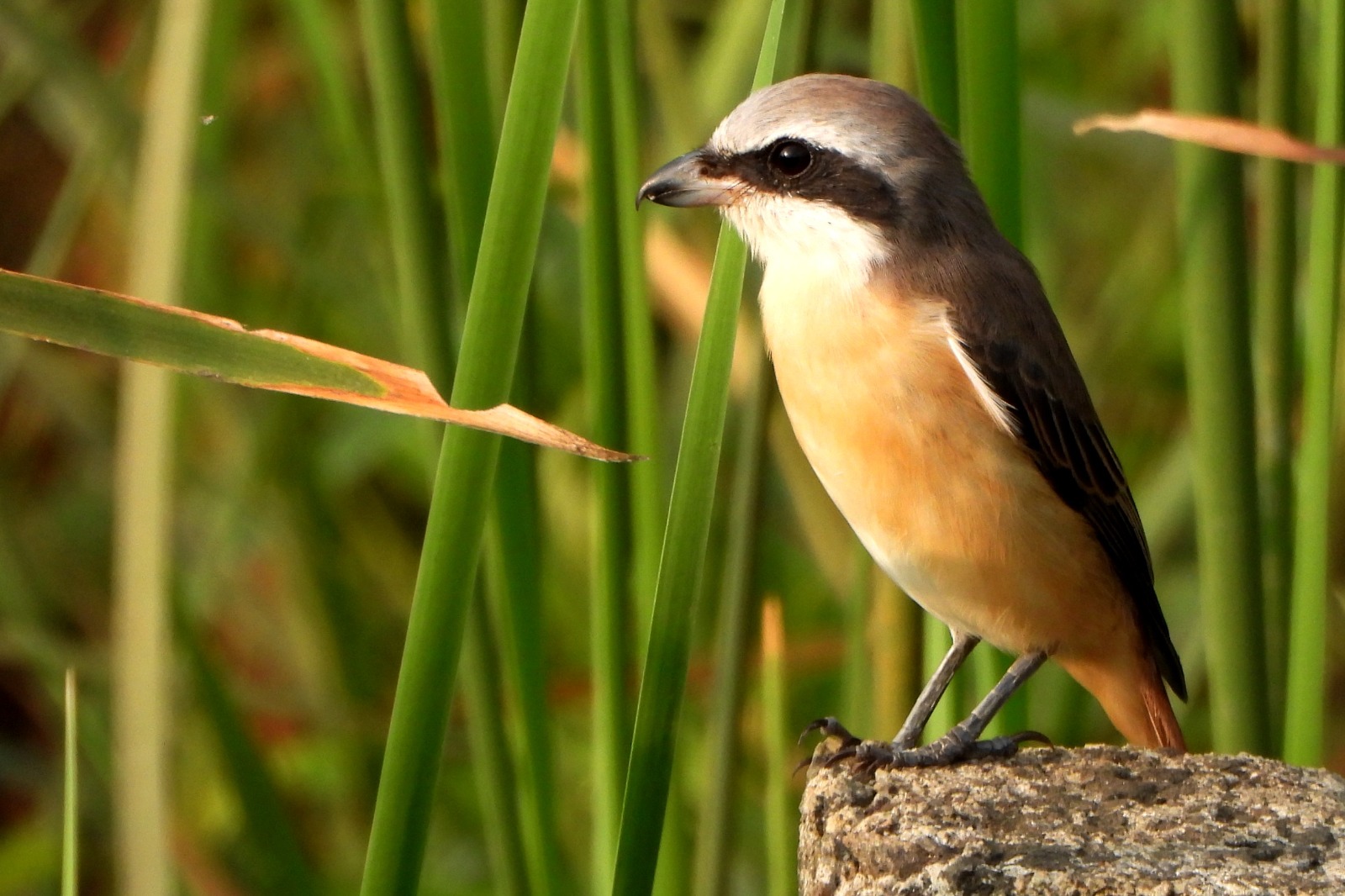
Lanius schach caniceps, commonly known as the Southwestern Long-tailed Shrike, is a subspecies of the Long-tailed Shrike native to western and southern India and Sri Lanka. It is distinguished by its gray head—reflected in the name caniceps, meaning “gray-headed”—along with a bold black eye mask and less rufous coloration on the upperparts than other subspecies.
The species Lanius schach was first described in 1758 by Carl Linnaeus (1707–1778), the Swedish biologist and physician who laid the foundations of modern taxonomy. The subspecies Lanius schach caniceps was later described in 1846 by Edward Blyth (1810–1873), the English zoologist who served for many years as Curator of Zoology at the Asiatic Society of Bengal in Calcutta (now Kolkata). The species name schach is derived from an onomatopoeic rendering of the bird’s call, while the English word “shrike” comes from the Old English scríc, meaning “shriek,” referring to its sharp, piercing vocalizations.
Often called the “butcher bird,” the Southwestern Long-tailed Shrike is a fearless and efficient predator. Since it lacks the powerful talons of birds of prey, it has evolved a remarkable hunting strategy: it impales insects, small lizards, rodents, and other prey on thorns, sharp twigs, or barbed wire. This behavior helps the bird hold its prey while feeding and also allows it to store food for later consumption.
This subspecies inhabits open scrublands, agricultural fields, grasslands, and lightly wooded areas, where it usually perches conspicuously while scanning for prey. In southern India, Lanius schach caniceps is commonly observed during winter, particularly in the dry coastal regions, where it plays an important ecological role by helping regulate insect and small vertebrate populations. Its adaptability, striking appearance, and unique hunting behavior make it one of the most fascinating shrikes of the Indian subcontinent.
– Vincent Vanur