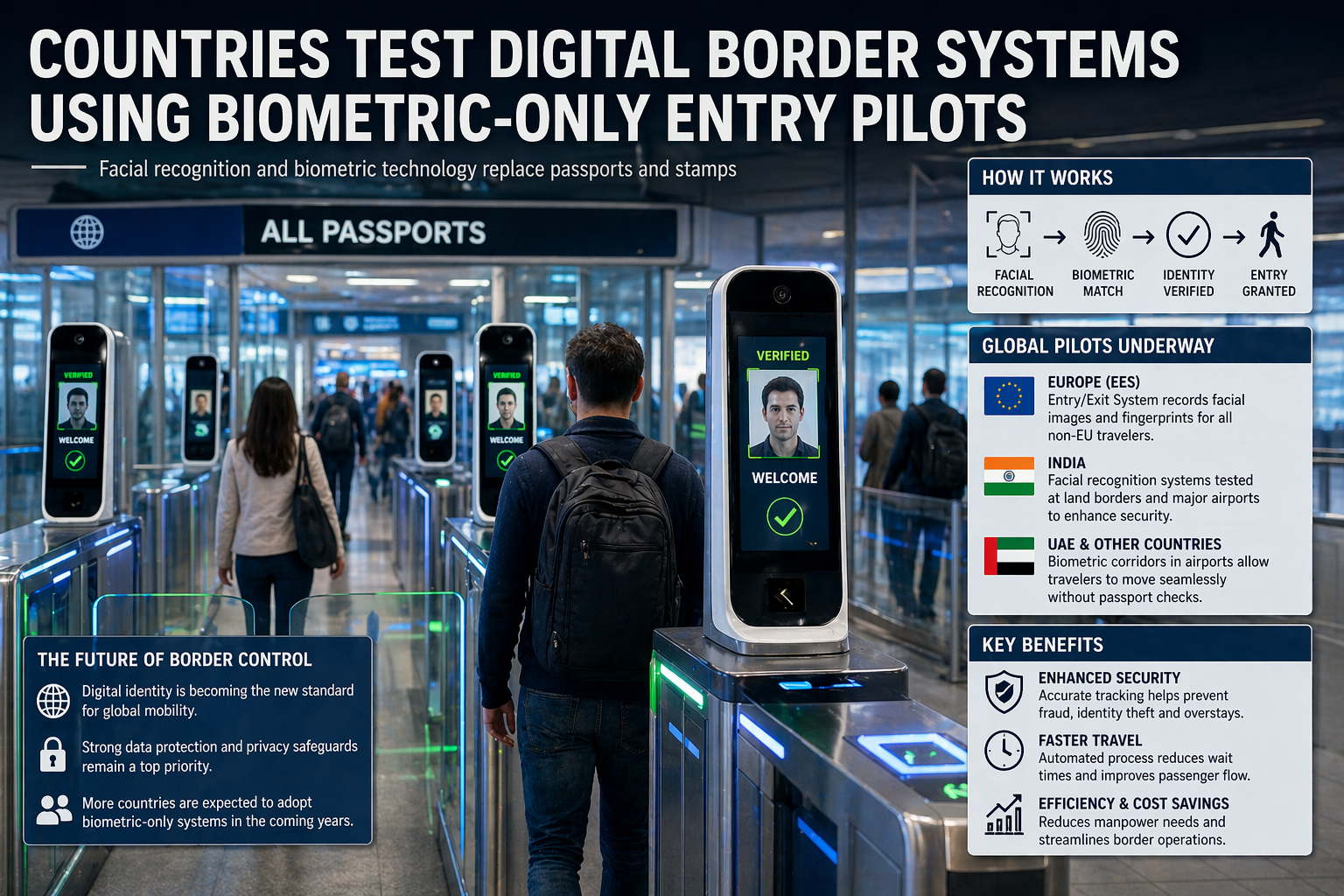
Countries around the world are accelerating trials of digital border systems that rely entirely on biometric identification, marking a major shift in how international travel is managed. These pilot programs use technologies such as facial recognition, fingerprint scanning, and AI-driven identity verification to replace traditional passport stamping and manual checks.
In Europe, the rollout of the Entry/Exit System (EES) has become one of the most prominent examples. Fully operational across the Schengen area as of April 2026, the system records travelers’ facial images and fingerprints, creating a digital log of entries and exits without the need for physical passport stamps.
Governments say the shift improves security by accurately tracking overstays, preventing identity fraud, and strengthening border control. Early data shows millions of crossings have already been recorded digitally, with authorities able to flag security risks more efficiently.
Beyond Europe, similar pilot initiatives are underway in other regions. India has tested facial recognition systems at select border points, while countries in the Middle East and Asia are deploying biometric corridors in airports where a traveler’s face effectively becomes their “passport.”
However, the transition has not been without challenges. Initial deployments have led to long queues and technical issues at several airports, raising concerns about scalability during peak travel seasons. Experts warn that infrastructure upgrades and better system integration will be essential before widespread adoption.
Privacy and data protection also remain key concerns. Critics argue that storing large volumes of biometric data could expose travelers to surveillance risks if not properly regulated, while governments insist strict safeguards are in place.
Despite these hurdles, analysts believe biometric-only border systems represent the future of global mobility. As trials expand and technology improves, digital identity-based travel could soon become the global standard—reshaping how people cross borders in an increasingly connected world.
News as Reported.