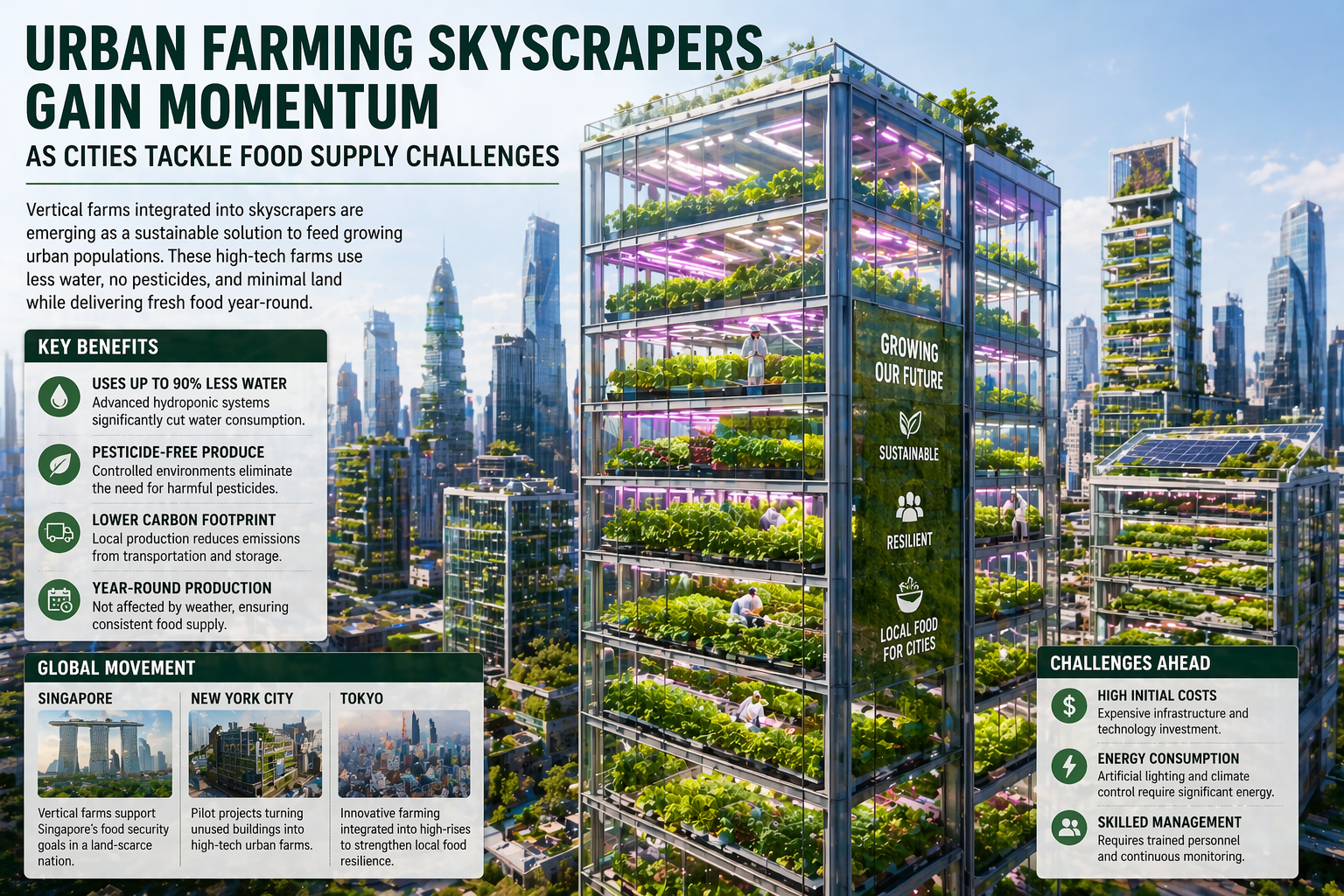
Urban farming skyscrapers—also known as vertical farms—are rapidly gaining traction as cities around the world look for innovative ways to secure food supplies amid growing populations and shrinking agricultural land. These high-rise agricultural systems integrate advanced technologies to grow fresh produce within city limits, reducing dependence on long-distance transportation and traditional farming.
Modern vertical farms rely on techniques such as Hydroponics, Aeroponics, and Controlled Environment Agriculture to cultivate crops in stacked layers. By optimizing light, water, and nutrients, these systems can produce significantly higher yields compared to conventional farming while using a fraction of the resources.
Cities including Singapore, New York City, and Tokyo are at the forefront of adopting vertical farming infrastructure. In Singapore, where land scarcity is a major challenge, urban farms are already contributing to national food security goals. Meanwhile, pilot projects in New York and Tokyo are transforming unused urban spaces into productive agricultural hubs.
Proponents highlight several advantages. Urban farming skyscrapers can dramatically cut water usage—sometimes by up to 90%—and eliminate the need for pesticides. Additionally, growing food closer to consumers reduces carbon emissions associated with transportation and storage. The approach also allows for year-round crop production, shielding food supply from climate-related disruptions.
However, challenges remain. High initial investment costs, energy consumption for artificial lighting, and the need for skilled technical management continue to limit widespread adoption. Critics argue that scaling these systems to meet the needs of entire populations will require further innovation and policy support.
Despite these hurdles, experts believe vertical farming could become a cornerstone of future urban planning. As cities continue to expand and climate pressures intensify, urban farming skyscrapers offer a compelling vision of sustainable, resilient food production—bringing agriculture directly into the heart of modern urban life. News as Reported.