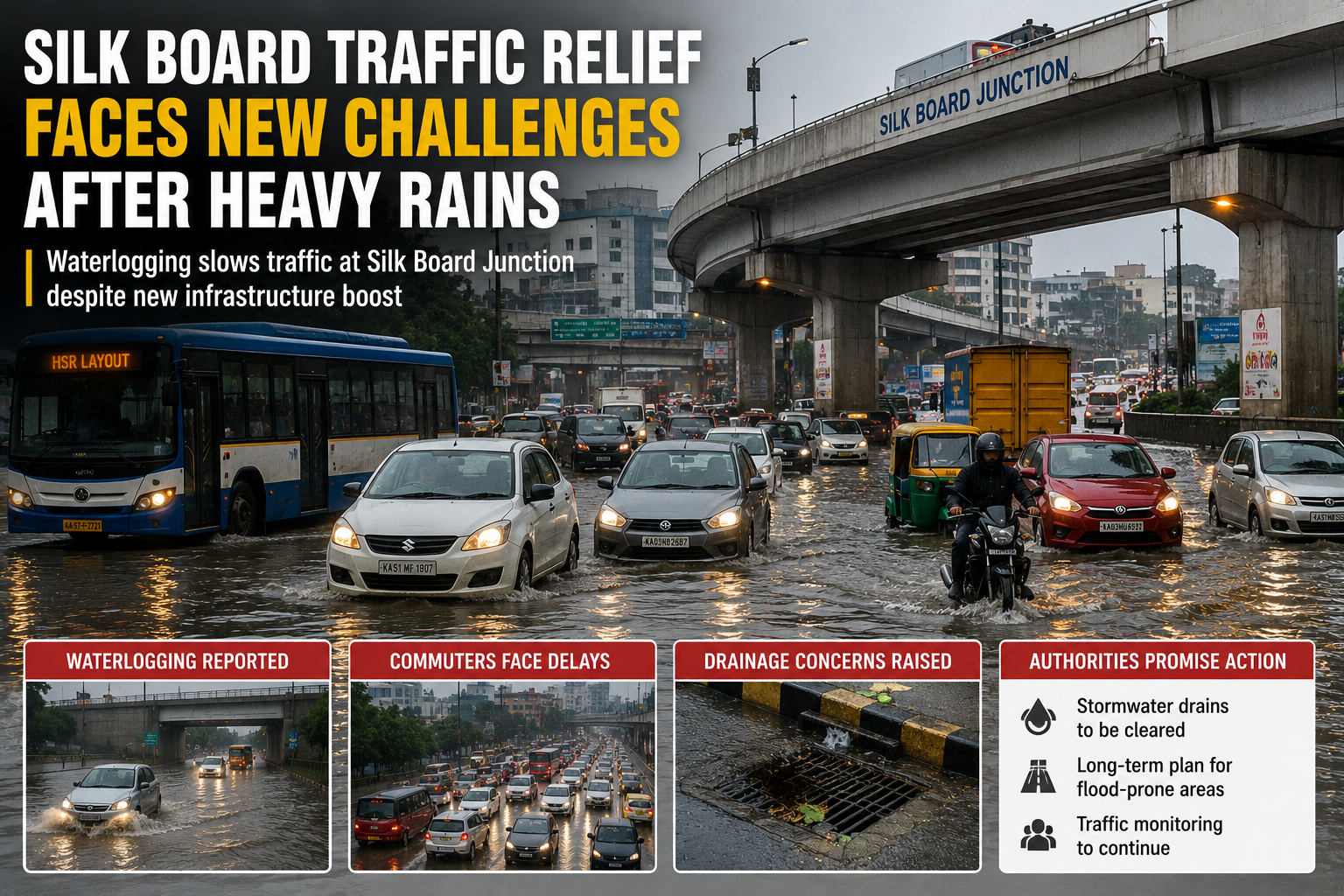
The recently upgraded Silk Board Junction corridor, one of Bengaluru’s most important traffic improvement projects, has once again become the focus of public discussion after heavy rains exposed fresh challenges in the area. The junction has long been known as one of the city’s worst traffic bottlenecks, serving thousands of commuters traveling between Electronic City, HSR Layout, BTM Layout, and other major residential and employment hubs.
The newly operational double-decker corridor was expected to significantly reduce congestion by creating smoother traffic flow and improving connectivity. Many commuters initially reported shorter travel times and reduced waiting periods after sections of the project became operational.
However, recent heavy rainfall led to waterlogging in surrounding areas, slowing traffic movement and causing delays for motorists. Images and videos shared on social media showed flooded stretches of road near the junction, reigniting concerns about Bengaluru’s drainage infrastructure and flood management systems.
Urban planners argue that large transportation projects alone cannot completely solve Bengaluru’s mobility challenges. While flyovers, elevated roads, and underpasses improve vehicle movement, supporting infrastructure such as stormwater drains, pedestrian facilities, and road maintenance are equally important.
The incident has renewed discussions about the city’s long-term infrastructure planning. Experts emphasize that Bengaluru’s rapid urbanization has increased pressure on systems originally designed for a much smaller population. Climate-related extreme weather events are also becoming more frequent, creating additional challenges for urban infrastructure.
Authorities have identified several flood-prone locations across the city and announced plans for drainage improvements. Traffic police are also working on measures to reduce congestion during heavy rain periods.
For many Bengaluru residents, the situation demonstrates that solving traffic problems requires a holistic approach. Infrastructure projects can provide relief, but sustainable mobility will depend on better planning, resilient drainage systems, public transport expansion, and coordinated urban development.
News as reported