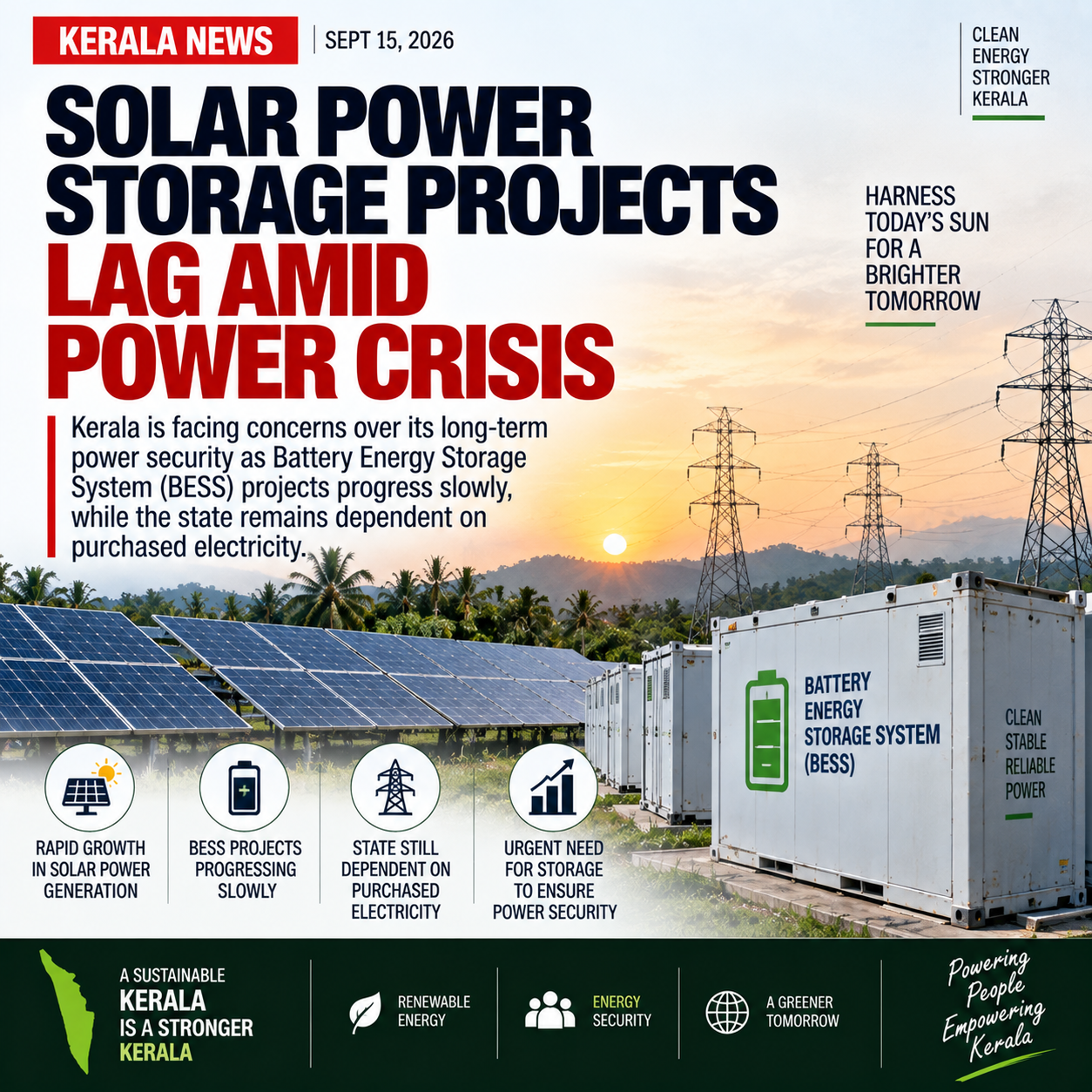
THIRUVANANTHAPURAM, September 15, 2026: Kerala’s ongoing power crisis has renewed concerns over the state’s ability to store and use the large amount of solar electricity being generated during daytime hours. While rooftop solar capacity has expanded rapidly, Battery Energy Storage System (BESS) projects needed to shift surplus daytime power to peak evening hours are progressing slowly.
According to a recent report, five BESS projects are currently under construction in Kerala, with a combined capacity expected to store around 500 MW of solar power for up to four hours. However, delays in completing these projects are limiting the state’s ability to make full use of solar generation when electricity demand rises later in the day.
The issue has become particularly important as Kerala struggles with a shortage of electricity during peak hours. The state has had to depend heavily on electricity purchased from outside, while power availability through the national market has remained tight. KSEB has recently secured an additional 150 MW from central generating stations to provide some immediate relief.
At the same time, Kerala’s rooftop solar sector has grown sharply. A recent report noted that rooftop solar generation capacity increased from just 17 MW in 2018 to around 2,500 MW in 2026. The rapid growth has also placed pressure on local transformers and the distribution network in some areas.
Battery storage could help address this mismatch by storing excess solar electricity produced during the day and making it available during the evening, when demand typically rises and solar generation falls. A 250 MW Battery Energy Storage project at Brahmapuram has already received regulatory approval, with the project intended to store daytime solar power and supply electricity at night.
KSEB has also indicated that wider adoption of battery storage will be part of its longer-term strategy. The board is examining suitable locations, battery technologies and grid-integration requirements for additional storage projects.
The state is simultaneously looking at new hydroelectric generation, including the second phase of the Idukki project, Sabarigiri and Kakkayam, alongside solar and battery storage. The combination is aimed at reducing Kerala’s dependence on expensive power purchases and strengthening supply during peak hours.
With electricity demand remaining high, the faster completion of storage infrastructure could become crucial for Kerala to turn its growing solar capacity into a reliable source of power throughout the day and night.