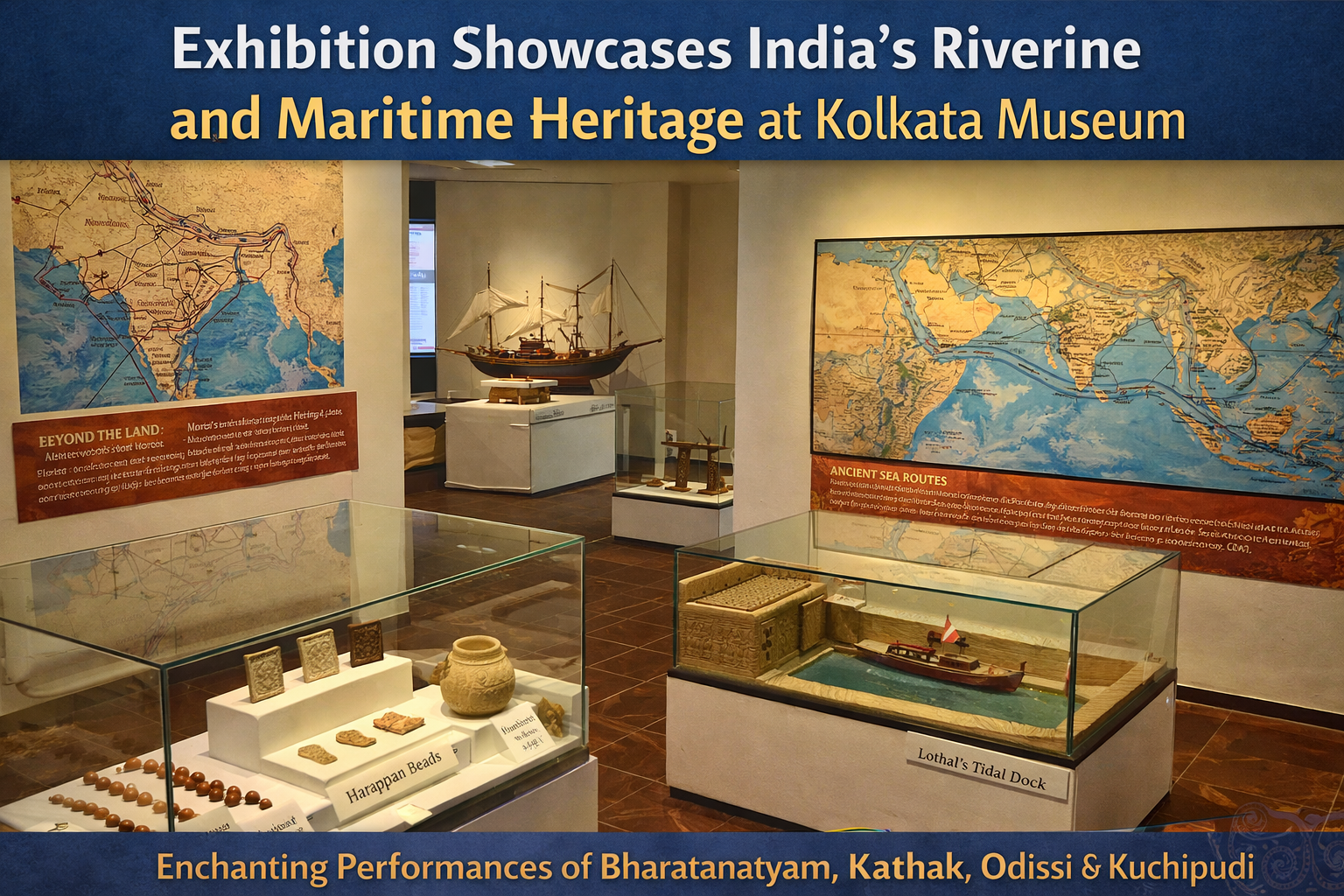
The Indian Museum in Kolkata has launched a compelling new exhibition titled “Beyond the Land: Markers of India’s Riverine and Maritime Heritage” to mark its 212th Foundation Day, highlighting India’s rich historical ties with waterways that shaped its civilisation, trade and cultural exchanges. The exhibition, inaugurated on February 2, 2026, will be open to visitors throughout February at the museum’s Exhibition Space.
Curators have drawn largely from the museum’s extensive reserve collection, presenting artefacts that reveal how India’s riverine networks and maritime routes underpinned ancient settlement patterns, agriculture and long-distance interactions. Among the centrepieces are relics from the Harappan civilisation, including seals, standardised weights, pottery and carnelian beads, illustrating advanced inland and seafaring activities. A notable highlight is the representation of Lothal’s tidal dock, one of the earliest known maritime infrastructures in the world, showcasing how engineers managed tides and facilitated trade.
The exhibition goes beyond inland rivers such as the Ganga, Godavari and Krishna, tracing how these waterways linked hinterlands to coastal ports and enabled the flow of goods and cultures across regions. Visitors can also explore mappings of ancient sea routes that connected the Indian subcontinent with Mesopotamia, Egypt, Persia and Southeast Asia, illustrating India’s integral role in early global networks of exchange.
Through artefacts, maps, visuals and interpretive displays, the exhibition offers fresh insights into how water — whether in the form of mighty rivers or the open sea — has been instrumental in shaping India’s social, economic and cultural history over millennia news as reported.