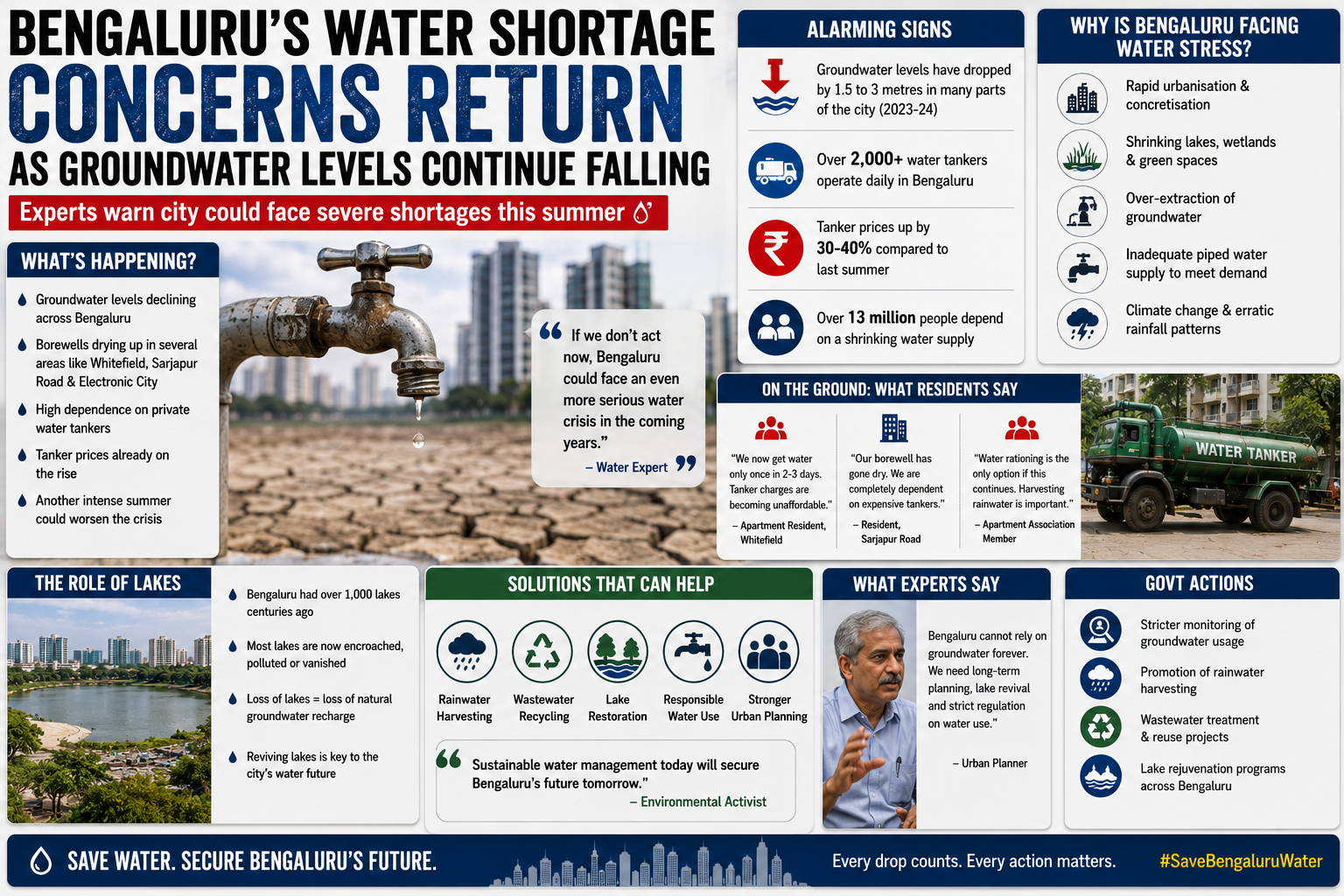
Bengaluru is once again facing growing concerns over water security as reports show groundwater levels declining across several parts of the city ahead of another intense summer season. Areas such as Whitefield, Sarjapur Road, and Electronic City are witnessing increasing dependence on private water tankers as borewells continue drying up.
Last year’s water crisis had already exposed Bengaluru’s vulnerability, with many apartment complexes struggling to secure regular water supply. Experts now warn that unless major conservation measures are implemented quickly, the city could face even more severe shortages in the coming years. Bengaluru’s rapid urban expansion, shrinking lakes, disappearing wetlands, and rising population are placing enormous pressure on limited water resources.
Residents in several newly developed residential areas say tanker prices have already started increasing. Some apartment associations are reportedly discussing water rationing plans and rainwater harvesting upgrades to prepare for future shortages. Social media discussions have intensified, with citizens questioning how India’s technology capital continues facing basic resource management problems despite rapid economic growth.
Environmental researchers say Bengaluru’s traditional lake systems once helped naturally recharge groundwater, but large-scale concretization and encroachments have significantly damaged these ecosystems. Experts also point out that many areas rely heavily on groundwater extraction because piped Cauvery water supply cannot fully meet the city’s expanding demand.
Authorities have announced stricter monitoring of groundwater usage and are encouraging rainwater harvesting systems across residential and commercial buildings. Civic agencies are also promoting wastewater recycling and lake restoration projects. However, environmental activists argue that long-term urban planning reforms are necessary instead of temporary emergency responses.
The issue has become increasingly serious because Bengaluru’s future growth depends heavily on sustainable resource management. Water experts warn that infrastructure expansion without environmental protection could create long-term risks for both residents and businesses.
For many citizens, the growing water crisis represents a larger warning about Bengaluru’s urban future — balancing development with sustainability in one of India’s fastest-growing metropolitan cities.
News as reported