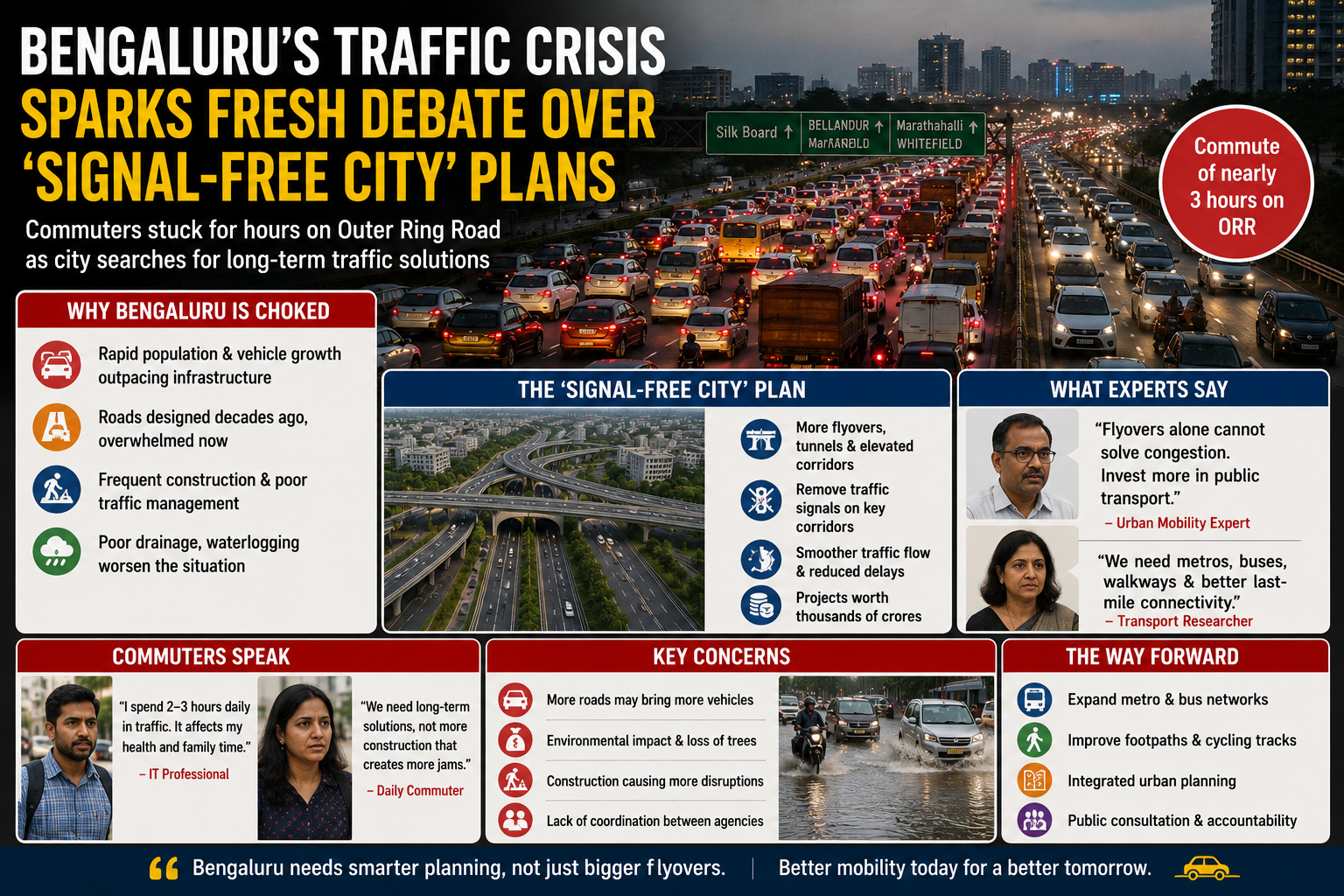
Bengaluru’s worsening traffic congestion has once again become a major public issue after viral social media posts highlighted commuters spending nearly three hours traveling through the city’s Outer Ring Road corridor. The incident reignited criticism over Bengaluru’s infrastructure planning, especially as authorities continue proposing more flyovers, tunnels, and elevated corridors under the city’s long-term mobility plans.
The Outer Ring Road stretch, home to hundreds of IT companies and lakhs of daily commuters, remains one of the city’s most congested corridors. Traffic experts say Bengaluru’s rapid population growth and increasing vehicle registrations have overwhelmed roads originally designed decades ago. Many residents now spend multiple hours daily commuting between work and home, significantly affecting productivity and quality of life.
Urban planners have questioned whether large-scale flyover and tunnel projects alone can solve Bengaluru’s traffic problems. Critics argue that continuous road expansion often encourages more private vehicle usage rather than reducing congestion permanently. Several experts from the Indian Institute of Science (IISc) and citizen groups are instead calling for stronger investment in metro expansion, bus systems, pedestrian infrastructure, and integrated public transport planning.
Public frustration has also increased because repeated road construction projects frequently create additional traffic bottlenecks before completion. The upcoming ₹378-crore ORR concretisation project, while expected to improve road durability, is also likely to create year-long disruptions for commuters already struggling with severe congestion.
Citizens on social media continue demanding better coordination between civic agencies, improved traffic management, and long-term planning instead of temporary fixes. Many argue Bengaluru’s infrastructure development has failed to keep pace with its economic growth as India’s technology capital.
For Bengaluru residents, the traffic crisis is no longer viewed as just an inconvenience — it has become one of the city’s biggest urban and economic challenges affecting mental health, business efficiency, and overall daily life.
News as reported