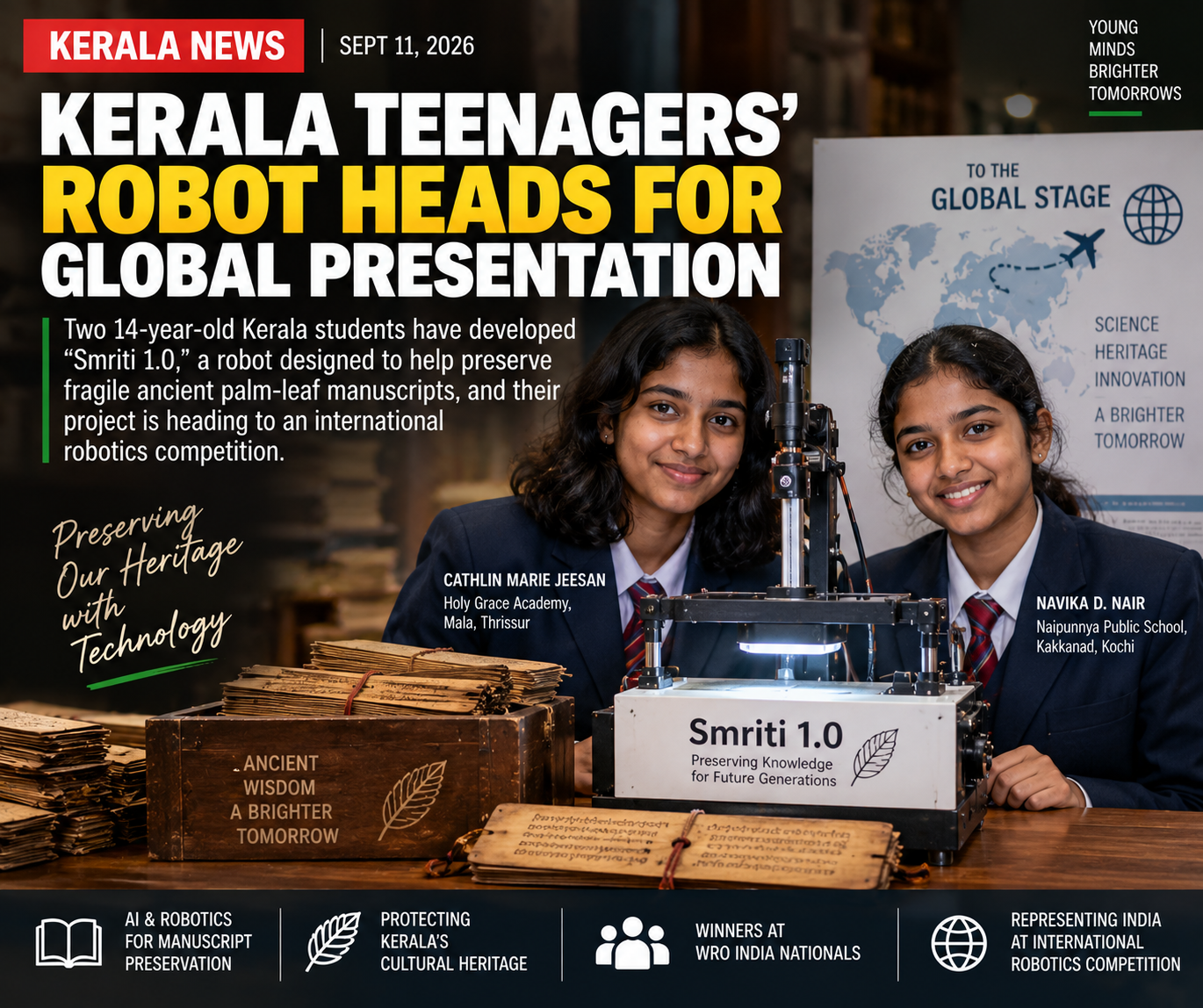
KOCHI: Two 14-year-old students from Kerala have developed an innovative robotic and artificial intelligence system designed to preserve and digitise centuries-old palm-leaf manuscripts, earning them a place at an international robotics competition.
Cathlin Marie Jeesan of Holy Grace Academy, Mala, Thrissur, and Navika D. Nair of Naipunnya Public School, Kakkanad, Kochi, developed “Smriti 1.0” as part of Team UWR Synergy. The project combines robotics, artificial intelligence and optical character recognition (OCR) to help protect fragile historical manuscripts.
The students were inspired by the historical and scientific knowledge preserved in Kerala’s palm-leaf manuscripts, including the works associated with mathematician and astronomer Madhava of Sangamagrama. They found that traditional preservation methods are painstaking, time-consuming and largely dependent on manual work.
Smriti 1.0 is designed to carefully move and clean palm leaves before applying preservation treatment. The system then uses cameras and sensors to capture the inscriptions. Its AI-powered OCR technology can help convert the text, including older Malayalam scripts, into digital records for easier access and preservation.
The innovation won first place in the Future Innovators–Senior category at the World Robot Olympiad (WRO) India Nationals, held in Hyderabad from August 26 to 28. Their victory secured the team a place at the WRO International Championship in Puerto Rico in December 2026, where they will represent India.
The students are now working to improve the prototype, including expanding its ability to handle manuscripts of different sizes and improving the accuracy of its OCR system. They also hope the technology can eventually make valuable historical material more accessible to researchers and students.
The project has attracted attention for bringing together Kerala’s cultural heritage and cutting-edge technology, showing how young innovators can use robotics and AI to address real-world challenges in heritage conservation.