

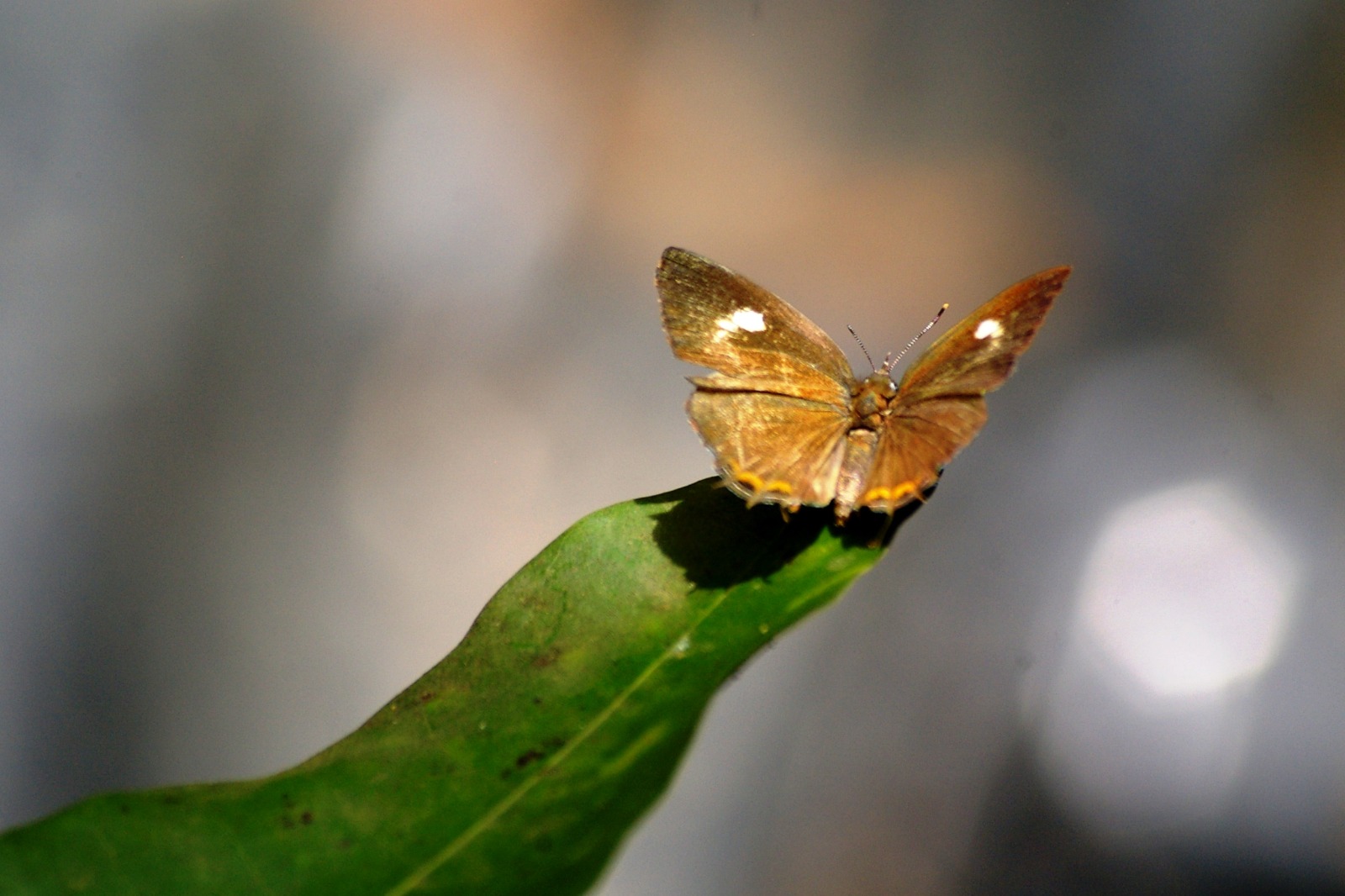
The monkey puzzle (Rathinda amor) is the only species in the butterfly genus Rathinda. It was first recorded in 1775 by the Danish zoologist Johan Christian Fabricius (1745 – 1808).
The antennae on the tail of this butterfly not only resemble the antennae on its head, but they also constantly move them up and down to make enemies think they are the antennae on its head. The spots on its tail also look like eyes. They are called ‘Iruthalachi’ (two-headed) in Malayalam because they appear to have two heads. There are two theories: about calling them ‘monkey puzzle’ in English. One is that the caterpillar of this butterfly resembles the head of a monkey, and the other is that the butterfly’s front and back are the same, making viewers ‘puzzled monkeys’. Apparently, humans use this trick. I remember a photographer named S. Hariharan writing in his Facebook post about people who walk on all fours with a tiger’s head fitted to their bottom to escape from the royal Bengal tiger.
Interestingly, there is a very tall Chilean tree named ‘Monkey puzzle tree’ (Araucaria araucana, an evergreen tree belonging to the family Araucariaceae). I searched for the origin of its name. The origin lies in its early cultivation in Britain c. 1850, when the species was still very rare in gardens and not widely known. Sir William Molesworth, the owner of a young specimen was showing it to a group of friends when one of them, the lawyer Charles Austin, remarked “It would puzzle a monkey to climb that”. As the species had no existing popular name, first “monkey puzzler” and then “monkey puzzle” stuck.
CONTRIBUTION BY VINCENT MASH — FORMER
EDITOR OF PHOTOWIDE MAGAZINE AND ASSOCIATE EDITOR OF PHOTO TRACK MAGAZINE
