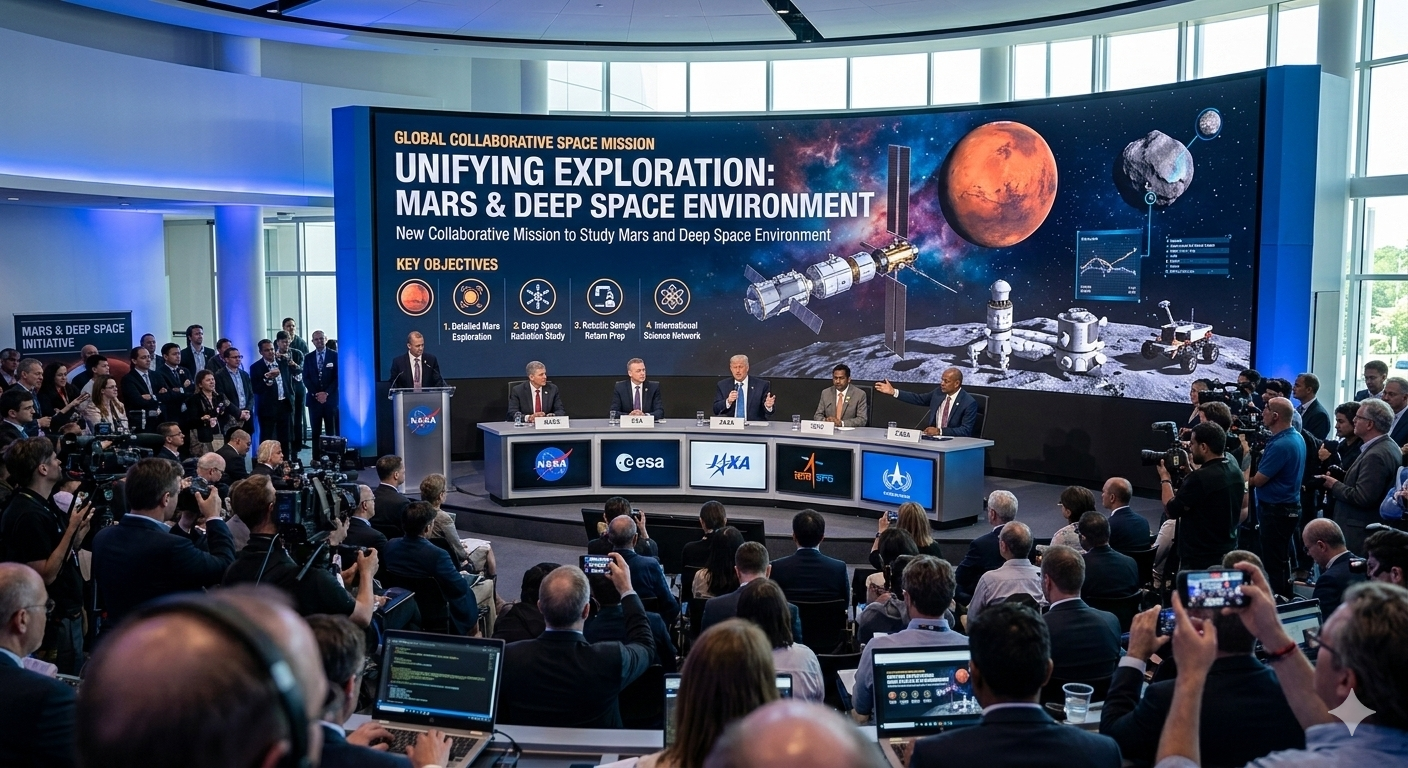
Major space agencies around the world are preparing for a new collaborative mission aimed at studying Mars and the surrounding deep space environment. The initiative is expected to bring together scientists, engineers, and researchers from multiple countries to explore new scientific opportunities and advance humanity’s understanding of the solar system.
Leading agencies such as NASA, European Space Agency, Indian Space Research Organisation, and Japan Aerospace Exploration Agency are discussing plans for joint missions that could include advanced satellites, robotic landers, and deep-space observation instruments. The goal is to collect valuable data about Mars’ atmosphere, surface conditions, and potential signs of past microbial life.
Scientists are particularly interested in studying how solar radiation and cosmic particles affect spacecraft and planetary environments during long-duration missions. Understanding these factors is critical for planning future human exploration missions to Mars and beyond. By examining the deep space environment, researchers hope to develop improved technologies that can protect astronauts and equipment from harmful radiation.
The collaborative mission will also focus on analyzing Martian soil, weather patterns, and underground water resources. Discoveries in these areas could provide clues about whether life ever existed on the Red Planet and help determine if Mars could support human missions in the future.
Experts say international cooperation is essential for large-scale space exploration projects, as they require advanced technology, significant funding, and shared scientific expertise. The proposed mission reflects a growing global commitment to space exploration and scientific discovery, opening new possibilities for understanding Mars and the wider universe.News as Reported.