

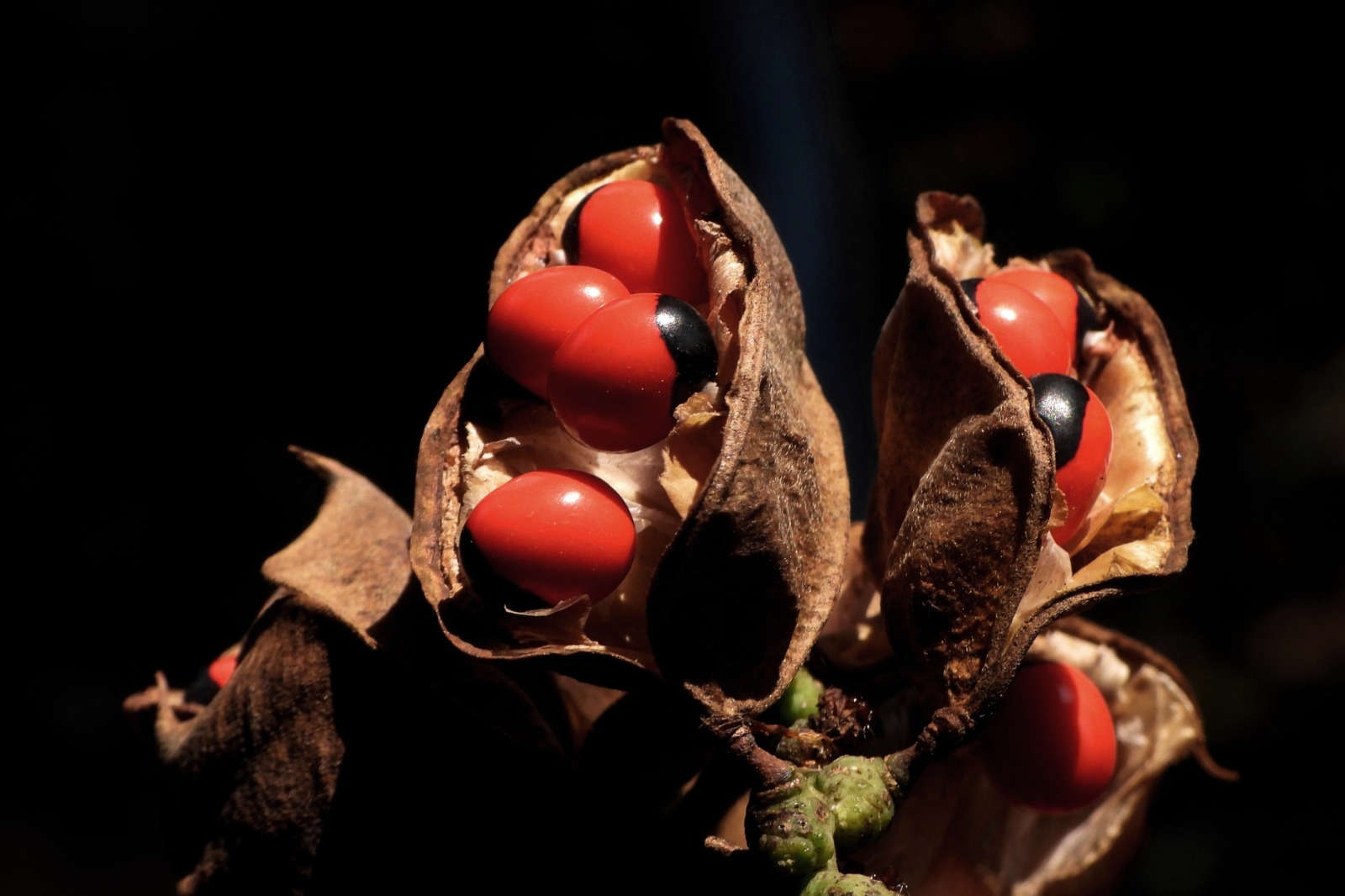
There are few people who have not seen the striking red (sometimes white) black-spotted seeds of Abrus precatorius, a plant known by many names such as jequirity, rosary pea, crab’s eye, love pea, prayer bead, coral bead, and Indian licorice. It is a slender yet remarkably strong climbing vine.
Although used by humans since prehistoric times, the plant was first formally described in modern botanical literature by the Swedish naturalist Carl Linnaeus in 1767, in the twelfth edition of his Systema Naturae.
The seeds are notable for their uniform size and weight. In many ancient cultures, they were used as standard units for weighing gold. Because their hard outer shell prevents moisture from affecting them, they remain consistent in weight regardless of weather conditions. Traditionally, eight seeds were considered to equal one gram, and eight grams made up one sovereign.
Despite their beauty, the seeds are highly toxic. Their hard shell allows them to pass through the digestive system intact, but if chewed or crushed, they release abrin, a potent toxin. Ingestion can lead to nausea, vomiting, liver failure, and even death. Historical records from British Bengal (1881) note that the poison was sometimes used to kill cattle for their hides.
The plant also has a long history in traditional medicine. In Siddha and Ayurvedic systems, as well as in folk medicine in regions such as South America, it has been used to treat fever, skin diseases, swelling, and certain eye conditions. Leaves and roots are also used medicinally. A traditional belief holds that applying a paste of the leaves to the palm allows a person to handle hot objects without being burned, though this claim lacks scientific validation.
CONTRIBUTION BY VINCENT MASH —FORMER
EDITOR OF PHOTOWIDE MAGAZINE AND ASSOCIATE EDITOR OF PHOTO TRACK MAGAZINE
