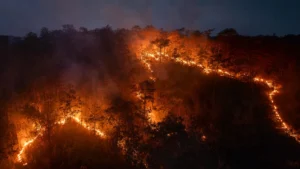
New research shows that forest loss in the Amazon Rainforest has dramatically intensified — not just through outright deforestation, but via an alarming surge in forest degradation and fires. Between 2023 and 2024, degradation indicators rose by 44%, equivalent to a 163% increase compared with 2022.
While official deforestation — i.e. total forest clearing — actually fell during that period, the damage from fires and selective logging exploded. In 2024 alone, an estimated 25,023 km² of Amazon forest experienced degradation, with roughly two-thirds of that attributed to wildfires.
Worse still, a 2025 study from the European Commission Joint Research Centre (JRC) found that 3.3 million hectares of forest were burned last year — triggering a catastrophic release of about 791 million tonnes of CO₂, roughly equivalent to the annual emissions of a mid-sized industrialized country.
Scientists warn that this shift — from deforestation to fire-driven degradation — indicates a dangerous new phase for the Amazon: one where intact canopy cover may mask deep ecological damage. If urgent global and local action is not taken, this could tip the rainforest past a point of “no return,” with devastating consequences for biodiversity, carbon storage, and indigenous communities