

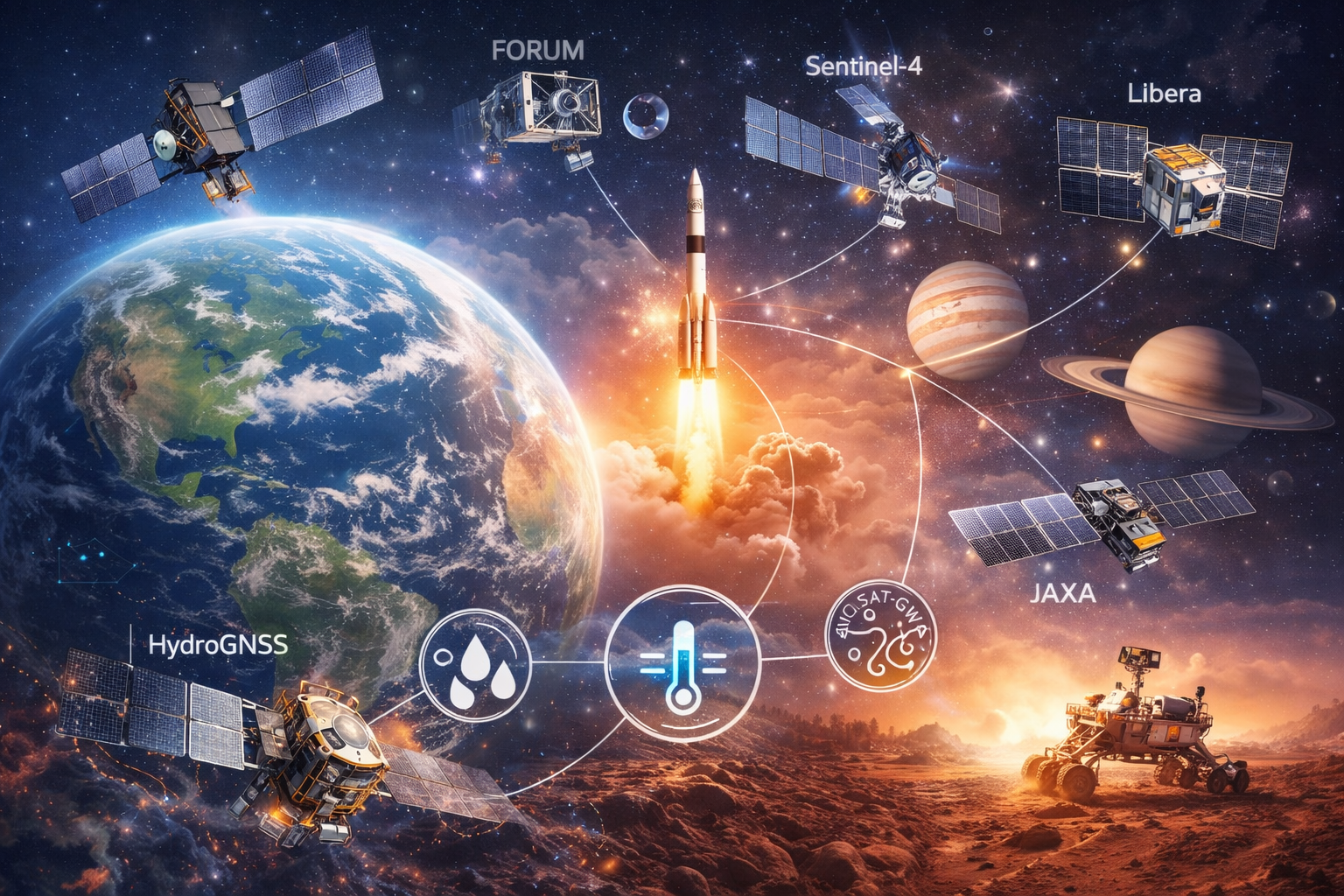
Major space agencies worldwide are rolling out a series of ambitious space missions aimed at enhancing climate monitoring and advancing planetary science in the years ahead. The European Space Agency (ESA) recently launched its HydroGNSS Earth observation satellites, part of a dual-satellite mission designed to monitor critical hydrological variables and improve understanding of water cycles essential to climate systems.
In support of atmospheric and environmental observation, ESA’s Sentinel-4 instruments aboard Meteosat Third Generation satellites continue to provide detailed measurements of trace gases and aerosols to bolster air-quality assessments and climate models. Additionally, ESA’s planned FORUM satellite, targeted for launch in 2027, will investigate Earth’s radiation budget — a key factor in climate change modeling and prediction.
Japan’s GOSAT-GW (Global Observing Satellite for Greenhouse Gases and Water Cycle) mission, launched aboard the final H-IIA rocket, is expanding JAXA’s capabilities to track greenhouse gases and water cycle dynamics, building on previous environmental satellite fleets.
Meanwhile, the United States, through NASA and partners, is preparing future climate-focused missions such as Libera, scheduled for launch in 2027 aboard NOAA’s JPSS-3 platform to monitor Earth’s radiation balance.
Beyond Earth, planetary research continues to advance with cooperative scientific missions and planning for deep-space exploration that will enhance understanding of planetary formation, atmospheres, and potential habitability across the solar system.
These efforts reflect a growing global consensus on the importance of space-based climate observation and planetary science as tools for understanding both Earth’s changing environment and the broader universe.


- upgraderz.aws@gmail.com
- upgraderz.aws@gmail.com
- upgraderz.aws@gmail.com
- upgraderz.aws@gmail.com