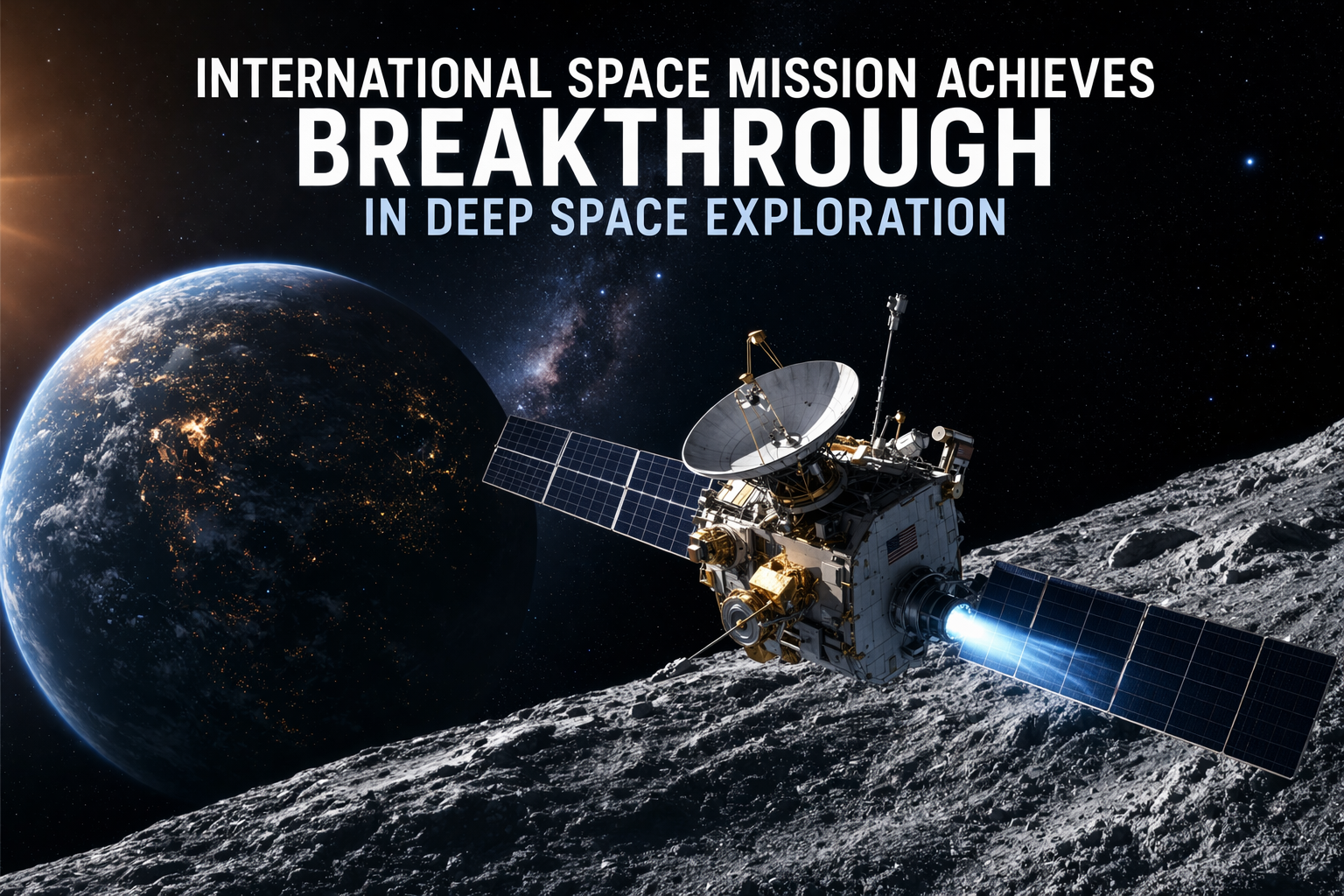
An international space mission has achieved a significant milestone in deep space exploration, marking a major advancement in humanity’s effort to understand distant regions of the universe. Scientists and engineers from multiple countries collaborated on the mission, which successfully sent an advanced spacecraft farther into deep space than many previous exploratory missions.
The spacecraft, equipped with high-precision instruments and next-generation communication systems, transmitted valuable scientific data back to Earth. Researchers say the mission will help scientists better understand distant planets, cosmic radiation, and the conditions present in deep space.
According to mission officials, the probe successfully performed a series of complex maneuvers and collected critical measurements while traveling through unexplored regions of space. The data gathered during the mission is expected to provide insights into planetary formation, asteroid composition, and the broader structure of the universe.
Space agencies involved in the project described the achievement as a landmark moment for international cooperation in space science. The mission combined advanced technologies, including autonomous navigation systems and high-resolution imaging tools, allowing scientists to study celestial objects with unprecedented detail.
Experts say breakthroughs like this pave the way for future interplanetary missions and could eventually support efforts to explore distant planets and potential habitable worlds beyond our solar system.
The success of the mission highlights the growing importance of global partnerships in space exploration, as countries continue to work together to push the boundaries of scientific discovery and technological innovation. News as Reported.