

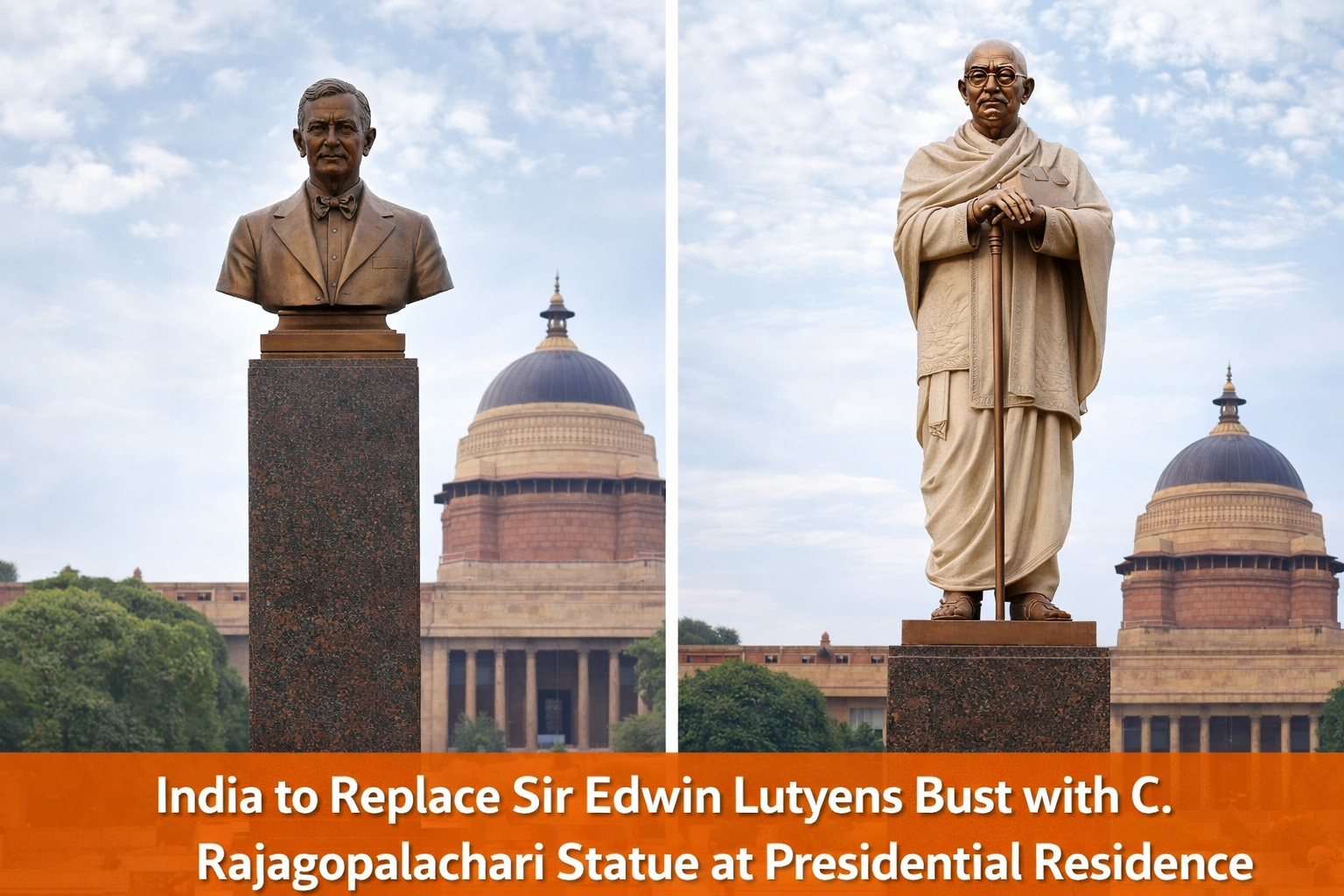
In a symbolic move toward reshaping national heritage narratives, the Government of India has announced that the bust of British architect Sir Edwin Lutyens at the Rashtrapati Bhavan—the official residence of the President of India—will be replaced with a statue of C. Rajagopalachari, the nation’s first and only Indian Governor-General after independence.
Prime Minister Narendra Modi made the announcement on February 22, 2026, during his monthly radio programme “Mann Ki Baat,” explaining that the decision reflects the country’s effort to move beyond colonial symbols and celebrate leaders who played pivotal roles in India’s journey to freedom and nation-building.
Sir Edwin Lutyens, a British architect, was instrumental in designing crucial landmarks of New Delhi during the colonial era, including Rashtrapati Bhavan, North Block, South Block, and India Gate. Though his architectural legacy continues to shape the capital’s landscape, official recognition of Indian leaders in central national institutions has become a priority for the government.
The statue of C. Rajagopalachari, affectionately known as “Rajaji,” will be unveiled on February 23, 2026, in the central courtyard of Rashtrapati Bhavan as part of the “Rajaji Utsav” celebrations. Rajagopalachari was a distinguished freedom fighter, close associate of Mahatma Gandhi, and the only Indian to hold the Governor-General post before the role was abolished when India became a republic.
In addition to the statue’s installation, an exhibition dedicated to Rajagopalachari’s life and contributions will run from February 24 to March 1, offering the public insight into his legacy.
This decision is part of a broader initiative by the government to elevate indigenous voices and figures in public spaces, underscoring an emphasis on national heritage and cultural identity in post-colonial India news as reported.


- upgraderz.aws@gmail.com
- upgraderz.aws@gmail.com
- upgraderz.aws@gmail.com
- upgraderz.aws@gmail.com