


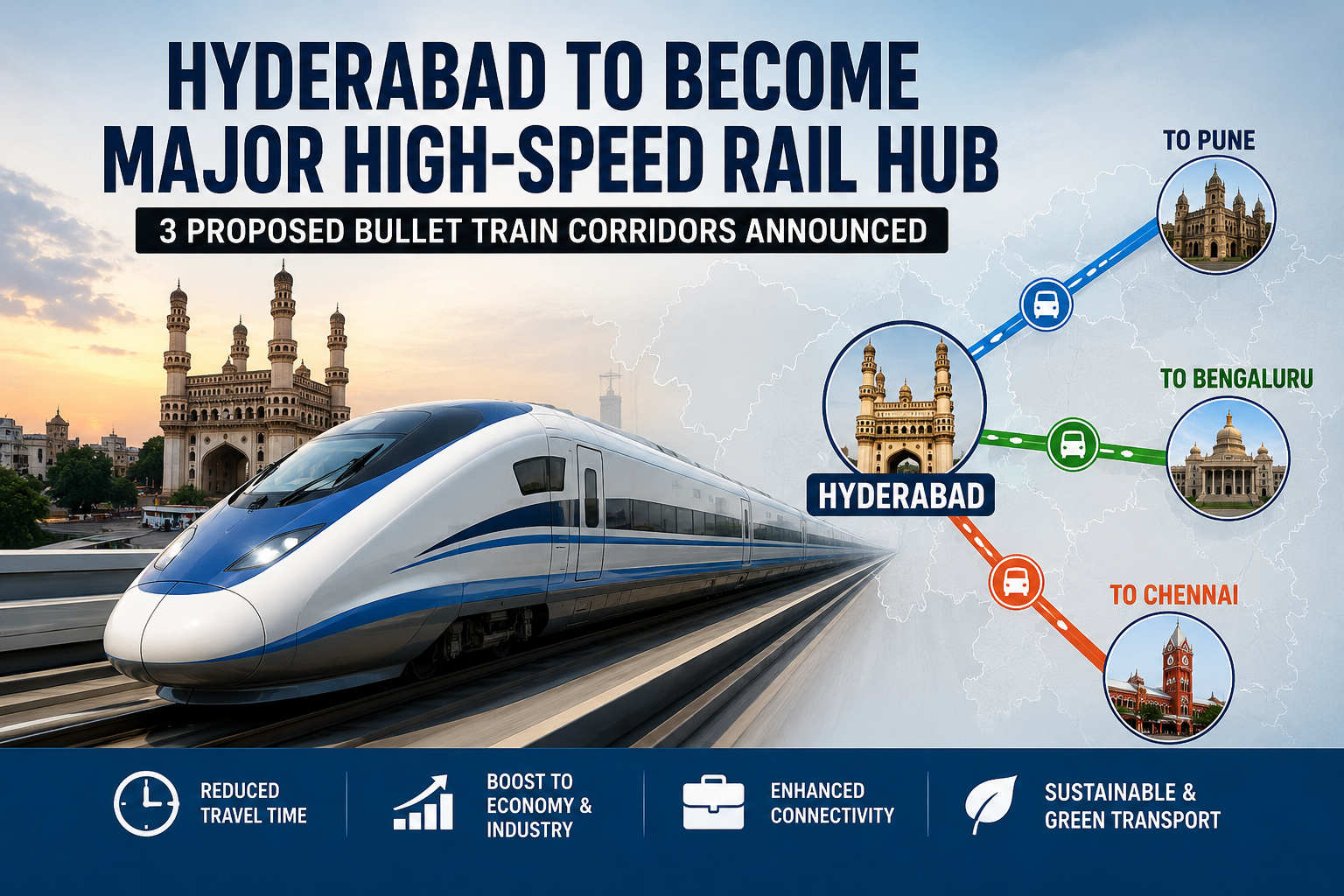
Hyderabad is poised to become one of India’s leading high-speed rail hubs after Union Railway Minister Ashwini Vaishnaw announced plans to connect the city through three proposed bullet train corridors. The ambitious project aims to strengthen connectivity between Hyderabad and the major economic centres of Pune, Bengaluru, and Chennai, significantly reducing travel time while boosting trade, tourism, and industrial growth.
Speaking at an industry event in Hyderabad, the Minister said the proposed high-speed rail network is part of the Central Government’s long-term vision to modernize India’s transportation infrastructure and create faster, greener, and more efficient intercity travel. He noted that Hyderabad’s strategic location and rapidly growing economy make it an ideal hub for high-speed rail development.
The three proposed corridors include Hyderabad–Pune, Hyderabad–Bengaluru, and Hyderabad–Chennai. Once operational, these routes are expected to reduce travel times dramatically, making same-day business travel between the cities more convenient. The network is also expected to integrate Hyderabad more closely with major technology, manufacturing, and logistics centres across southern and western India.
The announcement aligns with the Union Budget 2026 initiative, which proposed seven new high-speed rail corridors across the country following the progress of the Mumbai–Ahmedabad Bullet Train project. The government plans to adopt standardized engineering designs and construction methods to accelerate the implementation of future bullet train projects nationwide.
During the event, Union Minister G. Kishan Reddy highlighted that the Centre has earmarked ₹5 lakh crore for bullet train projects and is simultaneously modernizing 42 railway stations across Telangana, including Secunderabad and Nampally. He also encouraged the IT industry to expand into tier-2 cities such as Warangal and Karimnagar to support balanced regional development.
While the proposed bullet train corridors are still in the planning phase, officials believe the project will transform Hyderabad into a key transportation gateway, improve regional connectivity, attract new investments, and contribute significantly to India’s vision of becoming a globally competitive infrastructure economy. Detailed project reports, route alignments, and implementation timelines are expected to be finalized in the coming years.