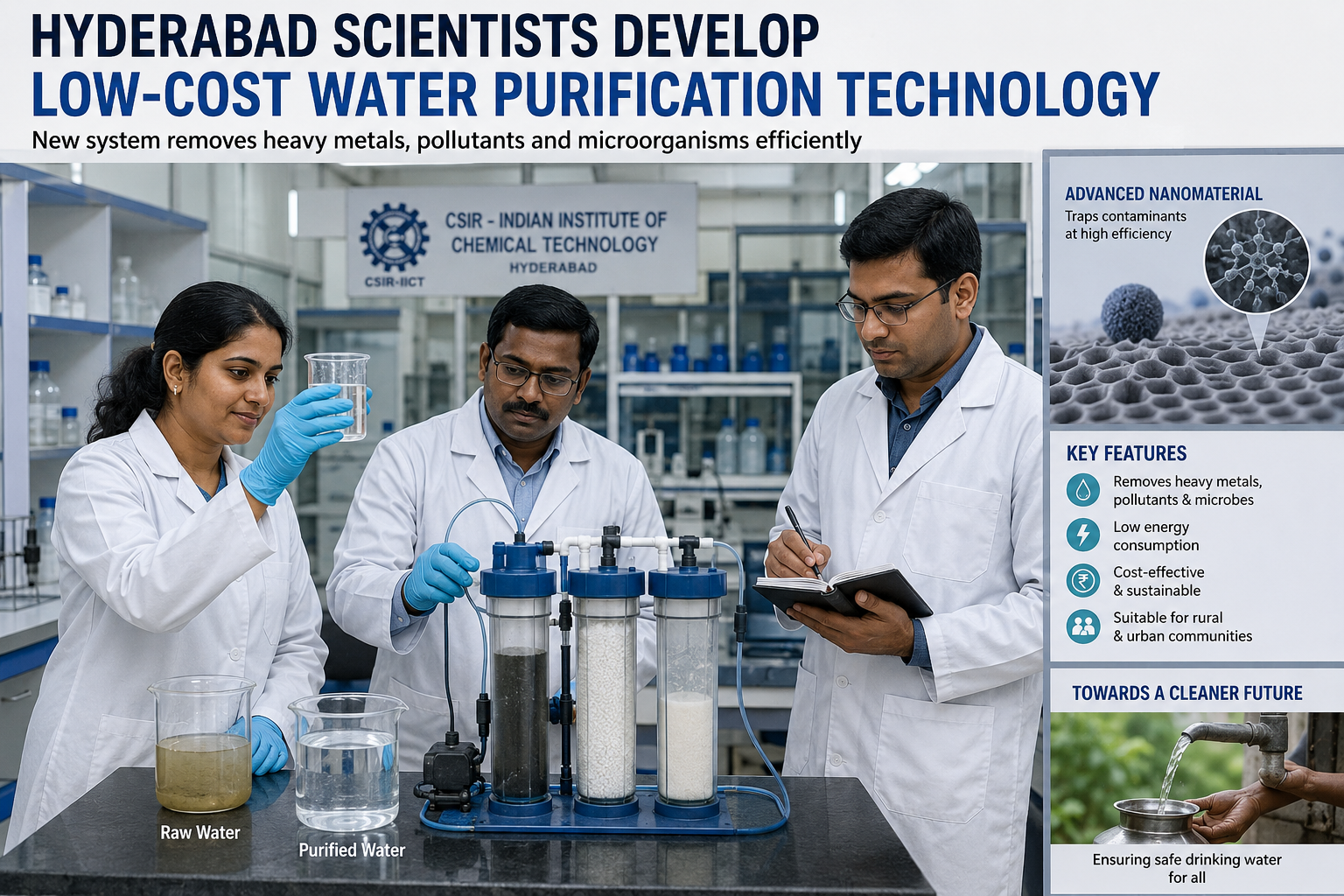
Researchers from CSIR–Indian Institute of Chemical Technology have developed a new low-cost water purification technology designed to improve access to safe drinking water in rural and urban communities. The research team recently demonstrated a filtration system capable of removing heavy metals, industrial pollutants, and harmful microorganisms using advanced nanomaterials and eco-friendly filtration techniques.
According to scientists involved in the project, the technology was developed with a focus on affordability and large-scale public use. The purification units require less electricity compared to conventional systems and are designed to function efficiently even in regions with inconsistent power supply. Researchers believe the innovation could be especially useful in areas facing groundwater contamination and industrial pollution challenges.
The institute stated that pilot projects are expected to begin in selected districts of Telangana later this year. Researchers are also working with local industries and government agencies to explore large-scale manufacturing and distribution possibilities. Environmental experts have praised the initiative, noting that affordable water purification solutions remain a critical need in many parts of India.
Scientists explained that the technology uses specialized nano-adsorbents capable of trapping toxic particles at high efficiency while maintaining water quality standards. The filtration process is also designed to minimize waste generation, making it more environmentally sustainable than many traditional purification methods.
Public health experts believe innovations like this can significantly reduce waterborne diseases and improve access to clean drinking water for economically weaker communities. Hyderabad has increasingly emerged as a major centre for biotechnology, pharmaceutical research, and scientific innovation, with institutions across the city contributing to healthcare and environmental research projects.
Officials indicated that further testing and certification procedures are currently underway before wider commercial deployment begins.
News as reported