

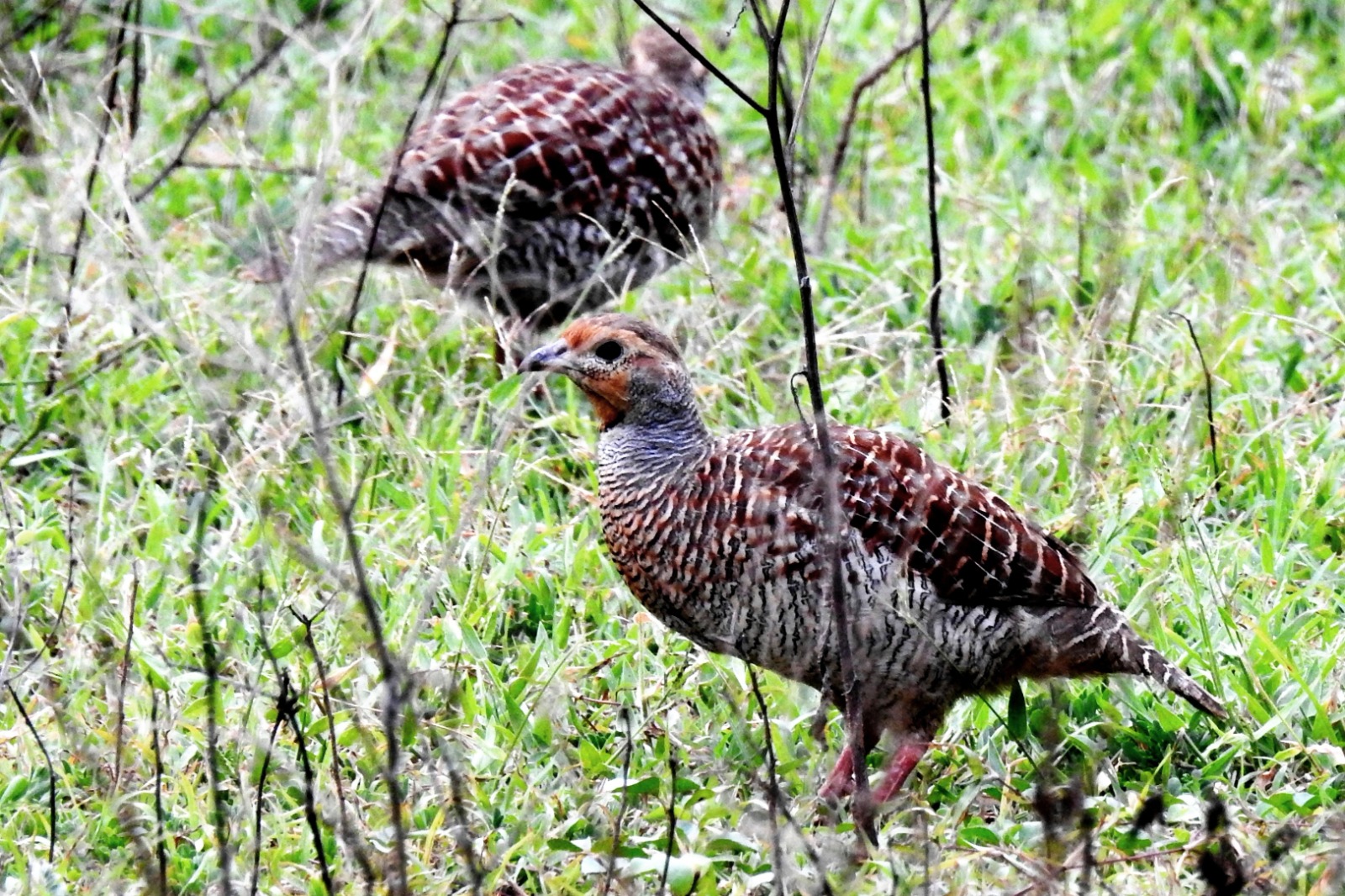
The Grey Francolin (Ortygornis pondicerianus), once widely known as the grey partridge, continues to draw attention for its rich historical and cultural significance across the Indian subcontinent. The subspecies found in South India and Sri Lanka, Ortygornis pondicerianus pondicerianus, has long been a familiar presence in open grasslands and scrub habitats.
First recorded scientifically in 1789 by German naturalist Johann Friedrich Gmelin, the Grey Francolin has since remained an important species in both ecological and cultural contexts. Known for its distinctive calls and ground-dwelling habits, the bird plays a role in maintaining ecological balance by feeding on seeds and insects.
Historically, the Grey Francolin also held a unique place in human society. In North India, it was commonly tamed and kept as a pet from ancient times. Lockwood Kipling, in his 1904 work Beast and Man in India, vividly described the bird’s graceful movement, noting how it followed its owner with a delicate gait. He famously remarked that comparing a loved one’s walk to that of a partridge was considered a high compliment.
Today, the Grey Francolin stands as a symbol of the deep connection between nature and culture in the region.
CONTRIBUTION BY VINCENT MASH —FORMER
EDITOR OF PHOTOWIDE MAGAZINE AND ASSOCIATE EDITOR OF PHOTO TRACK MAGAZINE
