

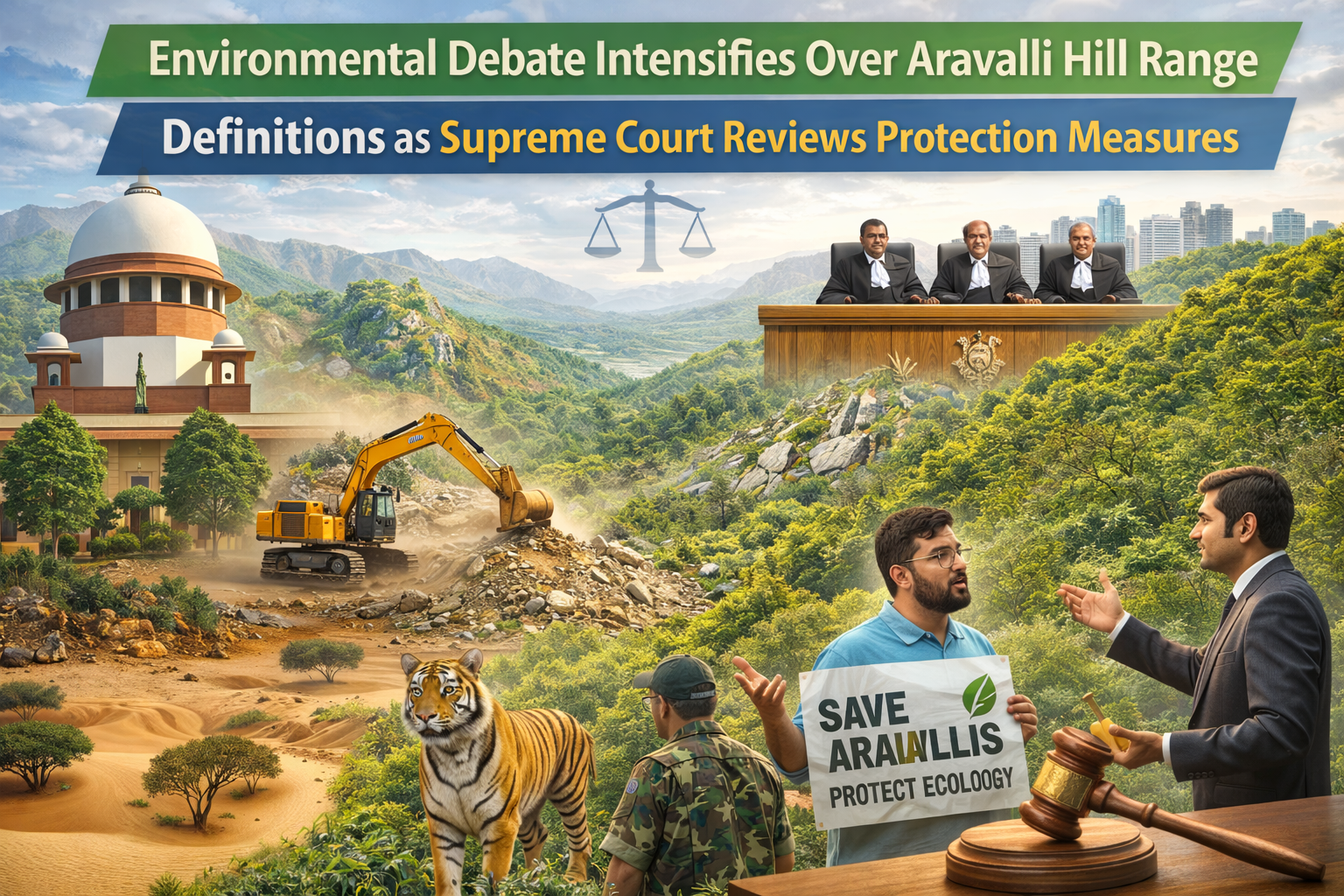
A major environmental debate has intensified around the Aravalli hill range as legal, scientific, and policy discussions linked to the Supreme Court focus on how the ancient mountain system is defined and protected. The outcome of the debate is expected to have far-reaching implications for ecological conservation, urban planning, and mining activities across parts of northern and western India.
At the centre of the issue is the definition of the Aravalli range in official records. Environmentalists argue that narrow or inconsistent definitions weaken protection measures, allowing construction, mining, and land-use changes in ecologically sensitive zones. They stress that the Aravallis play a critical role in preventing desertification, recharging groundwater, regulating climate, and supporting biodiversity across Rajasthan, Haryana, and the National Capital Region.
The Supreme Court has been examining whether existing safeguards are adequate and whether a more comprehensive, science-based definition is required to ensure uniform protection. Conservation groups have urged the court to adopt broader ecological criteria rather than relying solely on revenue or administrative classifications, which they say fail to reflect the true extent of the hill range.
On the other hand, some state authorities and development stakeholders have raised concerns about the economic impact of stricter definitions, citing infrastructure projects, housing needs, and employment generation. Balancing environmental protection with development priorities remains a key challenge.
Experts believe the court’s deliberations could set a landmark precedent for landscape-level conservation in India. A stronger legal framework for the Aravallis would reinforce long-term ecological security, protect fragile ecosystems, and underline the judiciary’s role in safeguarding natural heritage amid rapid urban expansion.


- upgraderz.aws@gmail.com
- upgraderz.aws@gmail.com
- upgraderz.aws@gmail.com
- upgraderz.aws@gmail.com