

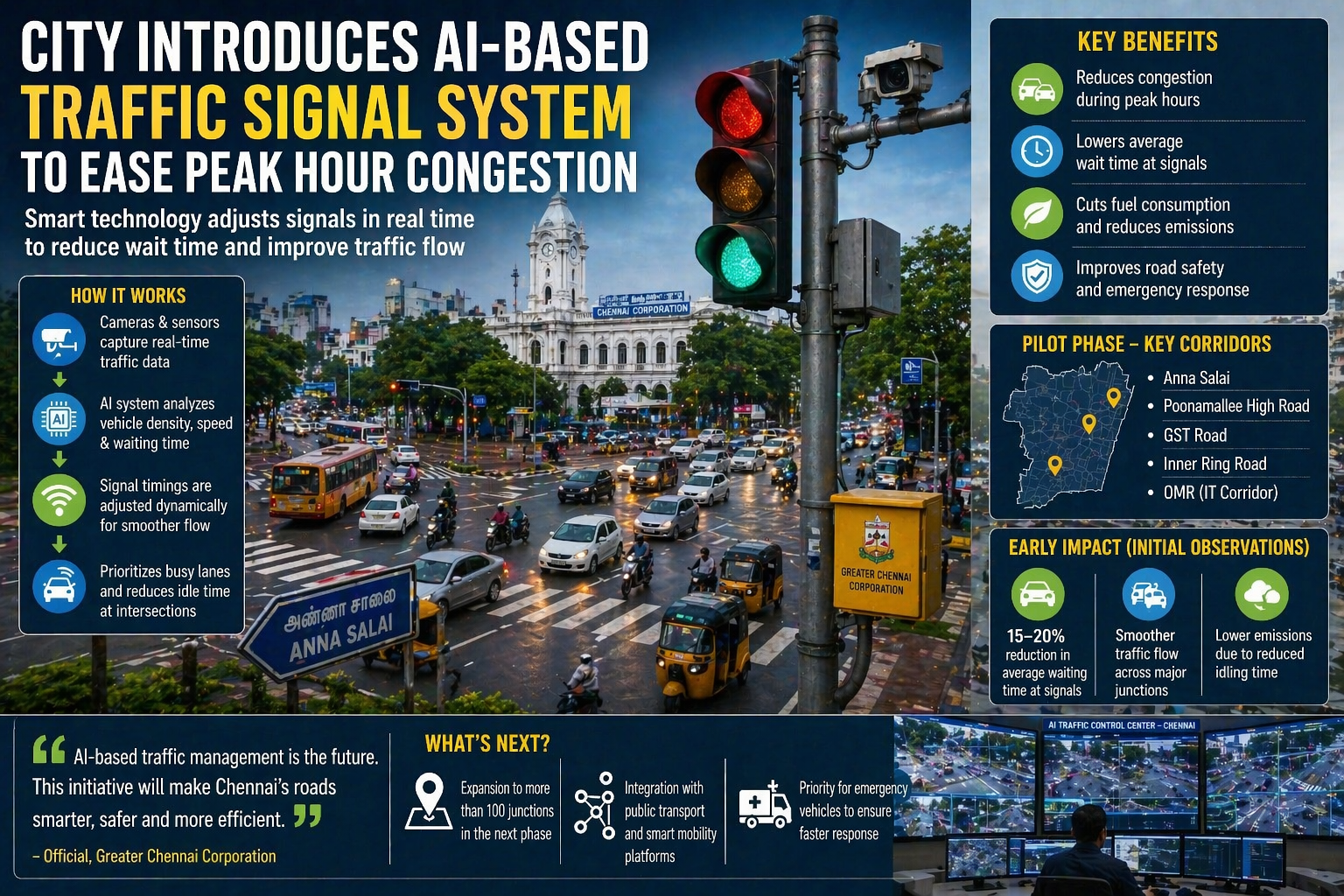
In a major step toward smarter urban mobility, Chennai has introduced an AI-based traffic signal system aimed at reducing peak-hour congestion across key junctions in the city.
The initiative, implemented by the Greater Chennai Corporation in collaboration with traffic police and technology partners, uses artificial intelligence to monitor real-time traffic flow and dynamically adjust signal timings. Unlike traditional fixed-timer signals, the new system analyzes vehicle density, waiting times, and traffic patterns to optimize movement at intersections.
Officials say the pilot phase has been launched in some of the busiest corridors, where traffic bottlenecks are most severe during morning and evening rush hours. Early observations indicate smoother vehicle flow, reduced waiting time at signals, and improved travel efficiency for commuters.
The system relies on cameras and sensors installed at junctions, feeding live data into a centralized control unit. AI algorithms process this data instantly, prioritizing lanes with heavier traffic while minimizing idle time for others. Authorities also plan to integrate the system with emergency response networks to give priority passage to ambulances and fire services.
Urban planners believe that such intelligent traffic management solutions are essential for rapidly growing cities like Chennai, where vehicle numbers continue to rise sharply. If successful, the project is expected to expand to more intersections across the city in the coming months.
Experts note that while AI-based systems offer significant benefits, continuous monitoring and fine-tuning will be necessary to ensure accuracy and prevent system glitches. News as Reported.
