

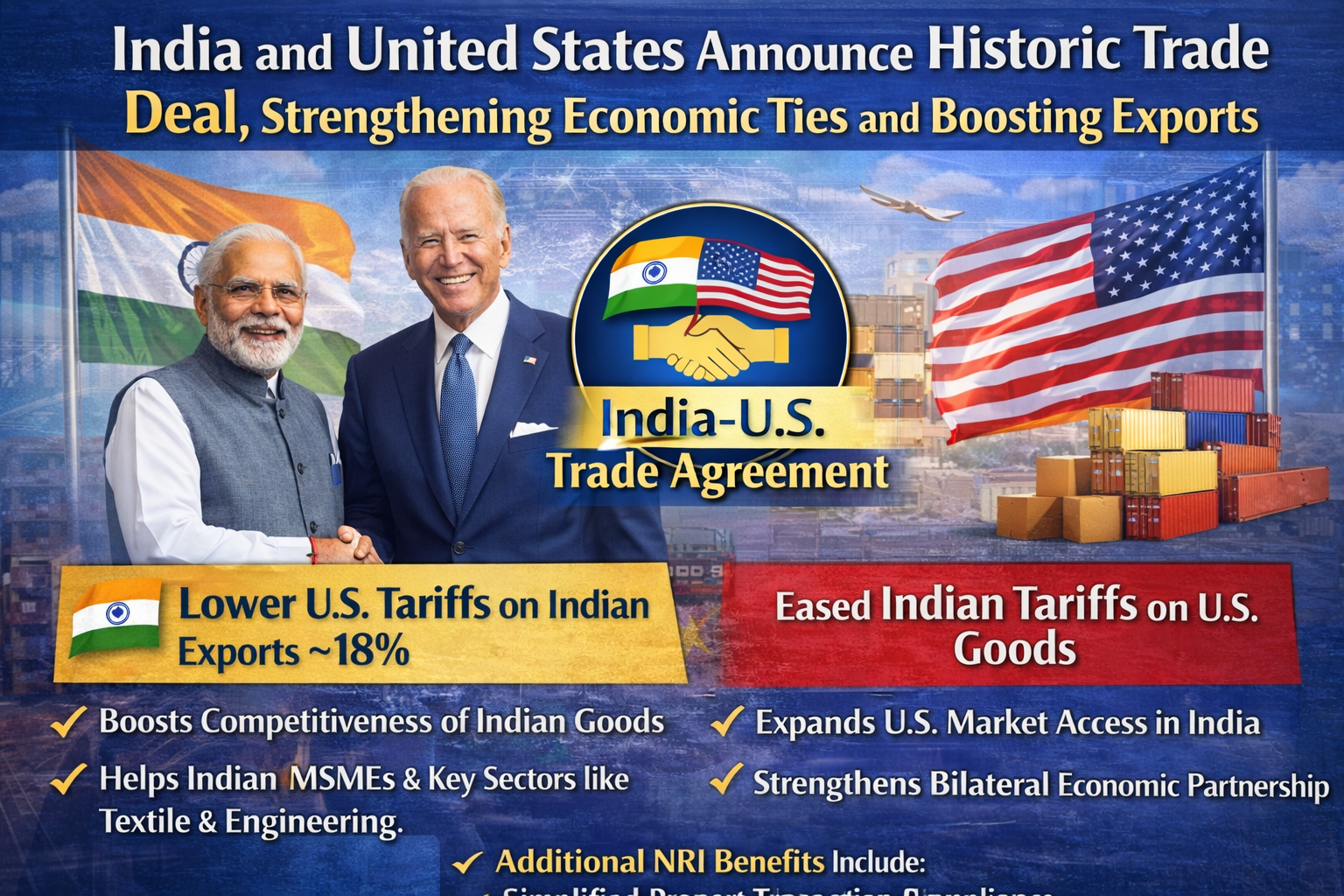
India and the United States have announced a historic bilateral trade agreement aimed at strengthening economic relations, enhancing market access, and boosting exports between the two largest democracies. The pact, confirmed after discussions between Prime Minister Narendra Modi and U.S. President Donald Trump, includes a significant reduction in U.S. tariffs on Indian goods, bringing them down to around 18 percent from previously higher levels — a move seen as a major step toward improving India’s export competitiveness in the U.S. market.
Under the agreement, the United States agreed to cut reciprocal tariffs on Indian exports, restoring competitiveness for key sectors such as textiles, engineering goods, leather products, gems and jewellery, and marine products — many of which were negatively impacted by punitive tariffs imposed in the latter half of 2025. The deal also involves commitments by India to ease tariffs and non-tariff barriers on U.S. imports, expanding bilateral trade flows and opening Indian markets to American goods.
Industry leaders and state governments have welcomed the development, noting that the tariff reductions are expected to re-energize Indian exporters, particularly labour-intensive MSMEs, and help capture market share lost to regional rivals such as Vietnam and Bangladesh. The agreement reportedly has already boosted investor confidence, contributing to positive sentiment in financial markets.
While certain sensitive sectors such as agriculture and dairy remain safeguarded, and some tariffs (like U.S. Section 232 duties on steel and aluminium) are likely to stay in place, analysts say the deal marks a major milestone in India-U.S. economic cooperation, setting a foundation for deeper engagement, greater investment flows, and a more robust export performance in the years ahead news as reported.


- upgraderz.aws@gmail.com
- upgraderz.aws@gmail.com
- upgraderz.aws@gmail.com
- upgraderz.aws@gmail.com