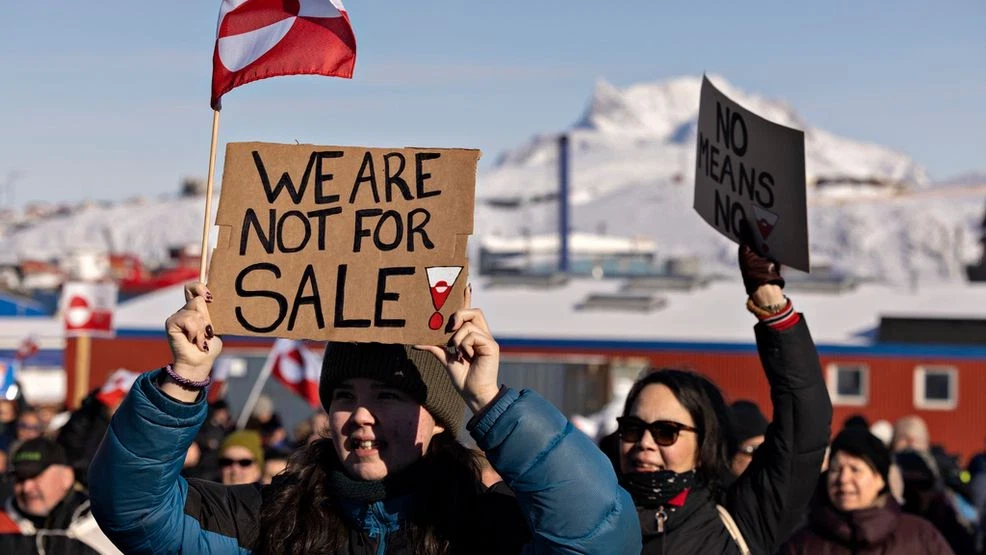
In a major international political standoff, U.S. President Donald Trump’s intensified bid to acquire the strategically significant Arctic territory of Greenland has sparked diplomatic backlash and security concerns among allies and rivals alike. Trump has repeatedly insisted that the United States must gain “complete and total control” over Greenland — an autonomous territory of Denmark — citing its vital role in national security amid competition with Russia and China. European leaders have uniformly rejected the notion that Greenland could be sold, affirming that its future should be decided by Denmark and the Greenlandic people themselves.
As part of his pressure campaign, Trump announced a 10% tariff on imports from eight NATO allies — including Denmark, Norway, Sweden, France, Germany, the United Kingdom, the Netherlands and Finland — starting February 1, with plans to raise it to 25% in June unless an agreement on Greenland is reached. The move has provoked strong pushback both within the United States — with some Republican lawmakers calling the strategy harmful to allies — and abroad, where NATO leaders warn that economic coercion could weaken the transatlantic alliance.
European countries have responded by bolstering their military presence in Greenland through joint exercises and deployments under NATO frameworks, and protests have erupted in Copenhagen and Nuuk under the slogan “Greenland is not for sale.” Meanwhile, the U.S. has announced deployment of NORAD aircraft to the Pituffik base in Greenland as tensions rise.
The dispute over Greenland underscores how Arctic strategy, alliance commitments, and trade policy have collided on the world stage in early 2026 amid deepening geopolitical competition — News as reported.