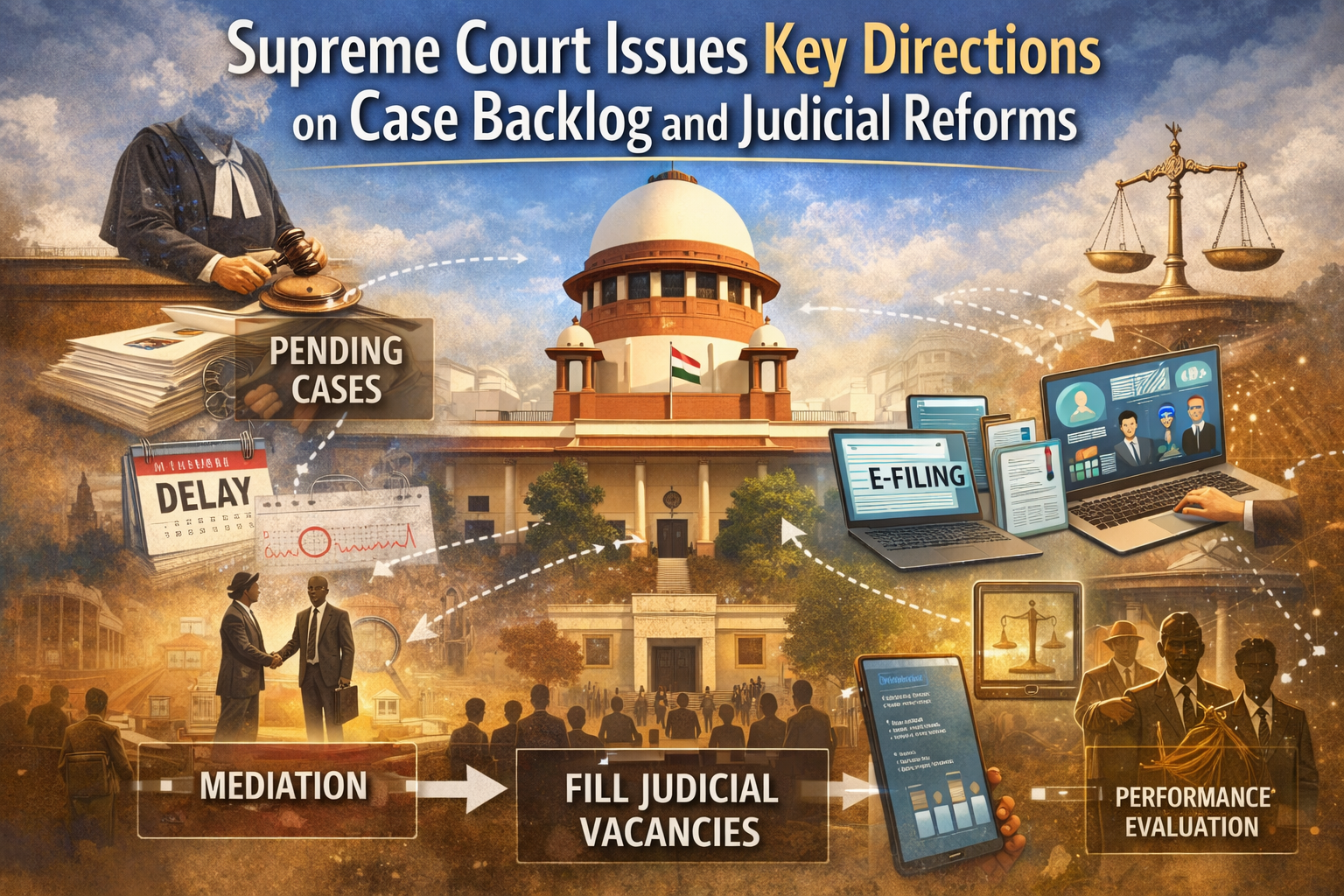
The Supreme Court has issued a series of important directions aimed at addressing the growing backlog of cases and accelerating long-pending judicial reforms across the country. Acknowledging that delays in the justice delivery system undermine public confidence, the apex court emphasized the need for coordinated efforts by the judiciary, executive, and legislature to ensure timely and effective resolution of disputes.
Among the key directions is the call for strict adherence to timelines in case management, particularly in civil and commercial matters. The Court stressed wider use of technology-driven solutions such as e-filing, virtual hearings, and digital case tracking systems to improve efficiency and reduce procedural delays. It also encouraged high courts to regularly monitor subordinate courts and identify bottlenecks contributing to pendency.
The Supreme Court highlighted the importance of strengthening alternative dispute resolution mechanisms, including mediation, arbitration, and Lok Adalats, to reduce the burden on courts. It directed authorities to promote pre-litigation mediation, especially in commercial and family-related disputes, to resolve issues outside the formal court process.
Judicial vacancies were another major concern addressed by the Court. The directions urge timely appointments of judges and support staff, along with better infrastructure and training facilities. The Court also emphasized judicial accountability and performance evaluation as part of long-term reforms.
These directions are expected to serve as a roadmap for improving judicial efficiency, reducing pendency, and ensuring faster access to justice. Legal experts view the move as a significant step toward building a more responsive, transparent, and citizen-friendly judicial system in India.