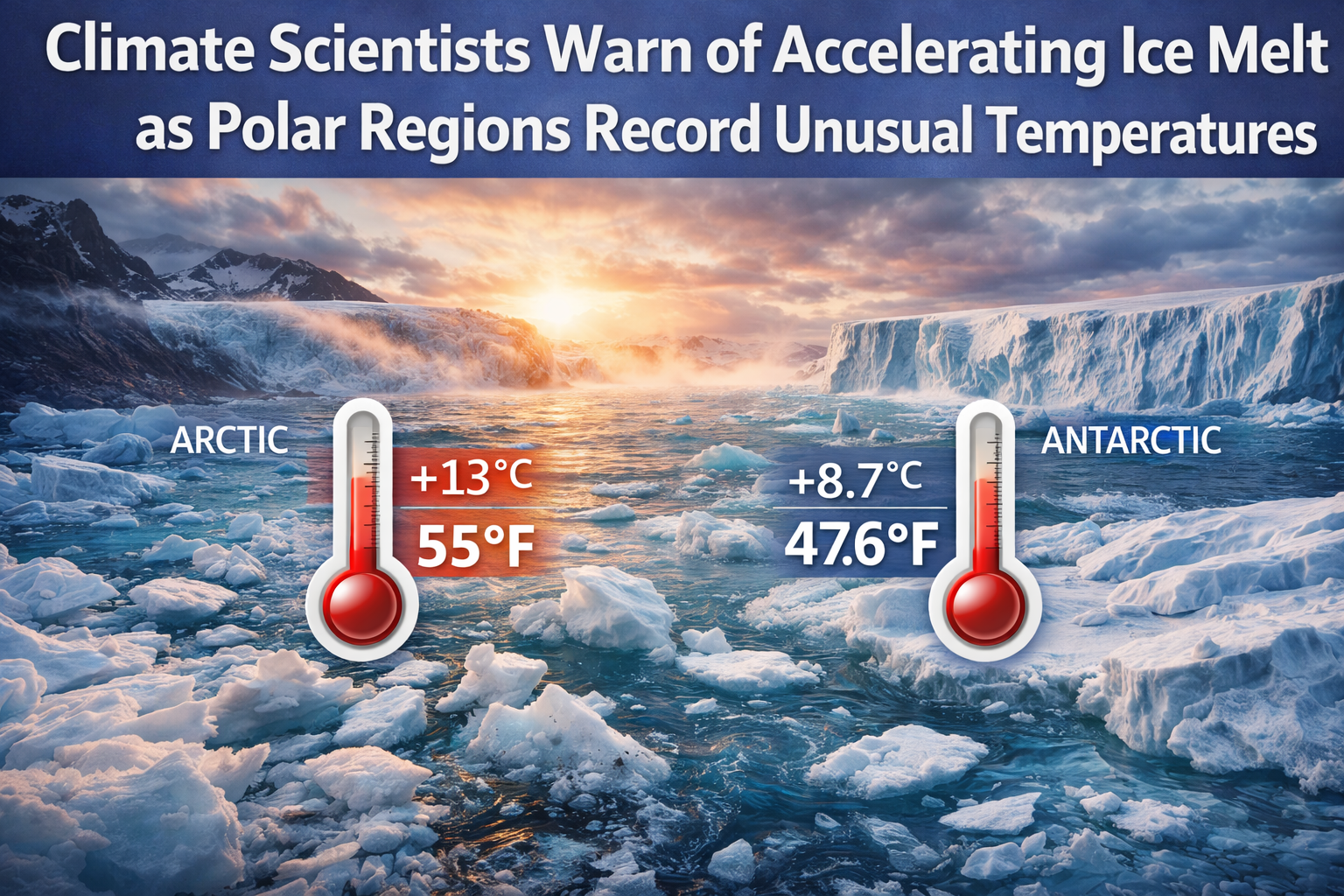
Climate scientists are raising urgent alarms as the Arctic and Antarctic continue to warm at unprecedented rates, leading to accelerated ice melt and serious concerns for global sea levels and ecosystems. According to the latest Arctic Report Card, the region experienced its highest temperatures in 125 years, with sea ice reaching a 47-year low at its peak — a stark indication that warming trends are intensifying in Earth’s polar regions.
The U.S. National Oceanic and Atmospheric Administration (NOAA) reports that the Arctic has warmed more than twice as fast as the global average, with recent observations showing significant declines in both sea ice and snow coverage. Seasonal rainfall — rather than snow — reached record levels in multiple seasons, further disrupting traditional polar climate patterns and contributing to faster ice loss.
Scientists warn that these changes are not isolated to the Arctic. Research shows that Greenland’s and Antarctica’s massive ice sheets are also losing mass rapidly, amplifying concerns about rising sea levels that threaten coastal communities worldwide. Even temperature anomalies in typically frigid Antarctic regions have broken records, underscoring the global scale of the warming trend.
Experts say that without urgent cuts in greenhouse gas emissions and sustained global action, the rapid melt of polar ice could accelerate further, accelerating climate impacts such as sea-level rise and altered weather patterns across the planet.