

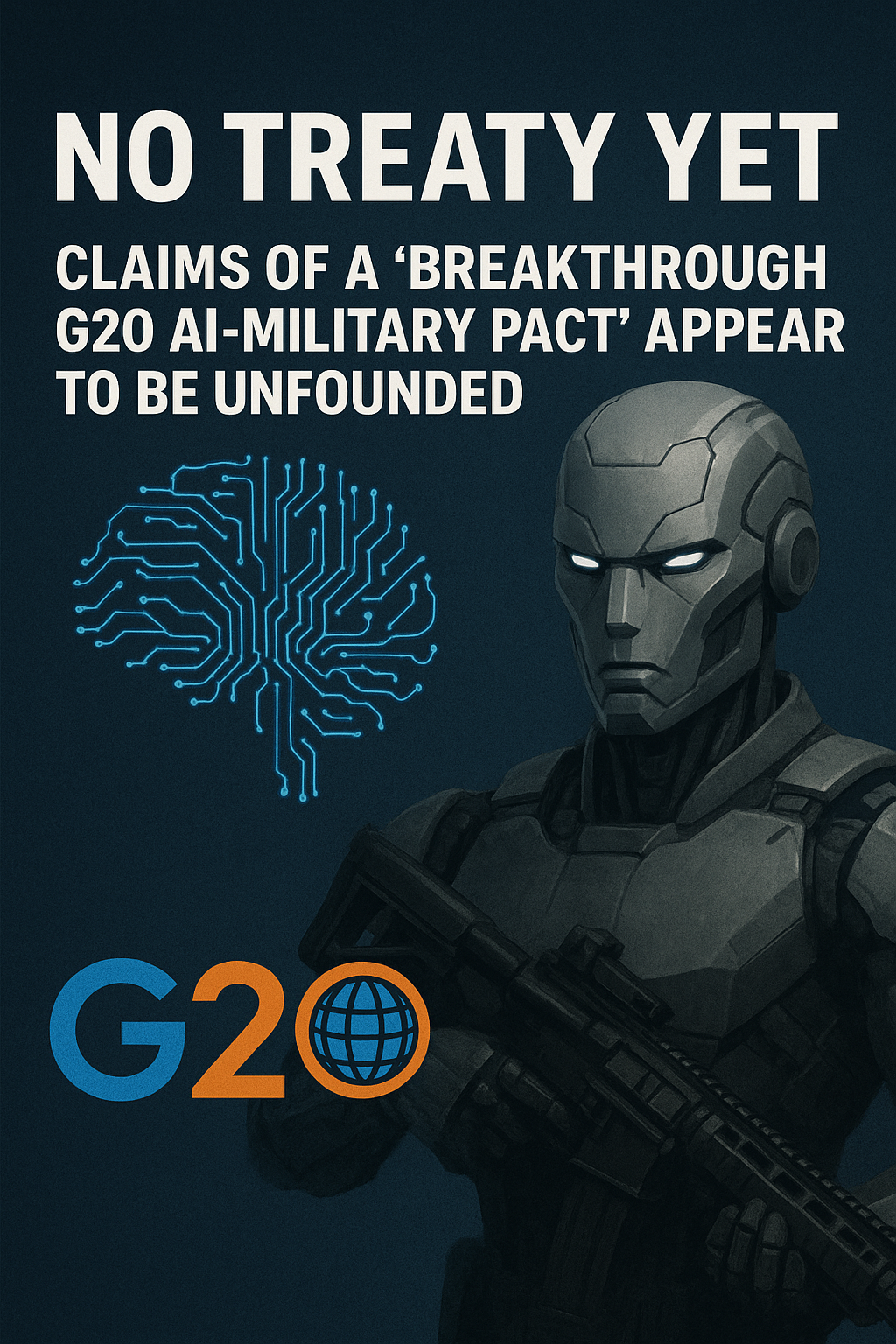
Several recent media and policy-analysis reports suggest that there is no credible evidence that G20 nations have signed a legally binding treaty to regulate the use of Artificial Intelligence (AI) in military applications worldwide. A prominent 2025 study on global AI governance notes that “there are no global norms or regulations regarding the use of AI in the military sphere.” SpringerLink
While multilateral efforts are underway, the most significant existing agreement is the Political Declaration on Responsible Military Use of Artificial Intelligence and Autonomy — adopted after the 2023 RE‑AIM Summit (Responsible AI in the Military Domain). But that declaration is non-binding and has not been endorsed by all major powers.
At the 2025 2025 G20 Johannesburg Summit, leaders such as Narendra Modi urged a “global compact on AI” for responsible use — stressing human oversight, transparency, and restrictions on misuse.
But these remain calls for broad principles — not a formal, binding treaty restricting military AI deployment. Some analysts emphasise that any comprehensive regulation must account for the rapidly evolving technical nature of AI, arguing that policy alone — without technical safeguards — is insufficient to address risks posed by autonomous weapon systems.
At present, therefore, claims of a “breakthrough G20 treaty to regulate military AI worldwide” appear to be premature. What we do have: growing international discussion, non-binding declarations, and proposals for future regulation — but no binding, enforceable global pact.


- upgraderz.aws@gmail.com
- upgraderz.aws@gmail.com
- upgraderz.aws@gmail.com
- upgraderz.aws@gmail.com