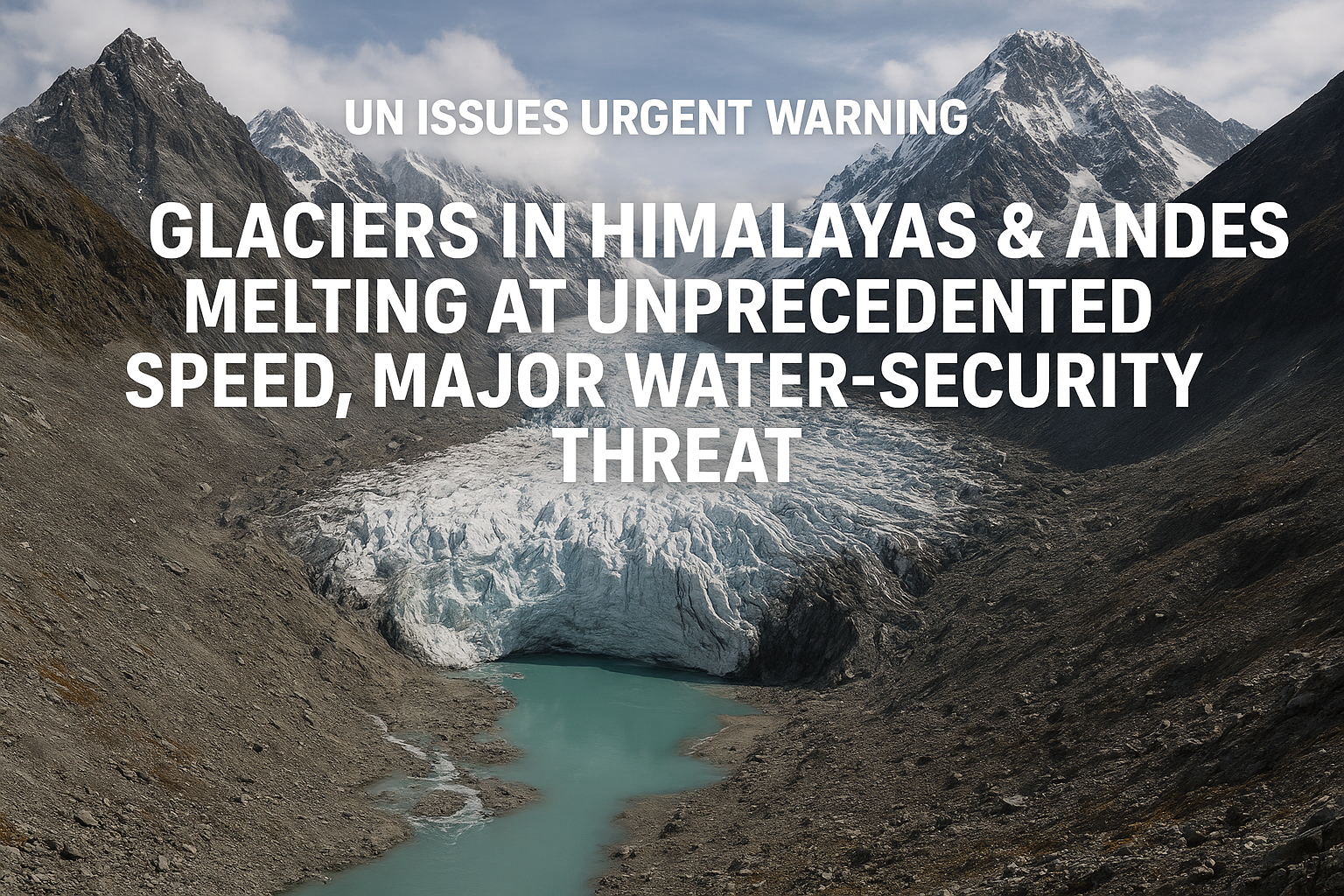
The United Nations and its affiliated agencies have raised the alarm over accelerating glacier melt in high-mountain regions — including the Himalayas and the Andes — warning of dire consequences for water security, agriculture and ecosystems. According to the 2025 World Water Development Report, glaciers worldwide are losing mass at the fastest rate on record, with the largest three-year ice loss ever documented between 2022 and 2024.
Glaciers and ice sheets store roughly 70% of the world’s freshwater. As these “water towers” shrink, communities downstream — many of them dependent on meltwater for drinking, irrigation and hydropower — face increasing shortages, irregular flows and heightened risk of natural disasters such as floods and glacial-lake outburst floods (GLOFs).
In the Andes alone, glacier thinning of about 0.7 metres per year — 35% faster than the global average — threatens water supply for nearly 90 million people, according to scientists presenting at the first-ever World Glaciers Day.
The UN warns that unless greenhouse-gas emissions are sharply reduced and adaptive water management strategies are adopted globally, the cascading impacts of glacier loss — from diminished water supply and crop failures to economic hardship and ecosystem collapse — will intensify, affecting billions worldwide.