


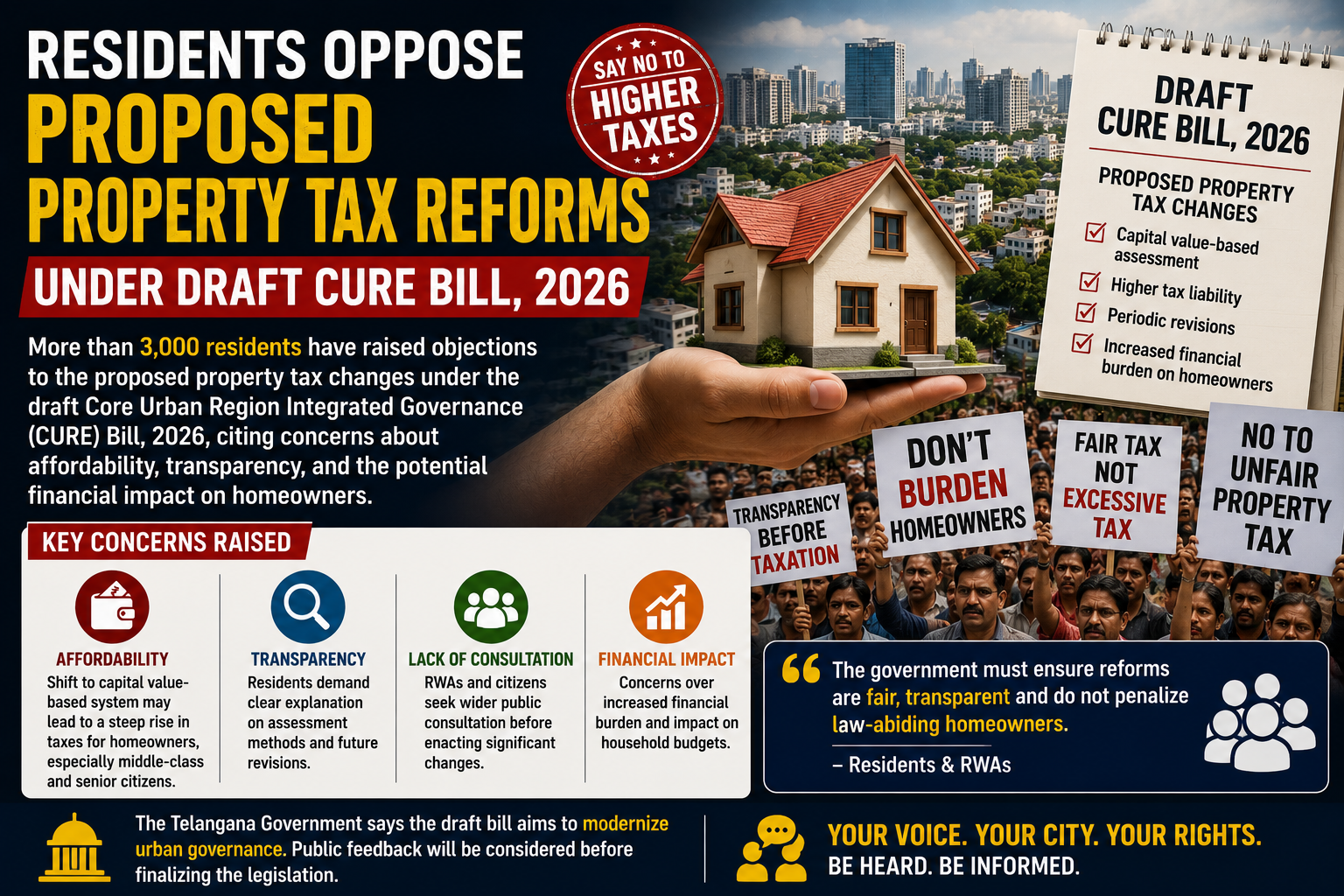
Hyderabad, July 31: More than 3,000 residents across Hyderabad have raised objections to the proposed property tax reforms included in the draft Core Urban Region Integrated Governance (CURE) Bill, 2026, expressing concerns that the changes could significantly increase the financial burden on homeowners. The proposals have triggered widespread public debate, with Resident Welfare Associations (RWAs), civic groups, and several public representatives calling for greater consultation before the legislation is finalized.
One of the key concerns relates to the proposed shift from the existing property tax assessment method to a capital value-based system, under which tax liability would be linked more closely to the market value of a property. Critics argue that such a system could substantially increase taxes for homeowners, particularly affecting middle-class families, senior citizens, and those living on fixed incomes. They fear that rapidly appreciating property values may result in higher annual tax bills, even when household incomes remain unchanged.
Resident Welfare Associations have also questioned the transparency of the proposed reforms, stating that citizens require a clearer explanation of how properties will be assessed and how future revisions will be carried out. Many residents have urged the government to conduct wider public consultations before implementing such significant changes to urban taxation. They have also sought safeguards to ensure that vulnerable sections of society are protected from sudden increases in civic charges.
In addition to property tax concerns, several stakeholders have objected to other provisions in the draft CURE Bill, including proposals related to periodic revisions of water supply and sewerage charges, governance structures, and the balance of powers between civic bodies and the proposed metropolitan authorities. Some elected representatives have argued that the legislation requires further review to ensure it strengthens, rather than weakens, local self-governance and citizen participation.
The Telangana Government has stated that the draft bill is intended to modernize Hyderabad’s urban governance framework and replace the decades-old GHMC Act of 1955 with legislation better suited to managing the needs of a rapidly expanding metropolitan region. Officials have emphasized that the draft is still under consideration and that public feedback will be reviewed before the final version is prepared.
As discussions continue, urban planning experts believe the final legislation will need to strike a balance between improving municipal finances and ensuring that property owners are not subjected to disproportionate financial burdens. The outcome of the consultation process is expected to play a key role in shaping Hyderabad’s future model of urban governance and municipal taxation.