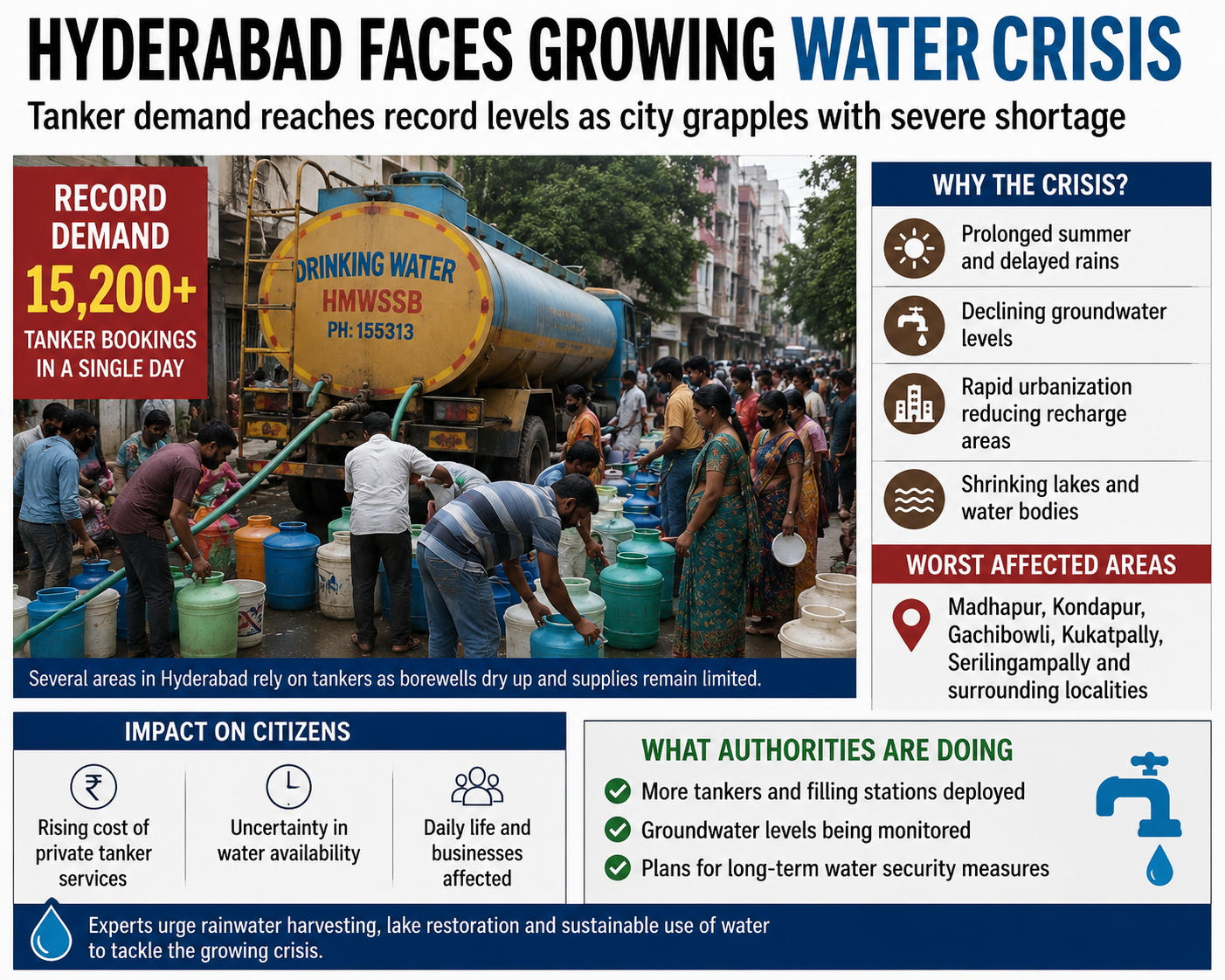
Hyderabad is confronting a serious water supply challenge after recording an all-time high of more than 15,000 water tanker bookings in a single day. The unprecedented demand reflects growing pressure on the city’s water resources following a prolonged summer, delayed rainfall, and declining groundwater levels.
Several western and northwestern localities, including areas around Madhapur, Kondapur, Gachibowli, Kukatpally, and Serilingampally, have emerged as some of the worst-affected zones. Residents in many neighborhoods are increasingly relying on private and government-operated tanker services as borewells struggle to meet demand.
Experts attribute the crisis to multiple factors. Rapid urbanization has replaced large areas of open land with concrete structures, reducing groundwater recharge. The city’s expanding population has increased water consumption, while shrinking lakes and wetlands have further weakened natural water-storage systems.
Authorities have expanded tanker fleets and increased the number of filling stations to address the situation. However, demand continues to exceed available supply in several areas. Environmental experts warn that unless long-term measures are implemented, Hyderabad could face increasingly severe water shortages in future summers.
Urban planners are advocating stronger rainwater harvesting systems, lake restoration projects, groundwater recharge programs, and sustainable urban development practices. They argue that water security must become a central component of city planning as Hyderabad continues to grow.
Residents have also expressed concerns regarding rising costs associated with private tanker services and the uncertainty of future water availability. Many believe the crisis should serve as a wake-up call regarding the importance of environmental conservation and resource management.
For Hyderabad, the current situation highlights the growing challenge of balancing rapid urban expansion with sustainable access to essential resources.
News as reported